Culinary Advisor
A cooking platform built around craft, culture, and the stories behind what we eat.
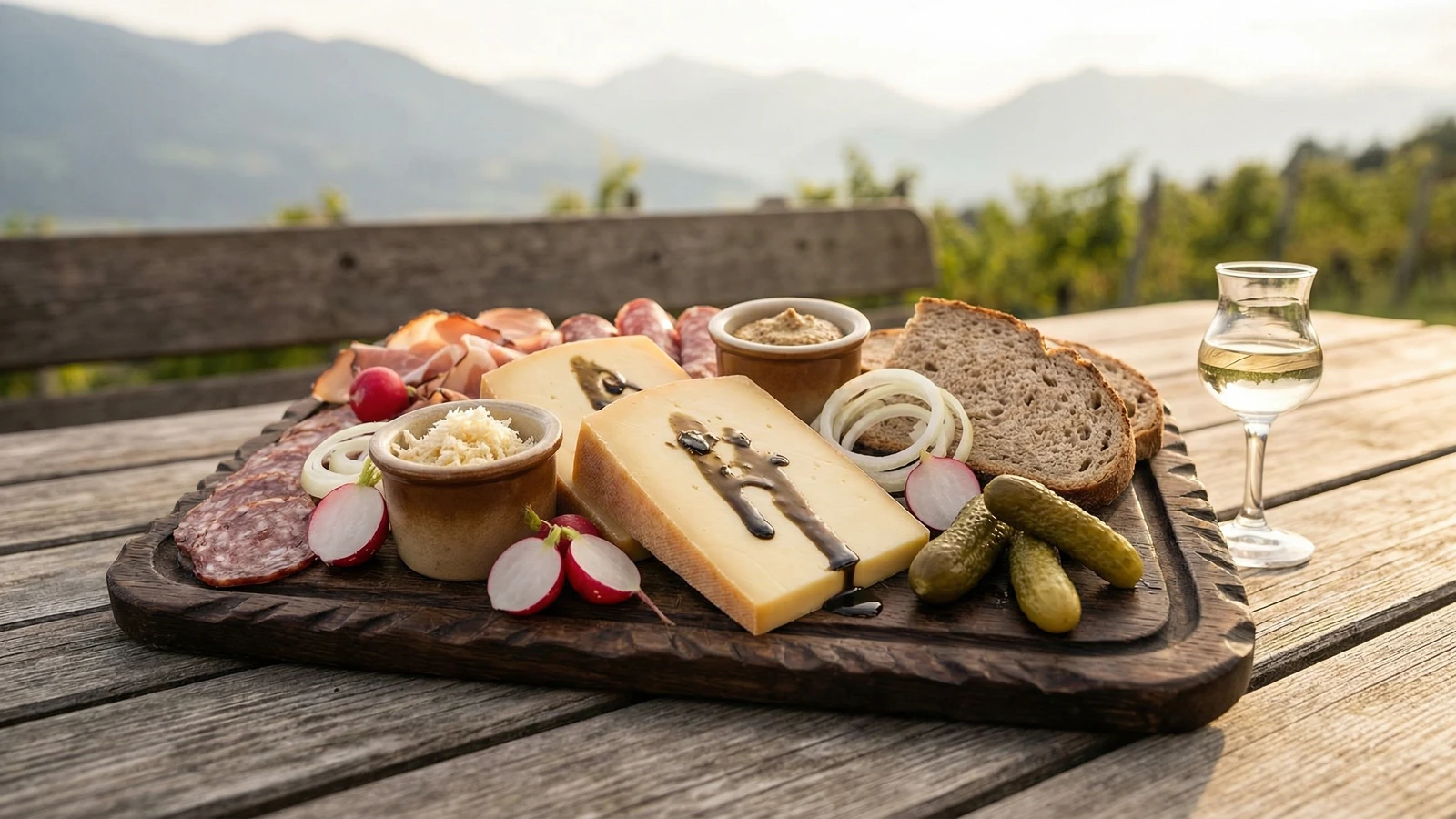
Gailtaler Almkäse Brettl (Carinthian Alpine Cheese Board)
Created by Chef Elsa
A proper Carinthian Brettljause built around PDO Gailtaler Almkäse, nutty raw-milk alpine cheese served with Speck, dark Bauernbrot, pickles, fresh horseradish, and everything you need for an afternoon on an Almhütte terrace.
The first time I ate Gailtaler Almkäse was on a childhood trip to Carinthia with Gretel and my grandmother Eva. We stopped at an Almhütte somewhere above Hermagor, and the farmer's wife brought out a wooden board with cheese she'd made that summer from the milk of her own cows grazing on the slopes behind us. The cheese was pale gold, firm but not hard, with a nutty sweetness that tasted like the meadow smelled. Gretel cut a piece, put it on a thick slab of dark bread, and said nothing for a full minute. That's how you know the food is good. When Gretel stopped talking, it meant she was paying attention to what was in her mouth.
A Brettljause is the Austrian answer to the question of what to eat when the weather is fine and you'd rather be outside than standing at a stove. Brettl means board. Jause means snack, though calling it a snack undersells it by quite a lot. You lay out cheese, cured meats, bread, pickles, mustard, horseradish, and whatever else the kitchen offers on a wooden board, and you sit with it for an hour. Maybe two. There's no rush. This is Gemütlichkeit made edible.
The Gailtaler Almkäse is the anchor of this particular Brettl. It's a PDO cheese, which means it can only be made in the Gailtal valley in Carinthia from the raw milk of cows grazing on alpine pastures between June and September. You can't fake it and you can't replicate it somewhere else. The pasture flowers and grasses that the cows eat give the cheese its character. Every wheel tastes like the summer it was made in. Build the rest of the board around it, not the other way around.
Gailtaler Almkäse received its Protected Designation of Origin (geschützte Ursprungsbezeichnung) from the European Union in 1996, making it one of Austria's first PDO cheeses. Cheesemaking in the Gailtal valley dates back over 700 years, with records of alpine dairy farming from the 13th century. The tradition of the Brettljause itself is rooted in Austria's Buschenschank and Almhütte culture, where farmers with a license could serve their own produce, including house-cured meats, cheese, and bread, to guests on simple wooden boards. The custom endures across Carinthia, Styria, and the Tyrol, though each region fills the board differently.
The technique, the tradition, and the story behind every dish.
Discover Culinary AdvisorIngredients
Gailtaler Almkäse
Quantity
300g
cut into thick wedges
Carinthian Speck or Bauchspeck
Quantity
150g
sliced thin
Hauswürstel or Kantwurst (Carinthian smoked sausage)
Quantity
100g
sliced on the bias
fresh horseradish root
Quantity
1 piece, about 8cm
Essiggurken (small sour pickles)
Quantity
4-6
radishes
Quantity
1 small bunch
halved
Kremser Senf (coarse-grain Austrian mustard)
Quantity
2 tablespoons
unsalted butter
Quantity
80g
at room temperature
dark Bauernbrot (farmhouse rye bread)
Quantity
half a loaf
thickly sliced
Kürbiskernöl (Styrian pumpkin seed oil) (optional)
Quantity
for drizzling
white onion
Quantity
1 small
sliced into thin rings
| Ingredient | Quantity |
|---|---|
| Gailtaler Almkäsecut into thick wedges | 300g |
| Carinthian Speck or Bauchspecksliced thin | 150g |
| Hauswürstel or Kantwurst (Carinthian smoked sausage)sliced on the bias | 100g |
| fresh horseradish root | 1 piece, about 8cm |
| Essiggurken (small sour pickles) | 4-6 |
| radisheshalved | 1 small bunch |
| Kremser Senf (coarse-grain Austrian mustard) | 2 tablespoons |
| unsalted butterat room temperature | 80g |
| dark Bauernbrot (farmhouse rye bread)thickly sliced | half a loaf |
| Kürbiskernöl (Styrian pumpkin seed oil) (optional) | for drizzling |
| white onionsliced into thin rings | 1 small |
Equipment Needed
- •Large wooden cutting board or Brettl (at least 40cm)
- •Small earthenware crocks for mustard and horseradish
- •Sharp knife for slicing cheese and meats
- •Fine grater or Microplane for fresh horseradish
Instructions
- 1
Temper the cheese
Take the Gailtaler Almkäse out of the fridge at least forty-five minutes before you plan to serve it. Cold cheese is closed cheese. The flavors won't open up until it reaches room temperature, and with a raw-milk alpine cheese this good, you want every bit of that nutty, meadow-sweet complexity on your tongue. Cut it into thick wedges or generous chunks. Don't slice it thin. This isn't deli cheese. You want pieces substantial enough to eat with bread and butter.
If you can't find Gailtaler Almkäse outside Austria, look for another alpine raw-milk cheese aged three to six months: a young Bergkäse or a Swiss Gruyère will carry the board. But if you can get the real thing, it's worth every effort. - 2
Prepare the accompaniments
Slice the Speck thin. It should be translucent at the edges, with the fat still white and clean-looking. Good Speck smells smoky and faintly sweet, never rancid. Cut the Hauswürstel on a bias into oval slices about half a centimeter thick. Halve the radishes. Slice the onion into thin rings and separate them. Grate or shave the horseradish fresh. I cannot stress this enough: use fresh horseradish, not the jarred stuff with vinegar and preservatives. Fresh horseradish hits your nose before it hits your tongue, and that sharpness is what cuts through the richness of the cheese and Speck.
Grate the horseradish at the last moment, just before it goes on the board. It loses its heat quickly once exposed to air. Keep the root wrapped in a damp cloth until you're ready. - 3
Prepare the bread and butter
Slice the Bauernbrot into thick pieces, about two centimeters. Dark rye bread is traditional and the right match for this board. The sour tang of the bread bridges the gap between the sweet cheese and the smoky Speck. Don't toast it. This bread should be dense and chewy, at room temperature. Set the butter out in a small crock or on a saucer. Room temperature butter that spreads easily onto coarse bread is one of life's small but genuine pleasures.
If you bake your own bread, a Roggenmischbrot (rye-wheat mix with a sourdough base) is ideal. If you're buying, ask a good bakery for their darkest, densest rye. Soft supermarket bread has no place on a Brettl. - 4
Build the board
Use a large wooden board, not a slate plate, not a marble slab. Wood is what this food was born to sit on. Place the cheese wedges at the center because they're the reason everyone is here. Fan the Speck slices on one side, arrange the Kantwurst on the other. Scatter the halved radishes and onion rings where they fit. Tuck the Essiggurken into the gaps. Put the mustard in a small dish and the freshly grated horseradish in another. Lay the bread slices along the edge or pile them in a basket alongside. If you're using Kürbiskernöl, drizzle a little over the cheese just before serving. The dark green oil against the pale gold cheese is beautiful, and it adds a roasted, earthy sweetness that Carinthians love.
- 5
Serve and eat slowly
Set the board on the table and let people help themselves. That's it. There's no plating, no portioning, no fuss. You tear bread, spread butter, lay a piece of cheese on top, add a shaving of horseradish if you want the heat, or a slick of mustard if you want the tang. Fold a slice of Speck next to it. Crunch a radish. Eat a pickle. This is food built for talking over, for sitting outside with a glass of cool Grüner Veltliner or a cold beer, for letting an afternoon become an evening without anyone noticing. Mahlzeit!
Chef Tips
- •The quality of every single item on this board matters because there's nowhere to hide. You can't cover bad Speck with a sauce or bury stale bread under garnish. Buy the best you can find, and if something isn't good, leave it off. A board with four excellent things is better than one with eight mediocre ones.
- •Gailtaler Almkäse has a season. The cheese is made from June through September when the cows are on the alpine pastures. Wheels aged through winter are available into spring, but by summer you can find fresh-season cheese in Carinthia. If you're ordering from Austria, ask your cheesemonger which Alm it came from.
- •Kremser Senf is a coarse, slightly sweet Austrian mustard named after the city of Krems in the Wachau. It's milder than Dijon and works perfectly with cured meats. If you can't find it, a grainy mustard with moderate heat is a fair substitute.
- •Gretel always said that a Jause board tells you everything about the cook without them having to do any cooking. It's all about selection and care. Choose well, arrange with respect, and get out of the way.
Advance Preparation
- •The Speck and Kantwurst can be sliced and loosely wrapped up to a day ahead. Bring to room temperature before serving.
- •Essiggurken and mustard keep indefinitely. The bread is best day-of, but a good Bauernbrot stays fine for two days if stored in a bread bag.
- •Do not grate the horseradish in advance. It loses its bite within minutes. Grate it at the table if you can.
Frequently Asked Questions
Nutrition Information
1 serving (about 350g)
Where cooking meets culture.
Culinary mentorship, cultural storytelling, and the editorial depth that makes cooking meaningful.
Explore Culinary Advisor