Culinary Advisor
A cooking platform built around craft, culture, and the stories behind what we eat.
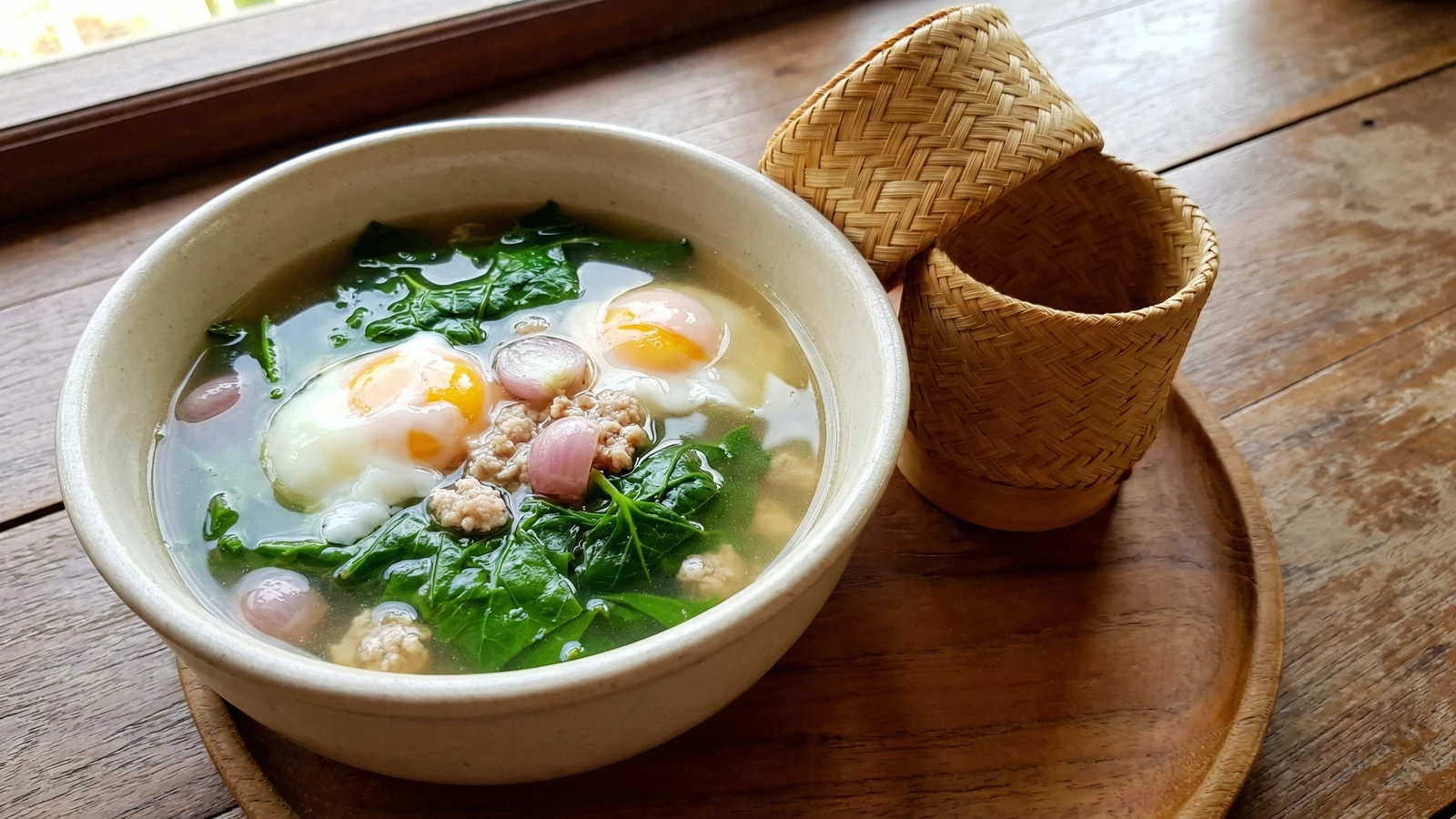
Northern Sweet Leaf Curry (Gaeng Phak Wan / แกงผักหวาน)
Created by
No paste. No mortar. Phak wan leaves, eggs, garlic, fish sauce, and water. Lanna home cooking stripped to the bone, and the four pillars still hold when everything else is gone.
Not every Thai dish needs a kreung tam. Ajarn would want me to be clear about that. The pounded paste is the foundation of Thai cooking, yes. But gaeng phak wan breaks that rule entirely. No mortar. No pestle. No paste. Just water, garlic, phak wan leaves, eggs, and fish sauce. That's it. This is a Lanna grandmother's weeknight curry, and it has no business being as good as it is.
Phak wan (ผักหวาน, "sweet vegetable") is a forest tree native to the northern highlands. The young leaves and tender tips are naturally sweet, with a clean, green flavor that's impossible to replicate with any other leaf. In Chiang Mai and Chiang Rai, phak wan grows in backyards and along forest edges. People pick the new shoots after the rains and cook this curry the same afternoon. When your dish has five ingredients, every single one carries weight. The phak wan has to be fresh. The fish sauce has to be good. There's nothing to hide behind here.
Here's what makes this work within the system. Fish sauce provides the salt pillar. The phak wan itself provides sweetness: that's literally what the name means. Heat is absent. Sour is absent. Two of the four pillars, and the dish is complete. Ajarn always said the system is flexible. Not every dish needs all four. The principle is balance, not formula. Gaeng phak wan finds its balance with just salty and sweet, each from a single source.
In Lanna, you eat this with sticky rice (khao niew), always. Tear a pinch of rice, scoop some broth and a few leaves, get a piece of soft egg. That's a bite. The mild sweetness against the salty depth of fish sauce, the richness of egg binding it all. No garnish. No condiment tray. This is the food of the northern highlands, where coconut palms don't grow and simplicity isn't a compromise. It's the tradition.
Phak wan (Melientha suavis) is a forest tree native to mainland Southeast Asia, particularly abundant in Northern Thailand's highlands where it has been foraged and semi-cultivated for centuries. Gaeng phak wan is among the simplest preparations in the Lanna repertoire, representing the region's deep forest-to-table tradition where wild and semi-wild plants form the backbone of daily cooking. The dish has no documented courtly or ceremonial origin: it is purely domestic food, the kind that never appeared in cookbooks because every Lanna household simply knew how to make it.
The technique, the tradition, and the story behind every dish.
Discover Culinary AdvisorIngredients
phak wan (sweet leaf)
Quantity
200g
young leaves and tender tips, picked from stems
minced pork
Quantity
100g
eggs
Quantity
2
garlic
Quantity
4 cloves
lightly crushed
shallots (hom daeng)
Quantity
2 small
halved
fish sauce (nam pla)
Quantity
2 tablespoons
water
Quantity
3 cups (750ml)
| Ingredient | Quantity |
|---|---|
| phak wan (sweet leaf)young leaves and tender tips, picked from stems | 200g |
| minced pork | 100g |
| eggs | 2 |
| garliclightly crushed | 4 cloves |
| shallots (hom daeng)halved | 2 small |
| fish sauce (nam pla) | 2 tablespoons |
| water | 3 cups (750ml) |
Equipment Needed
- •Small pot or saucepan with lid
Instructions
- 1
Build the broth
Bring the water to a boil in a small pot. Drop in the crushed garlic and halved shallots. Let them simmer for 2 minutes. The water should smell faintly sweet and aromatic from the shallots. This is your entire base: nothing more than water and alliums. In Lanna cooking, when there's no coconut milk and no paste, the broth does the quiet work. Don't rush this step. Those 2 minutes of simmering let the garlic and shallots release their flavor into the water.
Some Lanna cooks use pork bone stock instead of water for more body. If you have stock from simmering pork ribs or neck bones, use it. If you don't, plain water works. The fish sauce and minced pork will build enough depth on their own. - 2
Cook the pork and season
Scatter the minced pork into the simmering broth. Break it apart with a spoon so it doesn't clump into a single mass. Let it cook for about 2 minutes until the pork is just done and the broth turns slightly cloudy with porky richness. Add the fish sauce. Stir once. Taste the broth now. It should be clearly salty and savory, with a gentle sweetness starting to build from the shallots and the pork. Adjust the fish sauce if it needs more backbone. This broth is doing all the heavy lifting. It has to be right before the leaves go in.
- 3
Add the phak wan
Add all the phak wan leaves at once. Push them gently into the broth. They'll wilt in thirty seconds to a minute, no more. Don't overcook them. You want the leaves tender but still bright green with a slight bite. The natural sweetness should be obvious the moment they hit the hot liquid. If you cook them to mush, you lose that sweetness and the texture goes soft and sad. One minute. That's your window.
If your phak wan has thicker stems, drop those in about 30 seconds before the leaves. Stems need slightly more time. The tender leaf tips cook almost instantly. - 4
Poach the eggs and serve
Reduce the heat to low so the broth barely trembles. Crack the eggs directly into the pot, one on each side, keeping them whole. Cover and let them poach for 2 to 3 minutes. The whites should set but the yolks should stay soft and runny. When you break the yolk at the table, it enriches the broth and coats the sticky rice. That's the design. Ladle carefully into bowls with plenty of broth, making sure each bowl gets an egg, a share of leaves, and some pork. Eat with sticky rice (khao niew). Pinch, scoop, eat. Nothing else needed.
Chef Tips
- •Phak wan (Melientha suavis) is difficult to find outside Southeast Asia. If you're in Thailand, any northern market will have it in bundles during the rainy and cool seasons. Outside Thailand, the closest approximation might be chayote shoots or pea shoots, but neither has that specific natural sweetness. If you can't find phak wan, make a different dish. Don't force a substitute into a recipe this simple. There's nowhere for a wrong ingredient to hide.
- •The eggs are cracked whole into the broth, not beaten and scrambled in. This isn't egg drop soup. You want intact poached eggs that you break at the table, letting the yolk run into the broth and onto your sticky rice. Keep the heat low after cracking them in. A rolling boil will shred the whites and turn the broth murky.
- •This dish has no chili, no sour element, no added sugar. That's correct. Gaeng phak wan is intentionally mild and gentle. The Lanna table relies on the spread: a spicy nam prik on the side, a plate of raw vegetables, maybe a bowl of gaeng khae with its wild herb bitterness. Each dish covers different flavor territory. Gaeng phak wan is the quiet one in the lineup. Don't try to make it something it isn't.
- •Sticky rice (khao niew) is the only correct accompaniment for Lanna food. Not jasmine rice. Sticky rice is eaten by hand, pinched into small balls, and used to scoop. It absorbs the broth, holds the leaves, catches the runny yolk. If you serve this with jasmine rice and a spoon, you've turned a Lanna meal into a Central Thai one. The distinction matters.
Advance Preparation
- •Phak wan leaves can be washed, picked from stems, and stored wrapped in damp paper towels in the refrigerator for up to a day. Don't prep further ahead than that. The leaves start to lose their sweetness and go limp quickly.
- •This curry takes ten minutes from boiling water to the table. There is no component that benefits from being made ahead. Cook it, eat it.
Frequently Asked Questions
Nutrition Information
1 serving (about 530g)
Where cooking meets culture.
Culinary mentorship, cultural storytelling, and the editorial depth that makes cooking meaningful.
Explore Culinary Advisor