Culinary Advisor
A cooking platform built around craft, culture, and the stories behind what we eat.
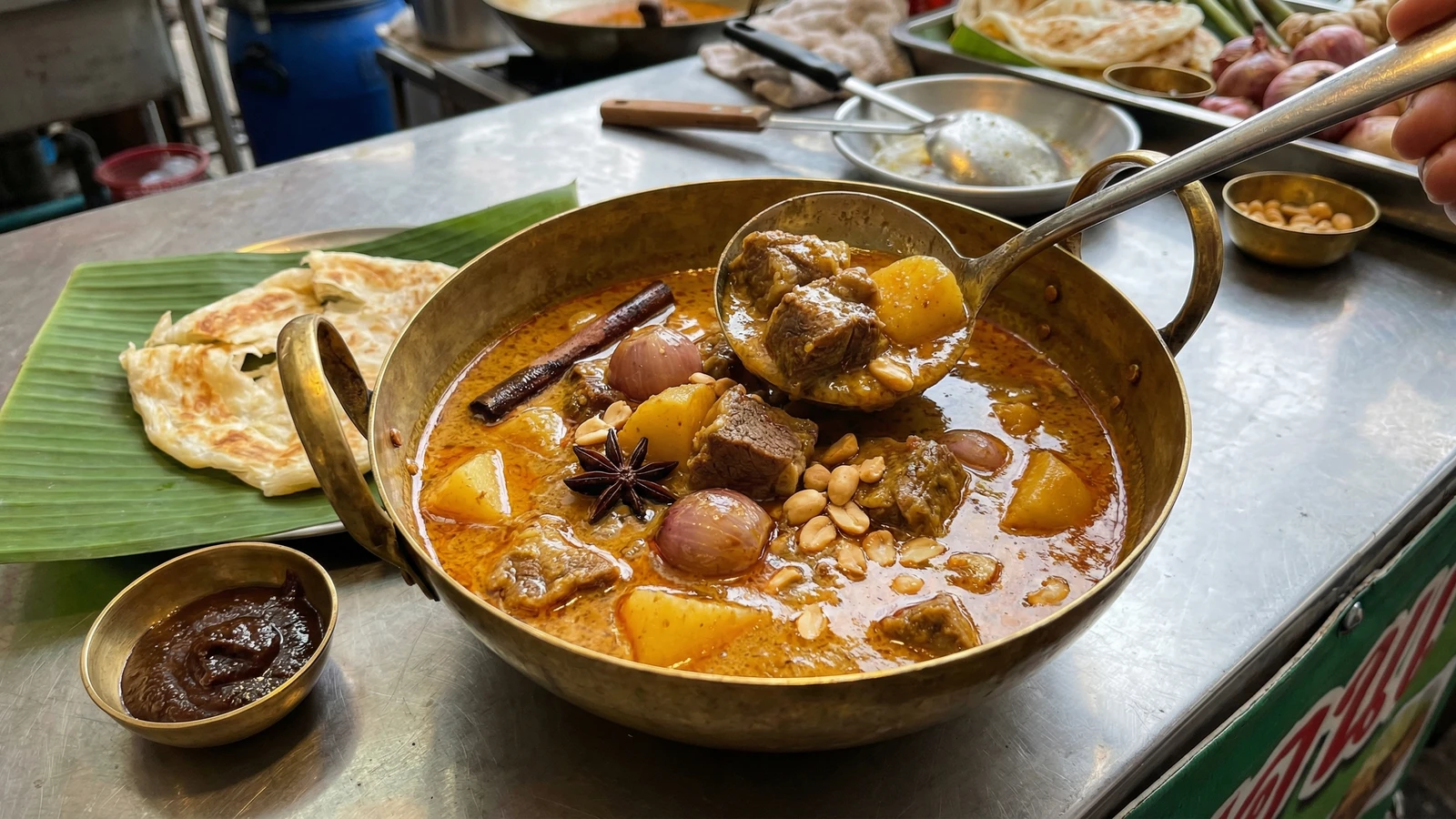
Southern Muslim Lamb Massaman (Gaeng Massaman Gae)
Created by
The kreung tam that absorbed the spice trade. Cardamom, star anise, cinnamon, cumin, all pounded into a Southern Thai paste, slow-braised with lamb in coconut cream. Muslim south. Indian roots. Thai principles intact.
This is the kreung tam that proves the system is alive. Not frozen. Not a museum piece. Alive.
When Muslim traders from India, Persia, and the Malay world arrived on the southern Thai peninsula centuries ago, they brought spices that didn't exist in the Thai kitchen: cardamom, cumin, star anise, cinnamon, cloves, nutmeg. Spices that define Indian curries. And what did Thai cooks do? They didn't abandon the kreung tam. They absorbed those spices INTO it. Pounded them right alongside the lemongrass, galangal, shallots, and chilies. The framework held. The paste expanded. That's the genius of the Thai system: it's a set of governing principles, not a locked recipe. Ajarn always said: "Understand the principles and you can cook anything." Massaman is the proof.
The four pillars are all here, but the balance shifts. Fish sauce for salt. Palm sugar for sweet, and more generously than in any other Southern curry. Tamarind for sour (not lime; massaman uses makham, which gives a rounder, darker acidity). Dried long chilies (prik haeng) for heat, but gentler than a gaeng tai pla or khua kling. This is the exception within Southern Thai cooking. The south leans sour and brutal. Massaman leans rich and warm. It has to. The Indian and Malay influence demanded it. The dried spices are aromatic, not sharp. They need sweetness and fat to carry them. That's why the coconut cream is thick, the palm sugar is unashamed, and the braise is slow.
Lamb, not beef, not chicken. The Muslim communities in Pattani, Yala, Narathiwat, and the coast around Songkhla cook massaman with lamb. It's the original protein. The connective tissue in lamb shoulder breaks down over two hours of low heat, melting into the coconut cream, thickening the sauce, carrying the spice. Chicken massaman is a Central Thai restaurant adaptation. Down south, at the food stalls near the mosques, it's lamb. It's always been lamb.
You will pound this kreung tam for thirty minutes. Your arm will ache. The dry spices need to be toasted first, then ground, then incorporated into the wet paste one ingredient at a time. There is no shortcut. A blender will heat the volatile oils and flatten the aroma. The krok releases them. That's the difference between a paste that smells like a spice market and one that smells like a powder. Krok ก่อน, krok ก่อน.
Massaman (มัสมั่น) derives from "Mussalman," the Persian word for Muslim, marking this as one of the few Thai curries explicitly named for its cultural origin. The dish appears in a poem attributed to King Rama II (early 19th century), praising its rich, fragrant character, but its roots stretch further back to the Ayutthaya period (1351-1767), when Indian and Persian Muslim traders established communities along the southern Thai peninsula. The kreung tam for massaman is unique in Thai cuisine for incorporating dry spices (cardamom, cumin, cinnamon, cloves, star anise, nutmeg) alongside the standard Thai aromatic base, a direct artifact of the Indian Ocean spice trade absorbed into the Thai paste system rather than replacing it.
The technique, the tradition, and the story behind every dish.
Discover Culinary AdvisorIngredients
dried long chilies (prik haeng)
Quantity
8
seeded, soaked in warm water 15 minutes, drained
coriander seeds (met phak chi)
Quantity
1 tablespoon
toasted
cumin seeds (yira)
Quantity
1 teaspoon
toasted
green cardamom pods (luk krawan)
Quantity
5
toasted, seeds extracted
cloves (kan plu)
Quantity
3
toasted
star anise (poy kak) for paste
Quantity
1
toasted
white peppercorns (prik thai)
Quantity
1/2 teaspoon
toasted
nutmeg (luk chan)
Quantity
1/4 teaspoon
freshly grated
shallots (hom daeng) for paste
Quantity
5
sliced
garlic (kratiam)
Quantity
8 cloves
lemongrass (takhrai)
Quantity
2 stalks
tender inner part, thinly sliced
galangal (kha)
Quantity
1 tablespoon
sliced
kaffir lime zest (phiu makrut)
Quantity
1 teaspoon
shrimp paste (kapi)
Quantity
1 tablespoon
salt
Quantity
1 teaspoon
bone-in lamb shoulder
Quantity
1 kg
cut into 4 cm chunks
coconut cream (hua kathi)
Quantity
800 ml
thick first pressing
coconut milk (hang kathi)
Quantity
400 ml
thin second pressing
fish sauce (nam pla)
Quantity
3 tablespoons
palm sugar (nam tan pip)
Quantity
3 tablespoons
shaved
tamarind paste (nam makham piak)
Quantity
2 tablespoons
waxy potatoes
Quantity
300g
peeled and quartered
whole shallots (hom daeng) for curry
Quantity
150g
peeled, left whole
roasted peanuts (thua lisong)
Quantity
80g
unsalted
green cardamom pods for curry
Quantity
3
lightly crushed
cinnamon stick (ob choei)
Quantity
1, about 8 cm
bay leaves (bai krawan)
Quantity
2
star anise (poy kak) for curry
Quantity
1
roti or steamed jasmine rice (optional)
Quantity
for serving
| Ingredient | Quantity |
|---|---|
| dried long chilies (prik haeng)seeded, soaked in warm water 15 minutes, drained | 8 |
| coriander seeds (met phak chi)toasted | 1 tablespoon |
| cumin seeds (yira)toasted | 1 teaspoon |
| green cardamom pods (luk krawan)toasted, seeds extracted | 5 |
| cloves (kan plu)toasted | 3 |
| star anise (poy kak) for pastetoasted | 1 |
| white peppercorns (prik thai)toasted | 1/2 teaspoon |
| nutmeg (luk chan)freshly grated | 1/4 teaspoon |
| shallots (hom daeng) for pastesliced | 5 |
| garlic (kratiam) | 8 cloves |
| lemongrass (takhrai)tender inner part, thinly sliced | 2 stalks |
| galangal (kha)sliced | 1 tablespoon |
| kaffir lime zest (phiu makrut) | 1 teaspoon |
| shrimp paste (kapi) | 1 tablespoon |
| salt | 1 teaspoon |
| bone-in lamb shouldercut into 4 cm chunks | 1 kg |
| coconut cream (hua kathi)thick first pressing | 800 ml |
| coconut milk (hang kathi)thin second pressing | 400 ml |
| fish sauce (nam pla) | 3 tablespoons |
| palm sugar (nam tan pip)shaved | 3 tablespoons |
| tamarind paste (nam makham piak) | 2 tablespoons |
| waxy potatoespeeled and quartered | 300g |
| whole shallots (hom daeng) for currypeeled, left whole | 150g |
| roasted peanuts (thua lisong)unsalted | 80g |
| green cardamom pods for currylightly crushed | 3 |
| cinnamon stick (ob choei) | 1, about 8 cm |
| bay leaves (bai krawan) | 2 |
| star anise (poy kak) for curry | 1 |
| roti or steamed jasmine rice (optional) | for serving |
Equipment Needed
- •Heavy granite mortar and pestle (krok hin), at least 7 inches diameter
- •Dutch oven or heavy-bottomed pot with lid
- •Dry skillet for toasting spices
Instructions
- 1
Toast the dry spices
Set a dry pan over medium-low heat. Add the coriander seeds, cumin seeds, cardamom pods, cloves, star anise, and white peppercorns. Keep the pan moving. You want slow, even heat. In about three minutes, the kitchen will smell like a spice market in Songkhla: warm, woody, intoxicating. The coriander seeds should be a shade darker. The cumin fragrant but not burnt. Pull them off the heat immediately. Burn them and you start over. No negotiation. Crack the cardamom pods and extract the tiny black seeds, discard the husks. Let everything cool for a few minutes.
Toast each spice separately if your pan runs hot. Cumin burns faster than coriander. Cardamom scorches before cloves do. When in doubt, lower the heat and go slower. You can't un-burn a spice. - 2
Grind the dry spices
Transfer the cooled toasted spices to your granite mortar (krok hin). Pound them to a fine powder. This takes work. Five minutes of steady, firm pounding. Add the freshly grated nutmeg and pound it in. The powder should be aromatic, fine, and uniform. No whole seeds left. Set aside. This is the Indian layer of your kreung tam, the spices the traders brought. They go into the paste, not alongside it. That's the Thai system absorbing foreign influence.
- 3
Pound the kreung tam
Start with the drained soaked chilies and salt in the mortar. Pound to a rough paste. Add the shallots and garlic. Pound until broken down and incorporated. Add the lemongrass and galangal. These are fibrous; they take time. Pound with purpose. Add the kaffir lime zest. Now add the ground spice powder from step 2, working it into the wet paste until everything is uniform. Finally, add the shrimp paste (kapi) and pound it through. The finished kreung tam should be thick, fragrant, and slightly coarse. Not silky smooth. You want texture. The color will be deep brick-red with golden undertones from the spices. The aroma should be extraordinary: warm spice layered over sharp Thai aromatics. That's two culinary traditions living in one mortar.
Ajarn always said: the kreung tam tells you when it's ready. When the aroma fills the room and the paste pulls away from the mortar walls cleanly, you're there. This paste will take twenty-five to thirty minutes of steady pounding. That's normal. That's correct. - 4
Crack the coconut cream
Pour about 250 ml of the thick coconut cream (hua kathi) into a heavy-bottomed pot or Dutch oven over medium heat. Stir occasionally as it heats. After five to seven minutes, the cream will separate: the fat rises and pools on the surface in clear, shimmering oil while the solids sink. This is called cracking the coconut cream, and it's the single most important technique in Thai curry making. If you skip this, the curry tastes flat. Every street vendor who makes curry starts here. The oil should pool visibly on the surface, glistening and fragrant. That's your signal.
- 5
Fry the paste
Add the kreung tam to the cracked coconut cream. Stir it into the oil and fry over medium heat for four to five minutes. The paste will darken, the aromatics will bloom, and the oil will begin to separate again around the edges of the paste. Your kitchen will smell like southern Thailand. That's the volatile oils from the spices releasing into the fat. Fat carries flavor. That's why you crack the cream first. The whole spices for the curry go in now: the three crushed cardamom pods, the cinnamon stick, the star anise, and the bay leaves. Fry them with the paste for another minute.
- 6
Sear the lamb
Add the lamb pieces to the pot. Toss them through the paste and oil, coating every surface. Let them sear on one side for two minutes without moving. You want color on the meat. That browning is flavor. The Maillard reaction creates new compounds that deepen the curry. Toss and sear the other sides. The lamb should be coated in paste and browned on the edges.
Bone-in lamb shoulder is non-negotiable. The bone adds gelatin to the braise. The connective tissue melts. Boneless leg is faster but the sauce will never have the same body. If your butcher can cut through the bone for you, even better. - 7
Braise low and slow
Pour in the remaining coconut cream and all the coconut milk. The liquid should nearly cover the lamb. Bring to a gentle simmer, never a boil. A boil breaks the coconut cream and the sauce turns grainy. Reduce the heat to the lowest setting your stove allows. Cover with the lid slightly ajar. Let this braise for one hour. Don't touch it. Don't stir it every five minutes. The lamb needs time. The collagen in the shoulder converts to gelatin between 70-80°C. That takes patience, not fire.
- 8
Add potatoes and shallots
After one hour, add the quartered potatoes and whole peeled shallots. Push them gently into the liquid. The lamb should already be giving way when pressed. Continue simmering uncovered for another 30-40 minutes until the potatoes are tender but not falling apart and the shallots are translucent and sweet. The sauce will reduce and thicken as it cooks uncovered. This is intentional.
- 9
Season and finish
Add the fish sauce, palm sugar, and tamarind paste. Stir gently to dissolve. Taste. This is where the four pillars reveal themselves. The fish sauce gives you salt and depth. The palm sugar gives you sweetness that rounds out the spice. The tamarind gives you sour, dark and fruity, not sharp like lime. Adjust. Massaman is the richest Thai curry, so the sweet and salty should be forward, with sour in the background and heat as a warm hum, not a punch. Fold in the roasted peanuts. Simmer for five more minutes.
Tamarind, not lime. This matters. Lime would cut through the coconut cream and clash with the warm spices. Tamarind provides a round, mellow acidity that sits alongside the sweetness instead of fighting it. That's why massaman uses makham. The ingredient serves the principle. - 10
Rest and serve
Remove from heat. Let the massaman rest for ten minutes. The sauce will tighten as the gelatin from the lamb bones sets slightly. Ladle into bowls, making sure each serving gets lamb, potato, shallots, and peanuts. Serve with roti for tearing and dipping, the way they eat it in Songkhla and Pattani. Jasmine rice works too, but roti is the southern Muslim tradition. The bread soaks up the rich, spiced coconut sauce in a way that rice simply can't. Two religions share a table in the deep south. This is the dish that proves it.
Chef Tips
- •The kreung tam for massaman contains more dry spices than any other Thai curry paste. Coriander, cumin, cardamom, cloves, star anise, peppercorns, nutmeg. These are the Indian Ocean spice trade, absorbed into the Thai paste system. Toast each one to activate the volatile oils, grind them to powder, then pound them into the wet paste. The spices go INTO the kreung tam. They don't float around loose in the curry. That's the Thai method: everything begins in the mortar.
- •Shrimp paste (kapi) is traditional in massaman paste, even in the Muslim south. Some Muslim cooks in the deep south omit it, using only fish sauce for the fermented element. Both approaches are legitimate. If you're cooking for observant Muslim guests who avoid kapi, increase the fish sauce by one tablespoon and add a pinch more salt to the paste. The principle of fermented salinity still holds.
- •Massaman improves dramatically overnight. The spices meld, the coconut cream absorbs deeper into the lamb, and the flavors settle. Make it a day ahead for a dinner party. Reheat gently over low heat, adding a splash of coconut milk if the sauce has thickened too much. This is one of the few Thai curries that rewards patience beyond the initial cook.
- •Roti is the traditional accompaniment in the Muslim south, not jasmine rice. The flatbread is cooked on a hot griddle, flaky from oil and folding, perfect for tearing and dragging through the rich sauce. If you can find a roti vendor or make your own, do it. The combination of roti and massaman is what this dish was designed for. Rice is fine. Roti is correct.
- •The whole spices in the curry (the extra cardamom, cinnamon stick, star anise, bay leaves) are not meant to be eaten. They're aromatic infusers. Leave them in the pot for presentation, but warn your guests. Biting into a whole star anise is an experience nobody wants twice.
Advance Preparation
- •The kreung tam can be pounded up to two days ahead and refrigerated in a sealed container. The flavor deepens as the spices marry. Bring to room temperature before frying.
- •Dry spices can be toasted and ground a week in advance. Store in an airtight jar away from light. The pre-ground powder loses potency after a week, so don't go longer.
- •The complete massaman is better the next day. Cool to room temperature, refrigerate, and reheat gently. The lamb will be more tender, the sauce richer, and the spices more integrated. For a dinner party, cook it the day before.
Frequently Asked Questions
Nutrition Information
1 serving (about 380g)
Where cooking meets culture.
Culinary mentorship, cultural storytelling, and the editorial depth that makes cooking meaningful.
Explore Culinary Advisor