Culinary Advisor
A cooking platform built around craft, culture, and the stories behind what we eat.
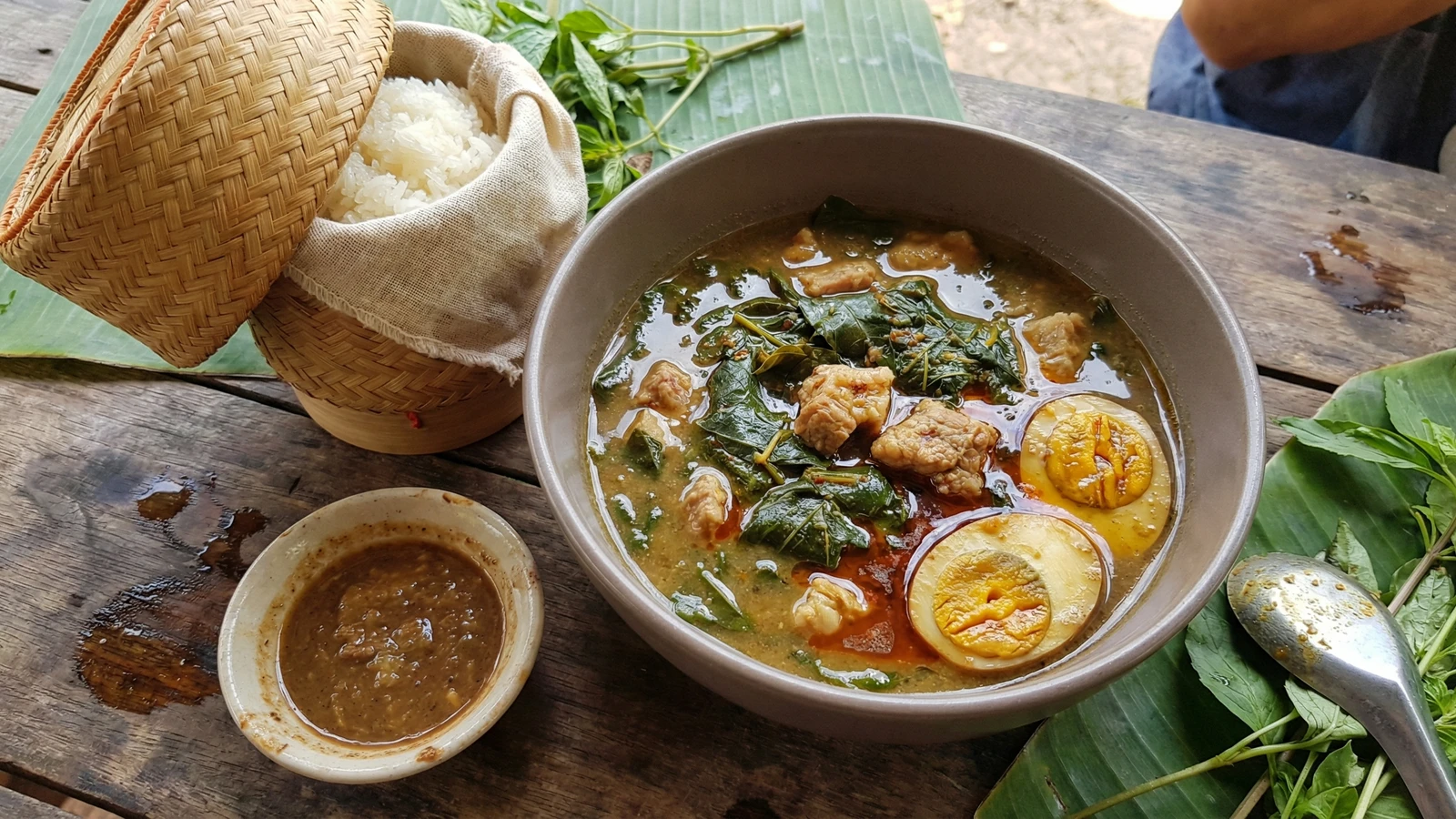
Cassia Leaf Curry (Gaeng Khi Lek)
Created by
Isan's bitter curry built on foraged cassia leaves, padaek funk, and a kreung tam that proves bitterness is a feature, not a flaw. The flavor dimension most of the world is too timid to embrace.
Bitterness. That's the flavor most people run from. Central Thai cooking balances salty, sweet, sour, and spicy. Isan takes all four and adds a fifth: bitter. Not as an accident. As a principle.
Gaeng khi lek is the dish that teaches this lesson. Cassia leaves (bai khi lek, ใบขี้เหล็ก) are foraged from trees that grow wild across the Isan plateau. They're bitter. Unapologetically bitter. And Isan cooks don't try to hide it. They blanch the leaves to take the edge off, then let that gentle, vegetal bitterness sit right at the center of the curry, balanced by the sour punch of tamarind and the deep, funky salinity of padaek (ปลาแดก). That's the Isan system: water-based, herb-forward, fermented-fish-driven. No coconut cream. No Central Thai sweetness. No apologies.
Ajarn always said the kreung tam is everything. Even in Isan, where the curries look nothing like a Bangkok gaeng, the foundation is still a pounded paste. Dried chilies, shallots, garlic, lemongrass, galangal, kapi. Pound it in the krok, fry it until fragrant, build the curry from there. The method is the same. The ingredients shift with the region. That's how a principled system works: the framework holds, the expression changes.
This is forager's food. My mother's people in Isan didn't go to the market for bai khi lek. They walked out to the tree in the yard, picked the young leaves and tender shoots, and made gaeng. The pork came from whatever was available. The eggs went in whole, soaking up the bitter-sour broth until they turned golden brown. You eat this with sticky rice (khao niew, ข้าวเหนียว), pinching off a piece, scooping up the curry, getting a bit of leaf and pork and egg in every bite. That's the design. Jasmine rice has no place at this table.
Gaeng khi lek belongs to the Isan foraging tradition, where cooks build dishes around wild plants rather than market ingredients. Cassia (Senna siamea), known as khi lek (ขี้เหล็ก) in Thai, is a leguminous tree native to Southeast Asia whose young leaves and flowers have been consumed for centuries across Thailand's northeast and in Lao cuisine. Thai traditional medicine has long valued the leaves for their mild sedative and digestive properties, making gaeng khi lek one of the rare dishes that functions simultaneously as food and folk remedy. The bitter flavor profile places it in a category of Isan dishes that Western-influenced Thai restaurants almost never serve, preserving it as deeply regional, home-kitchen food.
The technique, the tradition, and the story behind every dish.
Discover Culinary AdvisorIngredients
cassia leaves (bai khi lek)
Quantity
200g
young leaves and tender shoots, picked from stems
pork ribs or pork belly
Quantity
300g
cut into bite-sized pieces
eggs
Quantity
4
hard-boiled and peeled
water
Quantity
4 cups
padaek (fermented fish paste)
Quantity
2 tablespoons
strained through a fine sieve to remove bones
fish sauce (nam pla)
Quantity
1 tablespoon
tamarind paste (nam makham piak)
Quantity
2 tablespoons
dissolved in 3 tablespoons warm water, seeds and fibers discarded
palm sugar (nam tan pip)
Quantity
1 tablespoon
dried red chilies (prik haeng)
Quantity
7
soaked in warm water 15 minutes, deseeded
shallots (hom daeng)
Quantity
5
roughly sliced
garlic (kratiam)
Quantity
6 cloves
lemongrass (takhrai)
Quantity
2 stalks
lower 3 inches only, thinly sliced
galangal (kha)
Quantity
1-inch piece
thinly sliced
shrimp paste (kapi)
Quantity
1 tablespoon
vegetable oil
Quantity
2 tablespoons
sticky rice (khao niew)
Quantity
for serving
| Ingredient | Quantity |
|---|---|
| cassia leaves (bai khi lek)young leaves and tender shoots, picked from stems | 200g |
| pork ribs or pork bellycut into bite-sized pieces | 300g |
| eggshard-boiled and peeled | 4 |
| water | 4 cups |
| padaek (fermented fish paste)strained through a fine sieve to remove bones | 2 tablespoons |
| fish sauce (nam pla) | 1 tablespoon |
| tamarind paste (nam makham piak)dissolved in 3 tablespoons warm water, seeds and fibers discarded | 2 tablespoons |
| palm sugar (nam tan pip) | 1 tablespoon |
| dried red chilies (prik haeng)soaked in warm water 15 minutes, deseeded | 7 |
| shallots (hom daeng)roughly sliced | 5 |
| garlic (kratiam) | 6 cloves |
| lemongrass (takhrai)lower 3 inches only, thinly sliced | 2 stalks |
| galangal (kha)thinly sliced | 1-inch piece |
| shrimp paste (kapi) | 1 tablespoon |
| vegetable oil | 2 tablespoons |
| sticky rice (khao niew) | for serving |
Equipment Needed
- •Heavy granite mortar and pestle (krok hin) for the kreung tam
- •Medium stockpot
- •Fine-mesh strainer for padaek
- •Kratip (sticky rice basket) for serving
Instructions
- 1
Blanch the cassia leaves
Bring a pot of water to a rolling boil. Add the cassia leaves and blanch for 3 minutes. Drain and discard the water. Repeat this a second time with fresh water. This double blanch pulls out the harsh, aggressive bitterness while leaving the gentle, herbaceous bitterness that defines the dish. After two blanches, taste a leaf. It should be bitter but not punishing. If it still makes you wince, blanch a third time. You're moderating the bitterness, not eliminating it. Squeeze out excess water and set the leaves aside.
Young, tender cassia leaves need only two blanches. Older, tougher leaves may need three. The goal is a pleasant bitterness that plays well with the tamarind and padaek, not a flavor that overwhelms. Taste as you go. - 2
Simmer the pork
In a pot, bring 4 cups of water to a boil. Add the pork pieces and reduce to a steady simmer. Cook for 20 minutes until the pork is tender and the broth has some body. Skim any scum that rises to the surface. This broth becomes the base of your curry. No coconut milk. No stock cubes. Just pork and water. Isan curries are built on simplicity, and the pork does the work.
- 3
Pound the kreung tam
While the pork simmers, build your paste. Start with the soaked, drained dried chilies in a granite mortar (krok hin). Pound them down to a rough pulp. Add the garlic and shallots. Pound until they break apart and merge with the chili. Then the lemongrass and galangal, pounding until fibrous but integrated. Finally, the kapi. Pound until you have a coarse, fragrant paste. It won't be smooth. Isan pastes are rustic. They should smell like earth and fire: smoky chilies, sharp shallots, the funk of shrimp paste underneath everything.
Ajarn always said the kreung tam tells you when it's ready. When the aroma fills the room and you can't distinguish individual ingredients anymore, that's the paste talking to you. It should smell unified, not like a pile of separate things. - 4
Fry the paste
Heat the oil in a separate pan or the curry pot over medium heat. Add the kreung tam and fry, stirring constantly, for 3 to 4 minutes. The paste should darken slightly and the oil will start to separate at the edges. Your kitchen will smell incredible: roasted chili, caramelized shallots, that deep kapi funk blooming in the heat. This step is critical. Raw paste in broth tastes flat. Fried paste in broth tastes like a curry. The heat transforms the volatile oils and develops layers that pounding alone can't achieve.
- 5
Build the curry
Add the fried paste to the pot of simmering pork broth. Stir to dissolve. Add the strained padaek and fish sauce. Stir again. The broth will turn murky and aromatic, with that unmistakable Isan funk that padaek delivers. Add the tamarind water and palm sugar. Bring everything to a gentle simmer and let it cook together for 5 minutes so the flavors marry. Taste. The profile should be: sour from the tamarind leading, salty-funky from the padaek underneath, a background sweetness from the palm sugar to soften the edges, and heat from the paste holding it all together.
- 6
Add the leaves and eggs
Add the blanched cassia leaves and the peeled hard-boiled eggs to the curry. Simmer for another 10 minutes. The leaves will darken slightly and release their gentle bitterness into the broth. The eggs will absorb the curry, turning golden-brown on the outside and carrying the sour-bitter-salty flavor all the way through. This is the moment the dish comes together: bitter leaves, sour tamarind, funky padaek, tender pork, rich egg. Every flavor has a job. None of them are hiding.
If you can score shallow cuts into the hard-boiled eggs before adding them, the curry will penetrate deeper and faster. Some Isan cooks do this, some don't. Both ways work. - 7
Taste and serve
Final tasting. Adjust: more padaek if it needs depth, more tamarind if it needs sour, a pinch more palm sugar if the bitterness is too forward. The balance is yours, but the bitterness should be present. Don't chase it out. It belongs here. Ladle into bowls, making sure each serving gets pork, an egg (halved so the yolk shows), and plenty of cassia leaves in broth. Serve with sticky rice. Only sticky rice. You pinch, you scoop, you eat. That's the Isan way.
Chef Tips
- •Padaek (ปลาแดก) is not interchangeable with regular fish sauce. Fish sauce (nam pla) is the filtered, clear liquid from fermented fish. Padaek is the whole fermented product: thicker, chunkier, with a deeper funk and earthier character. Strain it to remove bones and scales, but don't filter out the flavor. If you substitute fish sauce alone, you lose half the soul of this dish. Find padaek at any Southeast Asian grocery. It's usually in a jar, murky and honest-looking. That's the one you want.
- •Cassia leaves (bai khi lek) are available fresh or frozen at Southeast Asian markets, especially those serving Thai or Lao communities. If you genuinely cannot find them, this dish cannot be made. There is no substitute for the specific bitterness of cassia. Don't try to fake it with other bitter greens. Make a different Isan curry instead. Principles, not workarounds.
- •The bitterness in gaeng khi lek is the point. Isan cooks treat bitterness the way Central Thai cooks treat sourness: as a primary flavor to be balanced, not masked. If you blanch the leaves too many times, you strip out the very thing that makes this dish what it is. Two blanches for young leaves, three maximum for older ones. Taste after each blanch. You want that herbaceous, quietly bitter undertone to remain.
- •Sticky rice (khao niew) is the only accompaniment. Jasmine rice with an Isan curry is like eating sushi with a fork. It works mechanically. It misses the entire design. Sticky rice is pinched and used as a scoop, a utensil, and a starch in one. The glutinous texture absorbs the broth and tempers the bitterness. The pairing is functional, not decorative.
Advance Preparation
- •The kreung tam can be pounded up to a day ahead and stored in the refrigerator. Bring to room temperature before frying.
- •Cassia leaves can be blanched and drained a few hours ahead. Keep covered at room temperature.
- •Hard-boiled eggs can be prepared ahead and refrigerated.
- •The finished curry actually improves after resting for 30 minutes, as the eggs and leaves absorb more flavor. Reheat gently before serving. Add a squeeze of tamarind if the sourness fades.
Frequently Asked Questions
Nutrition Information
1 serving (about 325g)
Where cooking meets culture.
Culinary mentorship, cultural storytelling, and the editorial depth that makes cooking meaningful.
Explore Culinary Advisor