Culinary Advisor
A cooking platform built around craft, culture, and the stories behind what we eat.
Forloren And
Created by Chef Freja Lund
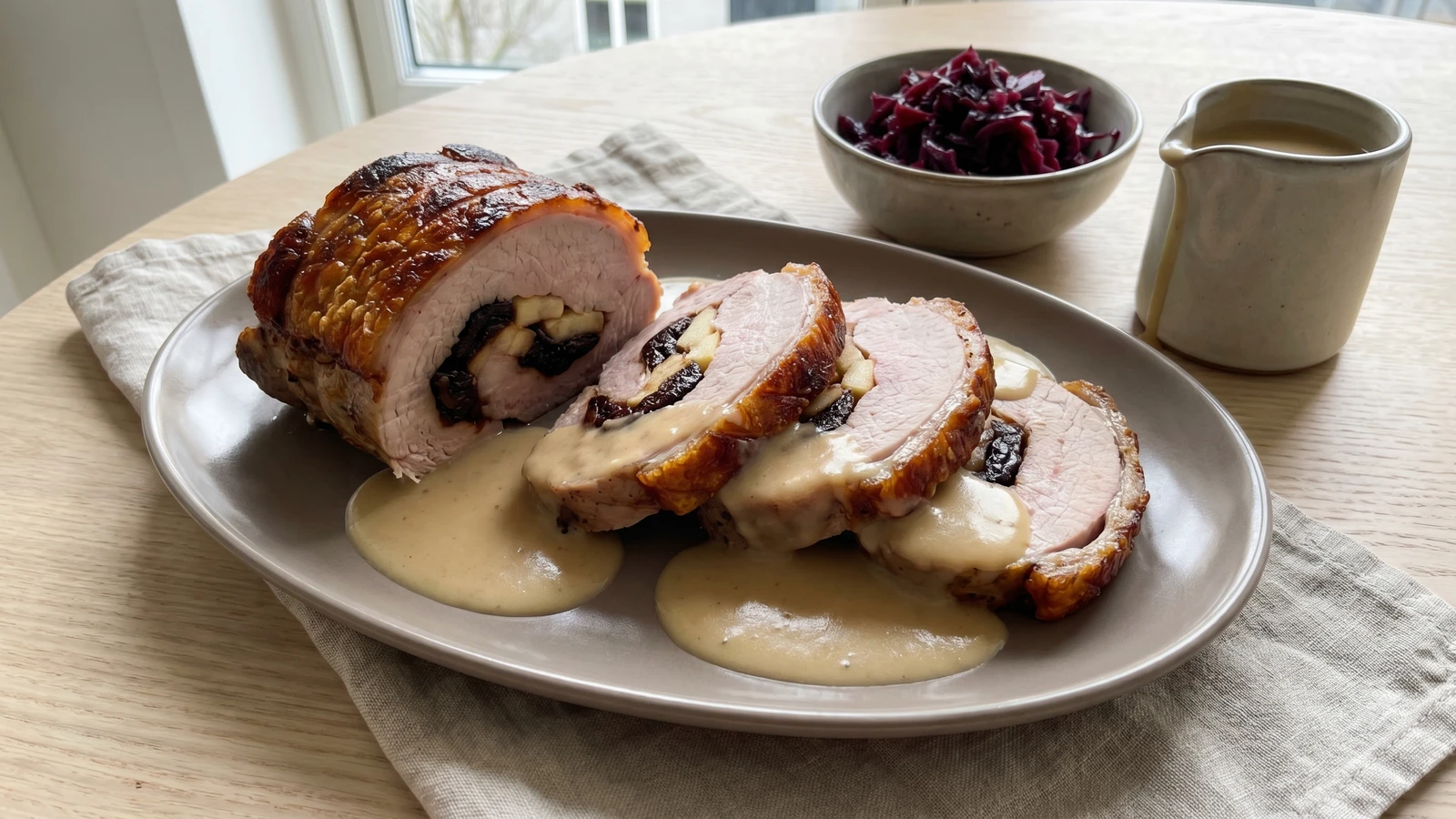
A boneless pork loin butterflied, filled with prunes and tart apples, rolled tight and roasted until deep golden. Post-war Danish ingenuity at its most generous, sliced thick and served with a smooth cream gravy.
November in Denmark is dark by four o'clock. The kitchen window becomes a mirror, and what you see reflected is the room itself: warm light, the oven on, something slow-roasting that fills the whole flat with the smell of pork and fruit and allspice. This is when forloren and belongs.
The name means "mock duck," and the story behind it is pure Danish pragmatism. When duck was scarce or too expensive for the Sunday table, home cooks took a pork loin, butterflied it open, filled it with prunes and sliced apples, rolled it tight, and roasted it until the outside went deep golden and the inside stayed juicy and tender. The dark fruit and the meat traded flavours in the oven's heat. It was economy dressed in celebration clothes, and the families who ate it didn't feel cheated. They felt fed. That's the genius of the dish. It doesn't pretend to be something it's not. It's something better: pork cooked with love and served with the understanding that a good meal doesn't depend on the most expensive ingredient.
What I want you to watch for is the browning. Before the roast goes into the oven, you'll sear it on all sides in butter until the surface is golden and caramelised. This isn't just for colour. The browning builds flavour on the surface of the meat and creates the fond in the pan that becomes your gravy. Take your time here. You'll know when it's right because the kitchen will smell of butter and roasted meat, and the surface will resist slightly when you turn it. After that, the oven does most of the work, and you are free to make the rødkål and the brunede kartofler that belong alongside.
Forloren and became widespread in Danish home kitchens during and after the Second World War, when poultry was rationed or prohibitively expensive for most families. The dish draws on a much longer Scandinavian tradition of pairing pork with dried fruit, a combination that stretches back to the medieval practice of cooking preserved fruits with salted meat during winter months when fresh produce did not exist. The name itself, "false duck," carries no apology. It became a badge of the resourceful Danish kitchen, and by the 1950s it had earned a permanent place on the Sunday dinner table, surviving long after duck became affordable again because the dish was simply too good to abandon.
The technique, the tradition, and the story behind every dish.
Discover Culinary AdvisorIngredients
boneless pork loin
Quantity
1.2 kg
in one piece, fat cap on if possible
pitted prunes
Quantity
150g
tart apples
Quantity
2 medium
such as Ingrid Marie or Granny Smith
fine sea salt
Quantity
1 teaspoon, plus extra for the exterior
black pepper
Quantity
½ teaspoon
freshly ground
ground allspice
Quantity
½ teaspoon
unsalted butter
Quantity
30g
neutral oil
Quantity
1 tablespoon
onion
Quantity
1 medium
quartered
carrot
Quantity
1 large
roughly chopped
bay leaves
Quantity
2
chicken or pork stock
Quantity
400ml
double cream
Quantity
100ml
plain flour
Quantity
1½ tablespoons
cold water
Quantity
2 tablespoons
| Ingredient | Quantity |
|---|---|
| boneless pork loinin one piece, fat cap on if possible | 1.2 kg |
| pitted prunes | 150g |
| tart applessuch as Ingrid Marie or Granny Smith | 2 medium |
| fine sea salt | 1 teaspoon, plus extra for the exterior |
| black pepperfreshly ground | ½ teaspoon |
| ground allspice | ½ teaspoon |
| unsalted butter | 30g |
| neutral oil | 1 tablespoon |
| onionquartered | 1 medium |
| carrotroughly chopped | 1 large |
| bay leaves | 2 |
| chicken or pork stock | 400ml |
| double cream | 100ml |
| plain flour | 1½ tablespoons |
| cold water | 2 tablespoons |
Equipment Needed
- •Sharp carving knife
- •Kitchen string
- •Heavy roasting pan or oven-safe skillet
- •Meat thermometer
- •Fine sieve for the gravy
Instructions
- 1
Prepare the fruit
Peel and core the apples and cut them into thick slices, about half a centimetre each. Thick matters here. Thin slices dissolve during the long roast and you lose the texture entirely. You want pieces that hold their shape and give a slight resistance when you bite through the finished slice. Set the apple slices and the prunes aside together. That's your filling.
- 2
Butterfly the pork
Lay the pork loin on a board with the fat side down. Hold your knife parallel to the board and cut horizontally into the thickest part of the loin, slicing about two thirds of the way through. Stop a centimetre before you cut all the way. Open it like a book. If the loin is very thick, you can make a second shallow cut on the thicker side and fold that flap out too. What you want is a flat, roughly even piece of meat large enough to hold the stuffing and roll around it. Don't worry about perfection. Once it's rolled and tied, nobody sees the inside architecture.
If butterflying feels unfamiliar, ask your butcher to do it. Tell them you want the loin opened flat for stuffing and rolling. Any good butcher will know exactly what you mean. - 3
Season and stuff
Season the opened surface of the pork with the salt, pepper, and allspice. Rub it in with your hands. The allspice is important: it's the quiet spice that connects pork and fruit in Danish cooking, warm and aromatic without being sweet. Now lay the prunes in a line down the centre of the meat. Arrange the apple slices alongside and between the prunes, filling the surface but leaving a two-centimetre border at the edges. The border keeps the stuffing from escaping when you roll.
- 4
Roll and tie
Starting from the long edge nearest you, roll the pork up tightly around the filling. Keep the tension steady and even. Don't squeeze, just guide. Tie the roll with kitchen string at three-centimetre intervals, pulling each knot firm enough to hold the shape but not so tight that you cut into the meat. Tie one final piece lengthwise to hold the ends closed. Season the outside with a generous pinch of salt.
A tight roll is the difference between clean slices and a filling that falls out on the board. Take your time with the tying. It pays for itself later. - 5
Brown the roast
Heat the oven to 180°C. Melt the butter with the oil in a heavy pan over medium-high heat. When the butter foams and begins to quiet down, lay the rolled pork in seam-side down. Brown it slowly on all sides, turning every couple of minutes, until the entire surface is deep golden. This takes eight to ten minutes and it is not optional. The browning builds flavour on the surface of the meat and creates the fond, the dark, caramelised residue on the bottom of the pan, that becomes the foundation of your gravy.
- 6
Roast in the oven
Transfer the browned roast to a roasting pan, or use the same pan if it's oven-safe. Scatter the onion quarters, chopped carrot, and bay leaves around the meat. Pour in half the stock. The vegetables and liquid serve two purposes: they prevent the drippings from burning on the bottom of the pan, and they build the aromatic base of the gravy as they cook down. Place the pan in the oven and roast for fifty-five to sixty-five minutes. Baste the roast with the pan juices every twenty minutes or so. The pork is done when a thermometer pushed into the thickest part reads 65°C. The meat will carry over to about 68°C while it rests, which gives you pork that is cooked through but still tender and faintly pink at the centre.
If you don't have a meat thermometer, press the roast firmly with your finger. It should feel like the base of your thumb when you press your thumb and ring finger together: firm but with give. If it feels hard, it's overcooked. - 7
Rest the meat
Lift the roast onto a board and cover it loosely with a sheet of foil. Let it rest for fifteen minutes. This is not a suggestion. If you cut too soon, the juices run out onto the board and the meat goes dry. Resting lets everything redistribute, so when you finally slice, the juices stay where they belong: in the pork.
- 8
Make the gravy
Set the roasting pan on the stovetop over medium heat. Pour in the remaining stock and use a wooden spoon to scrape up every bit of fond from the bottom. Let it simmer for a couple of minutes. In a small cup, mix the flour and cold water to a smooth paste, then stir it into the pan. Keep stirring as the gravy thickens, about three minutes. Add the cream, stir it through, and let the gravy simmer for another minute. Taste it. Adjust the salt. Strain everything through a fine sieve into a warm jug, pressing the softened vegetables with the back of a spoon to extract their flavour. Discard what's left in the sieve. The gravy should be smooth, glossy, and savoury, with a depth that comes from the roast itself.
- 9
Slice and serve
Remove the string from the rested roast. Use a sharp knife to cut thick slices, about two centimetres each. Go slowly. You want to see the cross-section: the golden crust, the pale pork, the dark prunes and the soft apple nestled at the centre. Arrange the slices on a warm serving plate and spoon a little gravy over the top. Serve the rest of the gravy alongside. This is the kind of dish that earns a tak for mad.
Chef Tips
- •Use good prunes. The soft, plump kind sold loose at a good grocer, not the dry compressed blocks. The prunes carry sweetness into the pork, and cheap prunes taste of nothing but sugar.
- •Ask your butcher for a loin with the fat cap still on. Score the fat in a crosshatch pattern before you season. The fat renders during roasting and bastes the meat from the outside. If your loin comes without a fat cap, the dish still works, but baste more often.
- •Serve this with rødkål (braised red cabbage with vinegar and redcurrant jelly) and brunede kartofler (caramelised potatoes). Those three together are a complete Danish Sunday dinner, and each one makes the others taste better. The sweet-sour cabbage cuts the richness of the pork, and the caramelised potatoes are the quiet luxury that ties the plate together.
- •A glass of cold Danish beer or a light red wine works here. Nothing heavy. The dish already has depth, and the drink should refresh, not compete.
Advance Preparation
- •The roast can be stuffed, rolled, and tied up to a day in advance. Wrap it tightly and keep it in the fridge. Bring it to room temperature for an hour before browning, so it cooks evenly.
- •Forloren and reheats well. Slice it cold, then warm the slices gently in the leftover gravy over low heat. The flavours deepen overnight, and some Danish cooks will tell you it's better on the second day.
Frequently Asked Questions
Nutrition Information
1 serving (about 310g)
Where cooking meets culture.
Culinary mentorship, cultural storytelling, and the editorial depth that makes cooking meaningful.
Explore Culinary Advisor