Culinary Advisor
A cooking platform built around craft, culture, and the stories behind what we eat.
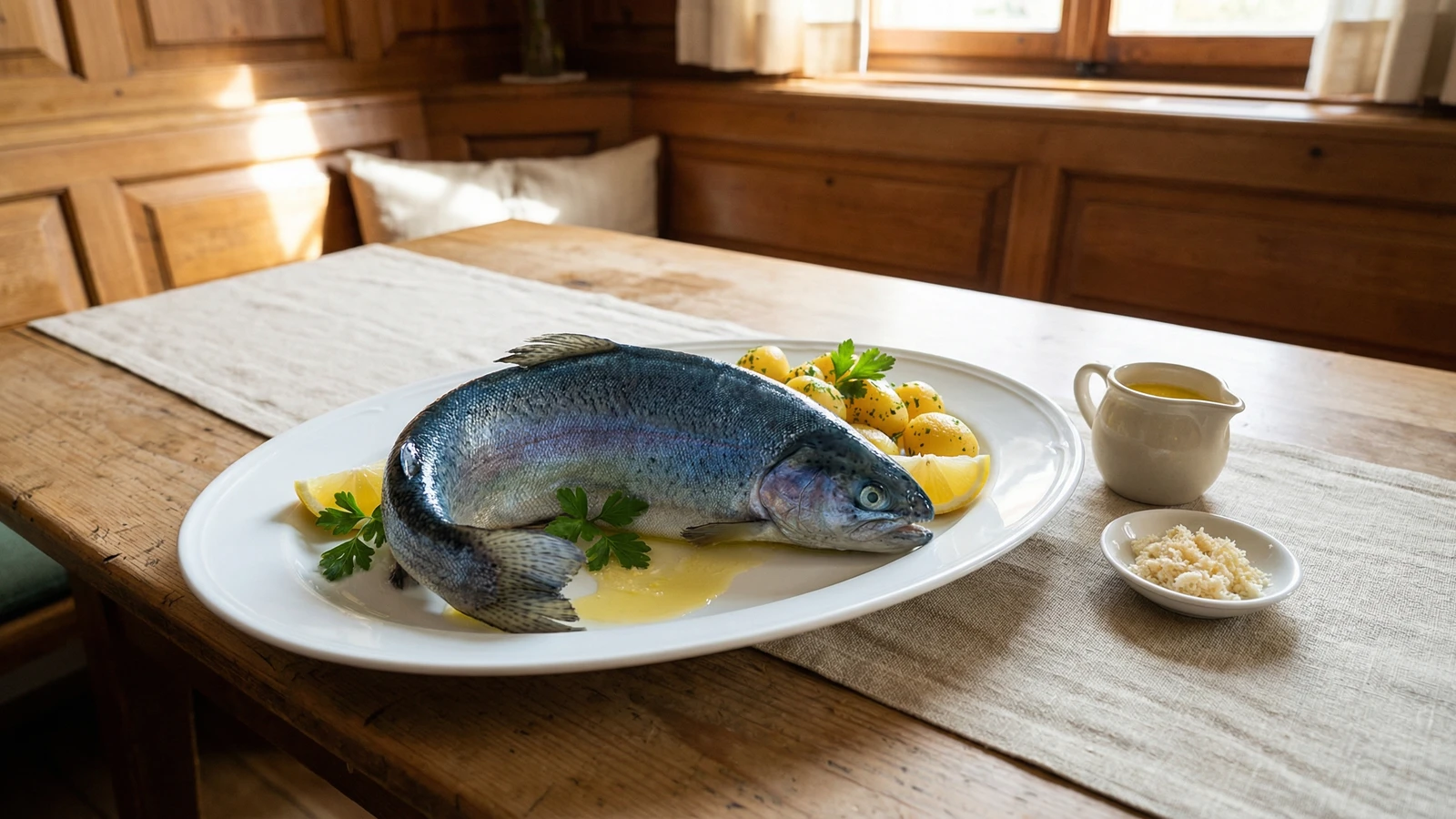
Forelle Blau
Created by Chef Elsa
Whole trout doused in hot vinegar until the skin turns an eerie iridescent blue, then gently poached in court-bouillon and served with nothing but melted butter, grated horseradish, and the quiet confidence of a dish that has nothing to hide.
Iremember the first time I saw a trout turn blue. I was ten years old, maybe eleven, standing in the kitchen of a Gasthaus somewhere near the Wolfgangsee during one of those summer trips with Gretel and Eva. The cook brought a live trout from the tank out back, gutted it in about fifteen seconds, poured steaming vinegar over the body, and the whole fish turned this shimmering, ghostly blue right there on the counter. I thought it was magic. Gretel told me it was chemistry, and then she told me the chemistry only works when the fish is so fresh it's practically still swimming.
Forelle Blau is the most honest dish in Austrian cooking. There is nowhere to hide. No breadcrumb coating, no cream sauce, no herb crust to distract from mediocre fish. It's a whole trout, poached gently in a court-bouillon scented with wine and root vegetables, served with melted butter and horseradish. If the fish is perfect, the dish is perfect. If the fish is anything less, you'll know it on the first bite.
The blue color comes from the natural slime on a freshly caught trout reacting with hot vinegar. It's not a dye, it's not a trick, it's a chemical reaction that only happens when the mucous coating is completely intact. That means the fish cannot have been frozen, shrink-wrapped, or sitting on a market counter since yesterday morning. This is a dish that demands you build a relationship with your fishmonger, or better yet, find a trout farm. In the Salzkammergut, every Gasthaus worth its salt keeps a trout pond. In Salzburg, I'm lucky enough to have farmers who bring fish to the Grünmarkt on Saturday mornings, still glistening.
Forelle Blau has been a fixture of Austrian and Central European gastronomy since at least the 18th century, deeply tied to the Alpine freshwater lakes and rivers of the Salzkammergut, Carinthia, and Tyrol. The technique of vinegar-bluing freshwater fish appears in Austrian cookbooks from the 1700s, and the dish became a symbol of Gasthaus cooking in the lake regions where trout were pulled from the water minutes before cooking. Schubert's famous "Trout Quintet" (Die Forelle, 1819) immortalized the fish in Austrian cultural life, and to this day Forelle Blau remains the standard by which Austrian Gasthäuser in lake country are judged.
The technique, the tradition, and the story behind every dish.
Discover Culinary AdvisorIngredients
whole fresh trout
Quantity
4 (about 300g each)
gutted but unscaled, slime coating intact
white wine vinegar
Quantity
150ml
cold water
Quantity
2 liters
dry white wine
Quantity
250ml
onion
Quantity
1 medium
sliced into rings
carrot
Quantity
1 medium
peeled and sliced
parsnip
Quantity
1 small
peeled and sliced
bay leaf
Quantity
1
whole black peppercorns
Quantity
6
allspice berries
Quantity
4
salt
Quantity
1 tablespoon
fresh parsley
Quantity
3 sprigs
lemon
Quantity
1
sliced
unsalted butter
Quantity
150g
fresh horseradish root
Quantity
to taste
finely grated
waxy potatoes (Kipfler or similar)
Quantity
800g
fresh parsley
Quantity
for the potatoes
chopped
lemon wedges
Quantity
for serving
| Ingredient | Quantity |
|---|---|
| whole fresh troutgutted but unscaled, slime coating intact | 4 (about 300g each) |
| white wine vinegar | 150ml |
| cold water | 2 liters |
| dry white wine | 250ml |
| onionsliced into rings | 1 medium |
| carrotpeeled and sliced | 1 medium |
| parsnippeeled and sliced | 1 small |
| bay leaf | 1 |
| whole black peppercorns | 6 |
| allspice berries | 4 |
| salt | 1 tablespoon |
| fresh parsley | 3 sprigs |
| lemonsliced | 1 |
| unsalted butter | 150g |
| fresh horseradish rootfinely grated | to taste |
| waxy potatoes (Kipfler or similar) | 800g |
| fresh parsleychopped | for the potatoes |
| lemon wedges | for serving |
Equipment Needed
- •Fish kettle or wide deep pan (large enough to hold 4 trout in a single layer)
- •Slotted spoon or fish slice
- •Kitchen string or toothpicks for curving the trout
- •Small saucepan for melting butter
- •Fine grater for horseradish
Instructions
- 1
Choose your trout
This recipe begins at the fishmonger, not at the stove. You need trout that has never been frozen, never been sealed in plastic, and ideally was alive that morning. The natural slime coating on the skin is what turns blue when it meets the vinegar. If the fish has been handled too much, rinsed, or stored on ice for days, that coating is gone and the bluing will not happen. Tell your fishmonger you need the fish whole and untouched, gutted through the gills if possible to keep the belly intact. Eyes should be clear, gills bright red, and the fish should smell like a clean river. Nothing else.
If you can buy live trout from a fish farm, that's the gold standard. Many Austrian Gasthäuser keep their own trout ponds for exactly this reason. The shorter the journey from water to pot, the more vivid the blue. - 2
Build the court-bouillon
Combine the cold water, white wine, onion, carrot, parsnip, bay leaf, peppercorns, allspice berries, salt, parsley sprigs, and lemon slices in a wide, deep pan or fish kettle. You want a vessel broad enough to hold all four trout in a single layer without stacking them. Bring the liquid to a gentle boil and let it simmer for fifteen minutes. The vegetables and aromatics need time to release their flavor into the water. This is your Sud, your court-bouillon, and it does most of the seasoning work for the fish.
A Grüner Veltliner is perfect here. Its white pepper and green apple notes complement trout beautifully. If you don't have Austrian wine, any clean, dry white will do. Save a glass for yourself while you cook. - 3
Start the potatoes
While the court-bouillon simmers, place your potatoes in a pot of cold salted water and bring to a boil. Cook until a knife slides through with no resistance, about twenty minutes depending on size. Drain them, peel if you like (I leave the skins on for Kipfler), and toss with a generous knob of butter and chopped parsley. Keep them warm under a lid.
- 4
Prepare the trout
Handle the fish as little as possible. Every time you touch it you disturb the slime layer. Lay each trout on a large plate or tray. Curve the fish gently so the tail nearly meets the head, like a crescent. You can tie it loosely with kitchen string if it won't hold the shape. This curl is traditional and also practical: it helps the fish fit in the pan and cook evenly.
Some cooks pierce a toothpick through the tail and the jaw to hold the curve. This works well and makes handling easier when you lift the cooked fish out of the liquid. - 5
Apply the vinegar
This is the moment that gives the dish its name. Heat 150ml of white wine vinegar until it's just below boiling. Slowly ladle or pour the hot vinegar over each trout, making sure it coats the skin evenly on all sides. You'll see it happen almost immediately: the slime reacts with the acid and the skin turns a ghostly, iridescent blue-grey. It's one of the most beautiful things a kitchen can show you. If the color doesn't come, your fish wasn't fresh enough. There's no fix for that.
- 6
Poach the trout
Remove the court-bouillon from the heat. It should be hot but not bubbling. Gently lower the vinegar-dressed trout into the liquid. The fish should be fully submerged. If the liquid doesn't cover them, add a splash of hot water. Let the trout poach off the heat for eight to twelve minutes, depending on their size. The liquid should never return to a boil. You'll know the fish is done when the dorsal fin pulls away easily with a gentle tug and the flesh near the backbone is opaque and just beginning to flake.
Poaching off the heat is the whole secret. If the water boils, the skin tears, the flesh tightens, and the blue color fades. You want the gentlest possible cooking. Patience again. - 7
Melt the butter
While the trout poaches, melt the butter in a small pan over low heat. Let it warm until it's fully liquid and just starting to foam, but don't let it brown. This is Zerlassene Butter, melted butter, not Nussbutter. You want it golden and clear, not nutty. Pour it into a warm serving jug or small bowl.
- 8
Plate and serve
Lift each trout carefully from the court-bouillon using a slotted spoon or fish slice and let it drain for a moment. Place it on a warm plate, still curved, with the blue skin facing up. Arrange the parsley potatoes alongside. Set the melted butter and freshly grated horseradish on the table in separate dishes. Lemon wedges on the side. The diner spoons the hot butter over each forkful and takes the horseradish in whatever quantity they please. That's it. No sauce, no reduction, nothing between you and the trout. Mahlzeit!
Chef Tips
- •The single most important thing is freshness. I cannot say this enough. If your fishmonger can't guarantee the trout was caught that day, make something else. Buy a piece of salmon and roast it. Don't attempt Forelle Blau with yesterday's fish. You'll just have a grey, sad-looking poached trout and you'll wonder what the fuss was about.
- •Grate the horseradish fresh at the table if you can. The moment you grate it, it starts losing its bite. Prepared horseradish from a jar works in a pinch, but the difference between fresh and jarred is the difference between a shout and a whisper.
- •In Austria, this dish is often served with a small bowl of the strained court-bouillon on the side. The broth picks up flavor from the fish and the aromatics and becomes a delicate little soup in its own right. Offer it to your guests in small cups. It's a lovely detail.
- •Gretel always said that Forelle Blau separates cooks who respect ingredients from cooks who just follow recipes. You can't technique your way out of a bad fish.
Advance Preparation
- •The court-bouillon can be made a day ahead and refrigerated. Reheat it gently before using, but don't bring it back to a rolling boil.
- •Potatoes can be boiled up to an hour ahead and kept warm in their pot with the lid on.
- •The trout itself cannot be prepared in advance. Buy it the day you cook it. The bluing only works with the freshest possible fish, and there are no shortcuts around that.
Frequently Asked Questions
Nutrition Information
1 serving (about 430g)
Where cooking meets culture.
Culinary mentorship, cultural storytelling, and the editorial depth that makes cooking meaningful.
Explore Culinary Advisor