Culinary Advisor
A cooking platform built around craft, culture, and the stories behind what we eat.
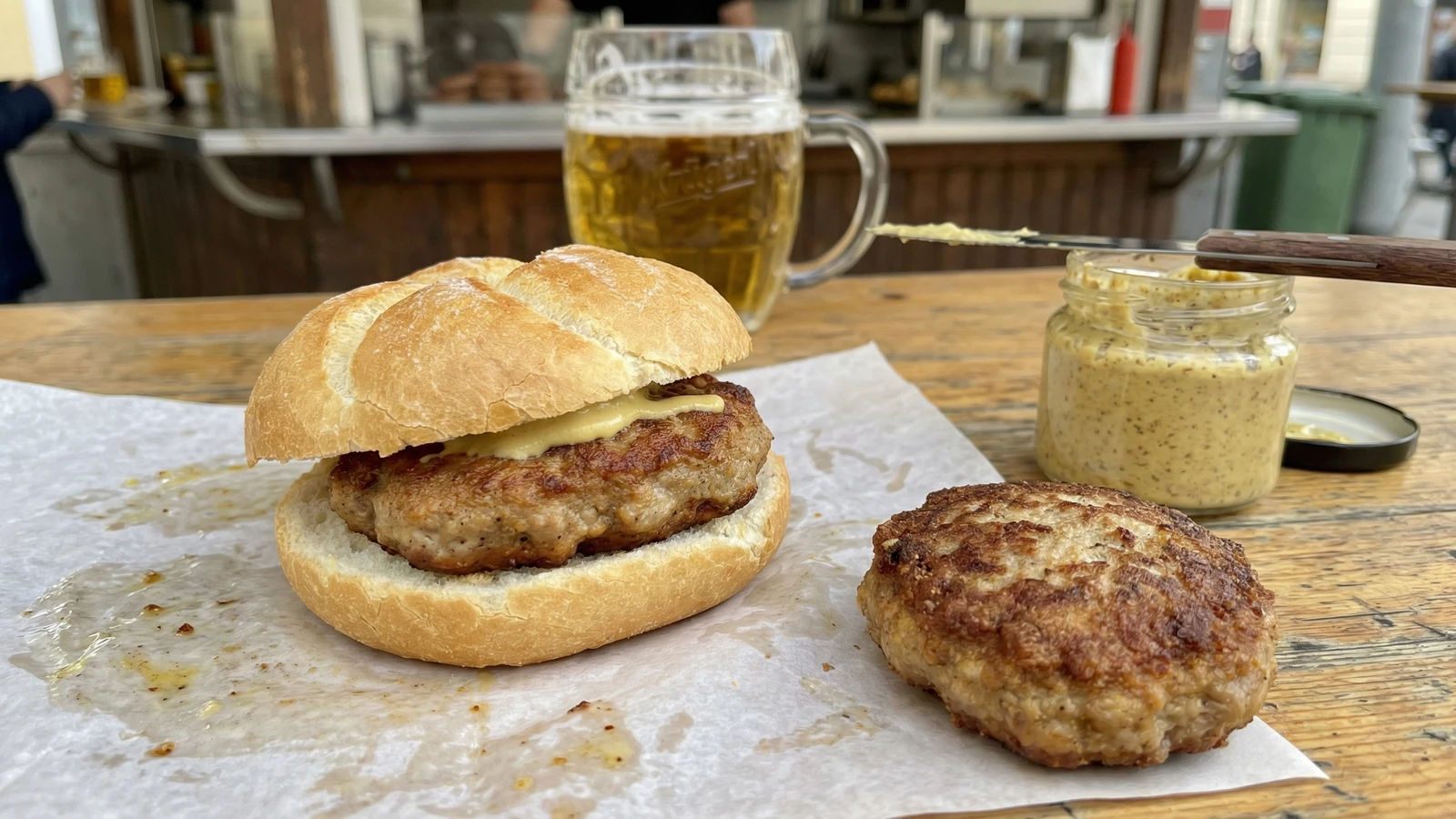
Fleischlaiberlsemmel
Created by Chef Elsa
Pork and beef patties with soaked bread, golden onions, and dried marjoram, pan-fried in butter until they crackle, then pressed into a Kaisersemmel with a stripe of sharp Austrian mustard.
The first time I ate a Fleischlaiberlsemmel that stopped me in my tracks, I was twelve years old, standing at a Würstelstand near the Salzburg train station with Gretel and my grandmother Eva. Gretel ordered for all three of us. The man behind the counter split a Kaisersemmel, laid a thick, golden-crusted Fleischlaiberl inside, and dragged a knife through sharp mustard across the top. That was the whole thing. No lettuce. No tomato. No ceremony. Just a meat patty in a bread roll, eaten standing up on a cold afternoon.
Fleischlaiberl are Austria's answer to the question every culture eventually asks: what do you do with leftover bread and good ground meat? You soak the stale bread in milk until it goes soft, squeeze it dry, and work it into a mixture of pork and beef with sweated onions, egg, and dried marjoram. The soaked bread does two things. It makes the patties lighter than a pure meat version, and it holds moisture inside so they don't dry out in the pan. This is not a hamburger. A hamburger wants to stay pink in the middle. A Fleischlaiberl cooks all the way through and stays juicy because the bread is doing its job.
Gretel always said good Austrian home cooking depends on understanding your ingredients, not on following complicated techniques. This is exactly that kind of cooking. You need good meat, good bread, real butter in the pan, and the patience to let the onions go soft and sweet before they go into the mixture. The marjoram is not optional. Without it, you have a meat patty. With it, you have a Fleischlaiberl. That herb is the signature of the dish, the thing that makes your kitchen smell like an Austrian one.
Fleischlaiberl belong to the broader Central European family of bread-enriched meat patties that stretches from Bohemia through Austria to Hungary, each country insisting its version is the original. The Austrian name varies by region: Fleischlaiberl in eastern Austria and Vienna, Fleischpflanzerl in parts of the west where Bavarian dialect creeps in, Faschierte Laibchen in older Viennese cookbooks. The technique of stretching ground meat with soaked bread (Semmeleinweiche) was originally an economy measure that became a texture preference. Austrian cooks discovered that the bread produced a lighter, more tender patty than pure meat, and what began as frugality became tradition.
The technique, the tradition, and the story behind every dish.
Discover Culinary AdvisorIngredients
stale Semmeln or white bread rolls
Quantity
2 (about 100g)
torn into pieces
whole milk
Quantity
150ml
warm
ground pork
Quantity
300g
ground beef
Quantity
200g
onion
Quantity
1 medium
finely diced
unsalted butter (for onions)
Quantity
2 tablespoons
egg
Quantity
1 large
garlic
Quantity
2 cloves
finely minced
dried marjoram
Quantity
1 heaped teaspoon
salt
Quantity
1 teaspoon
freshly ground black pepper
Quantity
1/2 teaspoon
sweet paprika
Quantity
1/2 teaspoon
fine breadcrumbs (optional)
Quantity
2 tablespoons
clarified butter or lard
Quantity
3 tablespoons
for frying
Kaisersemmeln
Quantity
4
fresh, for serving
sharp Austrian mustard (Estragonsenf)
Quantity
for serving
| Ingredient | Quantity |
|---|---|
| stale Semmeln or white bread rollstorn into pieces | 2 (about 100g) |
| whole milkwarm | 150ml |
| ground pork | 300g |
| ground beef | 200g |
| onionfinely diced | 1 medium |
| unsalted butter (for onions) | 2 tablespoons |
| egg | 1 large |
| garlicfinely minced | 2 cloves |
| dried marjoram | 1 heaped teaspoon |
| salt | 1 teaspoon |
| freshly ground black pepper | 1/2 teaspoon |
| sweet paprika | 1/2 teaspoon |
| fine breadcrumbs (optional) | 2 tablespoons |
| clarified butter or lardfor frying | 3 tablespoons |
| Kaisersemmelnfresh, for serving | 4 |
| sharp Austrian mustard (Estragonsenf) | for serving |
Equipment Needed
- •Heavy-bottomed skillet or cast iron pan (28cm)
- •Large mixing bowl
- •Small pan for sweating onions
Instructions
- 1
Soak the bread
Tear the stale Semmeln into rough pieces and place them in a bowl. Pour the warm milk over them and press the bread down so it's submerged. Let it soak for at least fifteen minutes. The bread should go completely soft, almost paste-like. This is the Semmeleinweiche, the soaked bread base that gives Fleischlaiberl their texture. If you skip this or rush it, your patties will be dense and heavy instead of light and tender.
Day-old Kaisersemmeln are ideal. If your bread is fresh, cut it into cubes and dry it in a low oven for ten minutes. You need stale bread because fresh bread won't absorb the milk properly and will turn gluey. - 2
Sweat the onions
Melt two tablespoons of butter in a small pan over medium-low heat. Add the diced onion and cook slowly, stirring now and then, until soft and translucent. This takes eight to ten minutes. Don't rush it. You want the onions sweet and yielding, not browned or crispy. Raw onion in the mixture will give you sharp, bitter pockets in the finished patty. Add the minced garlic in the last minute of cooking. Set the pan aside and let the onions cool completely before they go into the meat.
Cooling the onions matters. Warm onions will start to cook the egg and change the texture of the meat mixture before it ever reaches the pan. - 3
Squeeze the bread
Take the soaked bread from the milk and squeeze it firmly with both hands over the sink. You want to press out as much milk as possible. What you're left with should be a soft, almost doughy mass with no liquid dripping from it. If you leave too much milk in, the mixture will be too wet to shape and the patties will fall apart in the pan. Crumble the squeezed bread into a large mixing bowl.
- 4
Mix the Fleischlaiberl mass
Add the ground pork, ground beef, cooled onions, egg, dried marjoram, salt, pepper, and paprika to the bowl with the crumbled bread. Mix everything together with your hands. Work it just enough that the bread is evenly distributed through the meat. Don't knead it like dough. Overworking makes the patties tough and rubbery. The mixture should hold together when you press a handful into a ball. If it feels too loose, add a tablespoon or two of fine breadcrumbs to bind it. Let it rest for ten minutes. The flavors need a moment to come together.
The ratio of pork to beef matters. Pork brings fat and flavor, beef brings structure. All beef dries out. All pork can go soft and greasy. The 60/40 split gives you the best of both. - 5
Shape the patties
Wet your hands with cold water. Divide the mixture into eight equal portions and shape each one into a flat, oval patty about two centimeters thick. Fleischlaiberl are not round like hamburgers. They're oval, slightly flattened, with a gentle dome in the center that will flatten as they cook. The wet hands keep the mixture from sticking and help you get a smooth surface. A smooth surface browns better.
- 6
Pan-fry until golden
Heat the clarified butter or lard in a wide, heavy pan over medium heat. When the fat shimmers, lay the patties in without crowding. You should hear a firm, steady sizzle the moment they hit the pan. If you don't, your pan isn't hot enough. Cook for four to five minutes on the first side without moving them. Let the crust form. When you see the edges turning golden brown and the bottom releases easily, flip them once. Cook another four to five minutes on the second side. The center should be cooked through with no pink remaining. Cut one open to check if you're unsure.
Clarified butter is the first choice because it can handle the heat without burning. Regular butter will go dark and bitter before the patties finish cooking. Lard is the traditional alternative and gives an honest, savory flavor. - 7
Build the Semmel
Split each Kaisersemmel in half. The roll should be fresh enough to have a thin, crackly crust and a soft interior. Place a hot Fleischlaiberl on the bottom half. Spread a generous stripe of sharp mustard on the cut side of the top half. Press it down gently. The mustard goes on the lid, not on the meat. You want it to hit your palate first, then the patty. Serve immediately. This is Würstelstand food. It doesn't wait and it doesn't need a plate. Mahlzeit!
Chef Tips
- •Dried marjoram is traditional and correct here. Fresh marjoram has a gentler flavor that disappears into the meat. The dried herb holds its own against the pork and beef and gives the patties that unmistakable Austrian smell. Rub it between your palms before adding it to wake up the oils.
- •Austrian mustard (Estragonsenf) is tarragon-flavored and sharper than Dijon. If you can't find it, a good German or English mustard works. What you don't want is anything sweet. The mustard's job is to cut through the richness of the meat.
- •Fleischlaiberl are just as good eaten cold the next day, straight from the fridge, tucked into a Semmel for a packed lunch. In Austria, cold Fleischlaiberl are proper Jause food, the kind of thing you'd take on a hike in the Salzkammergut.
- •If the mixture feels right but the first patty falls apart in the pan, your pan wasn't hot enough. The sear needs to set the surface before the patty has time to crumble. Give the fat another minute to come up to temperature.
Advance Preparation
- •The raw Fleischlaiberl mixture can be made up to a day ahead and refrigerated, covered. In fact, it shapes more easily when cold.
- •Cooked patties keep in the fridge for three days. Reheat gently in a pan or eat them cold in a Semmel. Both are completely acceptable.
- •The onions can be sweated ahead and cooled. Store them in a small container in the fridge until you're ready to mix.
Frequently Asked Questions
Nutrition Information
1 serving (about 270g)
Where cooking meets culture.
Culinary mentorship, cultural storytelling, and the editorial depth that makes cooking meaningful.
Explore Culinary Advisor