Culinary Advisor
A cooking platform built around craft, culture, and the stories behind what we eat.
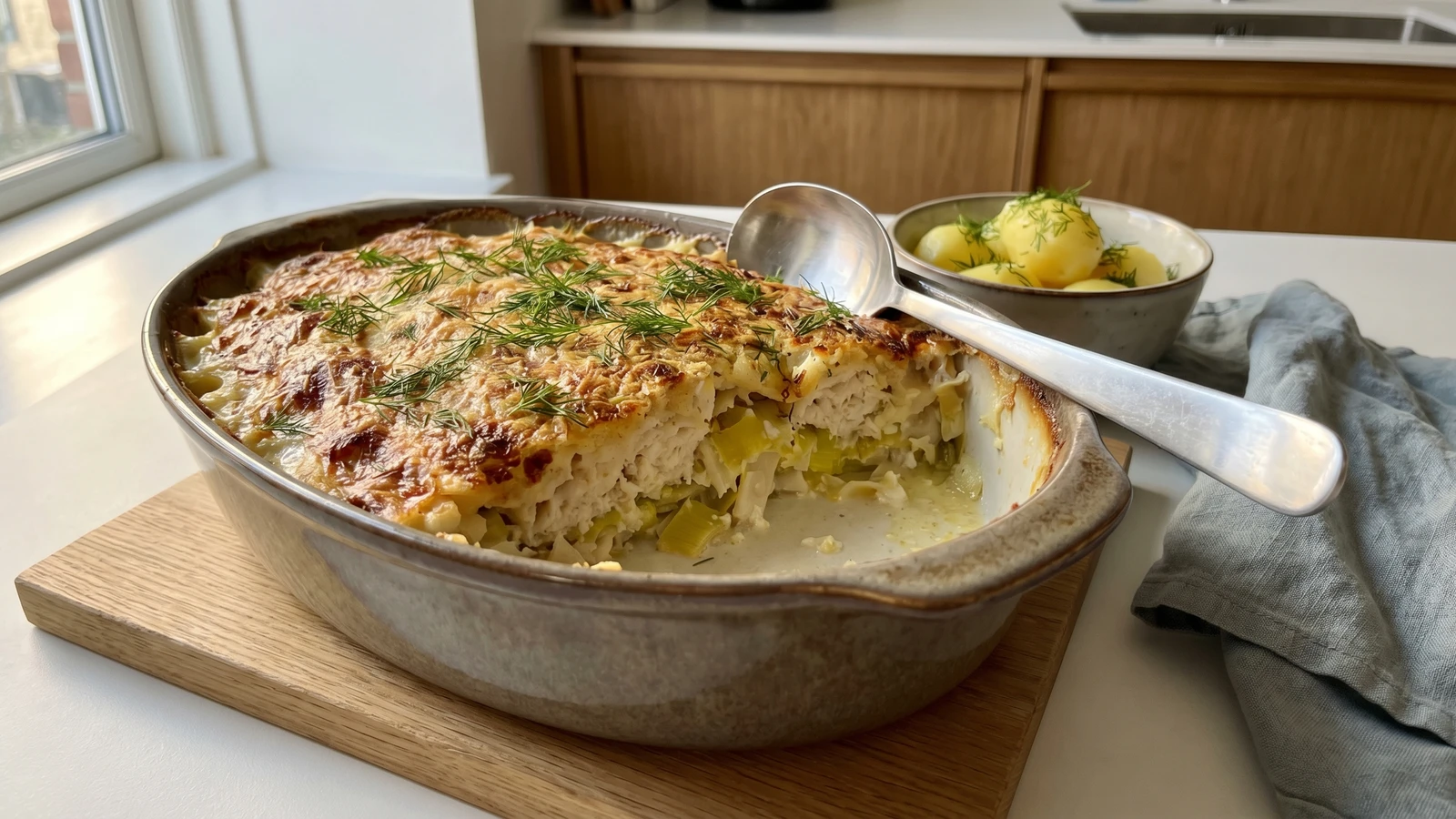
Fiskegratin med Fiskefars, Porrer og Selleri
Created by Chef Freja
Smooth fiskefars over softened leeks, celeriac, and carrots, blanketed in bechamel lifted with whisked egg whites, scattered with rasp and butter, baked until the surface cracks golden. Mormormad at its most generous.
November arrives and the root vegetables take over. Celeriac comes in heavy and pale from the fields, leeks stand thick in the market boxes, and the kitchen becomes the warmest room in the house again. This is when fiskegratin comes back to the table.
Fiskegratin med fiskefars is mormormad, grandmother's food, the kind of dish that doesn't announce itself but feeds everyone well and leaves them quiet with satisfaction. You make a smooth fiskefars from fresh white fish, spread it over a bed of softened porrer (leeks), knoldselleri (celeriac), and carrots, blanket the whole thing in a bechamel lightened with whisked egg whites, and scatter the top with rasp and dots of cold butter. Then you bake it until the surface cracks golden and the edges bubble. The house fills with fish and cream and something deeply familiar, even if you've never made it before.
Two things matter most, and I want you to understand both before you start. First: the fiskefars must be cold when you work it. Cold fish, cold cream, a cold bowl. Warmth breaks the emulsion and the texture turns grainy instead of smooth and light. Second: the egg whites folded into the bechamel are not an afterthought. They lift the sauce so it bakes into something almost souffle-like over the fish, tender and pale gold on top, creamy underneath. Get those two things right and the rest is layering and patience. You'll know when it's right.
Fiskefars, the Danish fish forcemeat, has been a cornerstone of home cooking since at least the late nineteenth century, when plentiful white fish from the North Sea and the Kattegat needed to stretch generously across large households. The technique of binding minced fish with egg whites, cream, and kartoffelmel (potato starch) appears in Danish cookbooks from the 1890s onward, and the gratin form, layered with seasonal vegetables and baked under a breadcrumb crust, became a weeknight standard by the mid-twentieth century. The refinement of folding whisked egg whites into the bechamel is a home cook's quiet borrowing from the professional kitchen, the kind of trick passed between generations at the counter, rarely written down until someone finally asks for the recipe.
The technique, the tradition, and the story behind every dish.
Discover Culinary AdvisorIngredients
firm white fish fillets (torsk or another white fish)
Quantity
500g
skinned, pin-boned
potato starch (kartoffelmel)
Quantity
2 tablespoons
egg whites (for the fiskefars)
Quantity
2 large
cold
cold heavy cream
Quantity
200ml
leeks (porrer)
Quantity
2 large
white and pale green parts, sliced into half-moons
celeriac (knoldselleri)
Quantity
300g
peeled, cut into 1cm dice
carrots
Quantity
2 medium
peeled, sliced into thin rounds
unsalted butter (for the vegetables)
Quantity
30g
unsalted butter (for the bechamel)
Quantity
40g
plain flour
Quantity
40g
whole milk
Quantity
500ml
egg whites (for the bechamel)
Quantity
2 large
fine sea salt
Quantity
to taste
white pepper
Quantity
to taste
whole nutmeg
Quantity
for grating
rasp (fine dried breadcrumbs)
Quantity
50g
cold unsalted butter (for the topping)
Quantity
30g
cut into small pieces
unsalted butter
Quantity
for greasing the dish
fresh dill
Quantity
generous handful
fronds picked, for serving
boiled potatoes
Quantity
to serve
| Ingredient | Quantity |
|---|---|
| firm white fish fillets (torsk or another white fish)skinned, pin-boned | 500g |
| potato starch (kartoffelmel) | 2 tablespoons |
| egg whites (for the fiskefars)cold | 2 large |
| cold heavy cream | 200ml |
| leeks (porrer)white and pale green parts, sliced into half-moons | 2 large |
| celeriac (knoldselleri)peeled, cut into 1cm dice | 300g |
| carrotspeeled, sliced into thin rounds | 2 medium |
| unsalted butter (for the vegetables) | 30g |
| unsalted butter (for the bechamel) | 40g |
| plain flour | 40g |
| whole milk | 500ml |
| egg whites (for the bechamel) | 2 large |
| fine sea salt | to taste |
| white pepper | to taste |
| whole nutmeg | for grating |
| rasp (fine dried breadcrumbs) | 50g |
| cold unsalted butter (for the topping)cut into small pieces | 30g |
| unsalted butter | for greasing the dish |
| fresh dillfronds picked, for serving | generous handful |
| boiled potatoes | to serve |
Equipment Needed
- •Food processor
- •Ovenproof gratin dish, approximately 25cm by 35cm
- •Wide pan with lid, for the leeks
- •Heavy saucepan, for the bechamel
- •Whisk
- •Flexible spatula
Instructions
- 1
Make the fiskefars
Cut the fish into rough pieces and spread them on a plate. Put the plate in the freezer for ten minutes. You want the fish very cold, not frozen. Cold fish emulsifies cleanly with cream. Warm fish resists, and the fiskefars turns grainy instead of smooth. Transfer the chilled fish to a food processor with the potato starch and one teaspoon of fine sea salt. Process until completely smooth, scraping the sides once or twice. With the motor running, add the two cold egg whites, then pour the cold cream in a thin, steady stream. Stop when the mixture is pale, glossy, and thick enough to hold its shape on a spoon. Season with white pepper and a small grating of nutmeg. Transfer to a bowl, cover, and refrigerate while you prepare everything else. The fiskefars needs to stay cold until the moment it goes into the dish.
If the fiskefars looks curdled or grainy, the fish or the cream was too warm. There is no saving a broken fiskefars. Start with everything cold, including the bowl of the food processor if your kitchen runs warm, and you won't have this problem. - 2
Soften the vegetables
Melt 30g of butter in a wide pan over a gentle heat. Add the sliced leeks and a good pinch of salt, stir them through the butter, and put the lid on. Let them soften for eight to ten minutes. You want them silky and translucent, never browned. Browning brings bitterness, and this dish wants the leeks' natural sweetness. While the leeks soften, bring a pot of salted water to a rolling boil. Add the diced celeriac and carrot slices together and blanch for four minutes, just until they yield to a knife but still hold their shape. Drain well and spread on a clean cloth for a minute. Soggy vegetables release water into the gratin and the sauce goes thin at the base.
Lift the lid on the leeks once and listen. If you hear aggressive sizzling, the heat is too high. The sound you want is the quiet hush of leeks softening in butter, nothing more. - 3
Layer the vegetables and fiskefars
Butter an ovenproof gratin dish generously. Spread the softened leeks across the bottom in an even layer. Scatter the blanched celeriac and carrots over the top. Take the fiskefars from the fridge and spread it in a smooth, even layer over the vegetables, about two centimetres thick. Use a wet spatula for this. Fiskefars clings to dry surfaces and fights you. A damp spatula glides. Smooth the top gently but don't press down hard. You want to preserve the layers underneath, because those layers are what make each serving interesting when you cut through.
- 4
Make the bechamel
Melt 40g of butter in a heavy saucepan over medium heat. Add the flour and stir constantly for two minutes with a wooden spoon or whisk. You're cooking out the raw flour taste, not browning the roux. It should smell faintly biscuity and stay pale. Pour in the milk in three additions, whisking vigorously after each one until smooth before adding the next. This prevents lumps. If you add all the milk at once, you'll be chasing lumps for ten minutes. Let the sauce simmer gently for five minutes, stirring often, until it coats the back of a spoon and holds a line when you draw your finger through it. Season with salt, white pepper, and a light grating of fresh nutmeg. Take the pan off the heat and let it cool for five minutes. The sauce must not be hot when the egg whites go in, or it will cook them on contact and the air disappears.
- 5
Fold in the egg whites
In a clean, dry bowl, whisk the two egg whites to soft peaks. They should hold a gentle curve when you lift the whisk, not stand stiff. Stiff whites are harder to fold and leave streaks. Spoon a third of the whites into the warm bechamel and stir them in briskly. This loosens the sauce. Now add the remaining whites and fold gently, turning the spatula from the bottom of the pan up and over, rotating the bowl as you go. You're keeping the air. That air is what makes the topping light and almost souffle-like once it bakes. A few small streaks of white are fine. Overfolding loses more air than a streak ever will. Pour the bechamel over the fiskefars and spread it gently to the edges of the dish.
The first third of whites is a sacrifice. Stir it in without ceremony to lighten the sauce, so the remaining two-thirds fold in easily and keep their air. - 6
Top with rasp and butter
Scatter the rasp evenly over the surface of the bechamel. Dot the cold butter pieces across the top, spacing them so each spoonful of the finished gratin gets some. The rasp absorbs butter as it bakes and forms a crisp, golden crust that crackles when you break through it. Without the butter, the breadcrumbs dry out and turn pale and papery. The butter is doing real work here.
- 7
Bake and rest
Heat the oven to 190°C. Place the dish on the middle shelf and bake for thirty-five to forty minutes. The top should be deep golden, cracked in places where the bechamel has puffed, and the edges should be bubbling gently. If the top colors too quickly, lay a sheet of foil loosely over it for the last ten minutes. Take the gratin out and let it rest for ten minutes on a wooden board or trivet. It firms as it sits, and the layers set, making it far easier to cut clean portions. Serve with boiled potatoes and a generous handful of fresh dill scattered over each plate. Tak for mad.
Chef Tips
- •Use the freshest white fish you can find. Torsk (cod) is the traditional choice and gives the smoothest fiskefars, but any firm white fish from a trusted fishmonger works. Avoid pre-frozen fillets if you can. They release water and the fiskefars goes slack.
- •Keep everything cold when making fiskefars. Cold fish, cold cream, cold egg whites, cold bowl. This is the single most important rule. The emulsion depends on temperature, and once it breaks there is no way to bring it back.
- •The gratin reheats beautifully the next day. Cover with foil and warm in a 160°C oven for twenty minutes. The topping stays crisp and the fiskefars stays moist. This makes it ideal for meal prep or feeding a crowd across two nights.
- •A glass of cold, dry white wine alongside is the honest pairing. Nothing complicated. Something from the Loire or a crisp Danish white if you can find one.
Advance Preparation
- •The fiskefars can be made up to one day ahead. Keep it covered and refrigerated. It actually firms and improves slightly overnight, making it easier to spread.
- •The whole gratin can be assembled up to the point of baking, covered, and refrigerated for up to twenty-four hours. Add ten minutes to the baking time if it goes into the oven cold.
- •The blanched vegetables can be prepared several hours ahead. Drain them well and keep covered at room temperature. Don't refrigerate or they'll release moisture when layered.
Frequently Asked Questions
Nutrition Information
1 serving (about 400g)
Where cooking meets culture.
Culinary mentorship, cultural storytelling, and the editorial depth that makes cooking meaningful.
Explore Culinary Advisor