Culinary Advisor
A cooking platform built around craft, culture, and the stories behind what we eat.
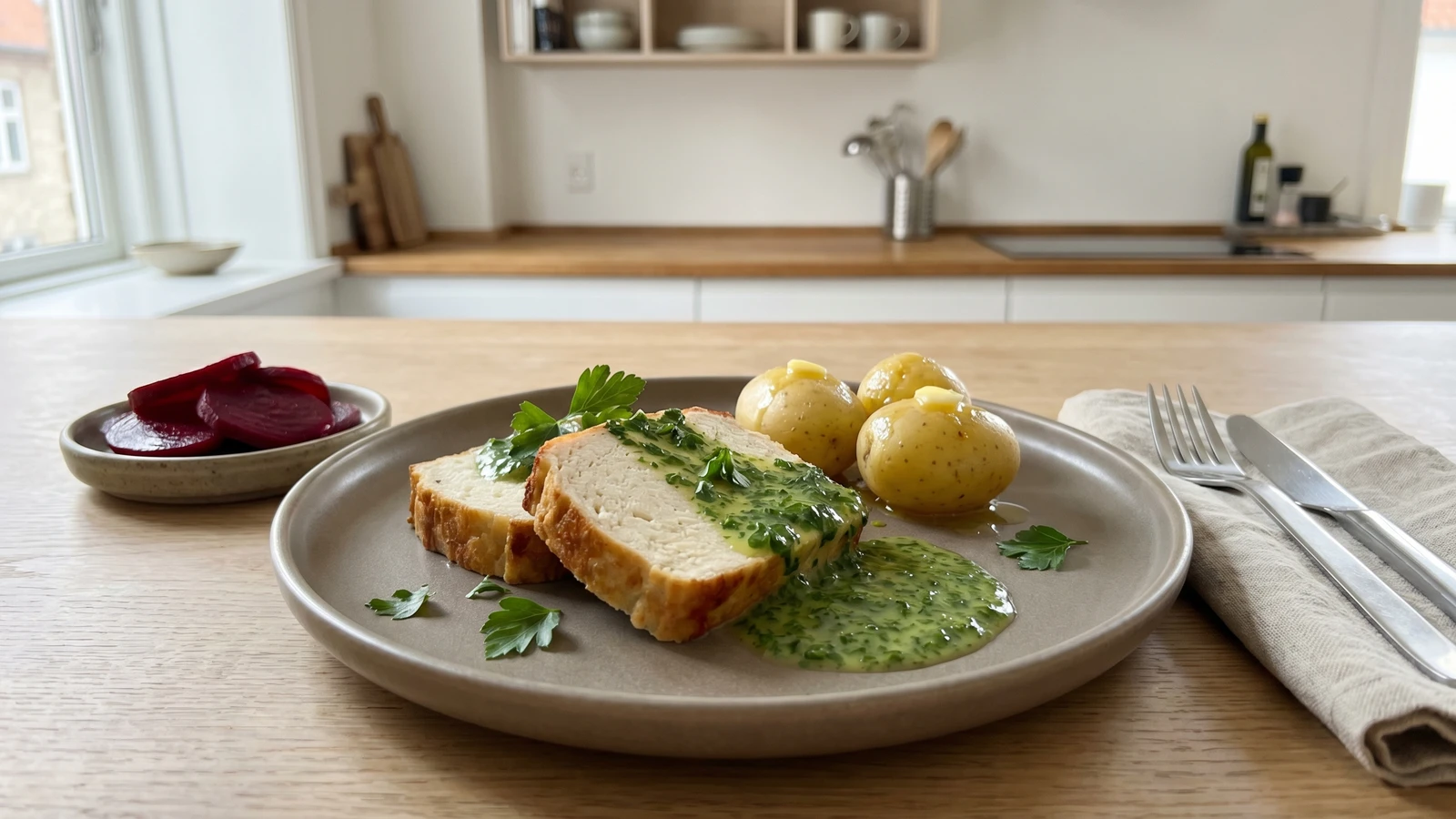
Fiskefarsbrod med Persillesovs
Created by Chef Freja
Danish fish loaf baked gently in a water bath until just set, sliced thick, and covered in persillesovs so green it looks like it belongs to a different season. Mormormad at its quiet, nourishing best.
November has a particular stillness in Denmark. The boats are in, the harbors are quiet, and the kitchens take over. This is when you reach for the kind of cooking your grandmother made without a recipe: simple, honest, built from fish and flour and the confidence that comes from having done something the same way a hundred times.
Fiskefarsbrod is fiskefars, a smooth fish forcemeat, packed into a buttered loaf pan and baked until it sets into something firm enough to slice but soft enough to yield under the side of a fork. The Danes call dishes like this mormormad, grandmother food, and this one carries the quiet genius of a generation that could feed a family beautifully on very little. Sliced thick and covered in persillesovs, a parsley sauce so green it looks like it belongs to a different season, it is one of the most comforting things the Danish kitchen has ever produced.
The technique is straightforward but it asks you to pay attention in one place: the moment you add the cold milk and cream to the processed fish. Pour slowly. Let the fiskefars absorb the liquid before you add more. Rush this and the loaf turns dense and wet. Take your time and it comes out pale, tender, and clean, the kind of thing that makes you understand why a whole country kept cooking it. I'll walk you through every step. You'll know when it's right.
Fiskefars, the finely processed fish forcemeat that forms the base of this dish, has roots in the Danish kitchen stretching back to the 18th century, when fish quenelles and dumplings appeared in bourgeois Copenhagen cookbooks. The loaf form became widely popular in the 1950s and 1960s as practical weeknight cooking for Danish families: inexpensive, nourishing, and forgiving enough to make ahead and slice cold for the next day's smorrebrod. It is one of the defining dishes of mormormad, the grandmother cooking tradition that young Danish cooks are now returning to with a respect that skips a generation.
The technique, the tradition, and the story behind every dish.
Discover Culinary AdvisorIngredients
cod fillet (torsk), or other firm white fish
Quantity
700g
boneless, skinless, cold
plain flour (for the fiskefars)
Quantity
3 tablespoons
fine sea salt
Quantity
1½ teaspoons
eggs
Quantity
3 large
cold whole milk (for the fiskefars)
Quantity
150ml
cold heavy cream
Quantity
100ml
onion
Quantity
1 small
finely grated
white pepper
Quantity
½ teaspoon
unsalted butter
Quantity
for the pan
softened
fine dry breadcrumbs
Quantity
for the pan
unsalted butter (for the persillesovs)
Quantity
40g
plain flour (for the persillesovs)
Quantity
3 tablespoons
whole milk (for the persillesovs)
Quantity
500ml
warmed
fresh parsley
Quantity
large bunch, about 40g
finely chopped
fine sea salt and white pepper
Quantity
to taste
nutmeg (optional)
Quantity
small grating
boiled potatoes
Quantity
to serve
pickled beets (syltede rødbeder)
Quantity
to serve
| Ingredient | Quantity |
|---|---|
| cod fillet (torsk), or other firm white fishboneless, skinless, cold | 700g |
| plain flour (for the fiskefars) | 3 tablespoons |
| fine sea salt | 1½ teaspoons |
| eggs | 3 large |
| cold whole milk (for the fiskefars) | 150ml |
| cold heavy cream | 100ml |
| onionfinely grated | 1 small |
| white pepper | ½ teaspoon |
| unsalted buttersoftened | for the pan |
| fine dry breadcrumbs | for the pan |
| unsalted butter (for the persillesovs) | 40g |
| plain flour (for the persillesovs) | 3 tablespoons |
| whole milk (for the persillesovs)warmed | 500ml |
| fresh parsleyfinely chopped | large bunch, about 40g |
| fine sea salt and white pepper | to taste |
| nutmeg (optional) | small grating |
| boiled potatoes | to serve |
| pickled beets (syltede rødbeder) | to serve |
Equipment Needed
- •Food processor
- •Loaf pan, approximately 25cm by 12cm
- •Deep roasting tin for the water bath
- •Medium saucepan
- •Whisk
- •Wire cooling rack
Instructions
- 1
Prepare the loaf pan
Butter the inside of a loaf pan generously, using soft butter and your fingers to reach every corner and angle. Sprinkle in fine dry breadcrumbs, then turn and tilt the pan until all the buttered surfaces are evenly coated. Tap out the excess. The breadcrumbs form a thin crust around the fiskefars as it bakes. This gives the outside a gentle texture and lets the loaf release cleanly when you turn it out. Set the pan aside. Heat the oven to 175C. Put a kettle on to boil. You'll need the water soon for the water bath.
- 2
Process the fiskefars
Cut the cold fish into rough chunks and run your fingers through each piece to check for any remaining bones. Place the fish in a food processor with the flour and salt. Process until completely smooth, about one minute, scraping down the sides once or twice. Add the eggs one at a time, processing briefly after each. Then, with the machine running, pour in the cold milk and cream in a slow, thin stream. This is the step that decides the texture of the entire loaf. The fiskefars needs time to absorb the liquid gradually. If you pour too fast, the mixture won't bind properly and the baked loaf will be dense and wet inside. When it's done, you should have a pale, smooth, soft mixture that holds its shape gently on a spoon.
Everything should be cold: the fish, the milk, the cream. Cold temperatures help the proteins in the fish bind with the liquid and hold air. A warm fiskefars loses its structure and the loaf turns heavy. - 3
Season and fill the pan
Fold the grated onion and white pepper into the fiskefars by hand using a spatula. Stir gently. You don't want to knock out the air the processor worked in. The onion should be felt as a background sweetness, not a presence. Spoon the mixture into the prepared loaf pan and smooth the top with a wet spatula. A wet spatula glides over the surface without dragging. Set the loaf pan inside a deep roasting tin and pour the boiling water from the kettle into the tin until it reaches halfway up the sides of the loaf pan. The water bath insulates the fiskefars from direct oven heat and cooks it evenly from all sides. Without it, the edges cook too fast while the center stays raw.
Pour the boiling water into the roasting tin after you've placed it on the oven rack, pulled partway out. Carrying a tin of boiling water across the kitchen is a risk you don't need to take. - 4
Bake the loaf
Slide the rack in carefully and bake for fifty to fifty-five minutes. The loaf is ready when the surface is pale gold and just set, and a skewer inserted into the center comes out clean with no wet mixture clinging to it. If the skewer comes out wet, give it five more minutes and check again. Don't overbake. A fiskefarsbrod that stays in too long turns dry and crumbly, and no amount of persillesovs will bring it back. When it's done, lift the loaf pan out of the water bath and set it on a wire rack to rest for ten minutes. The resting firms the loaf enough to slice cleanly.
- 5
Make the persillesovs
While the loaf bakes, make the parsley sauce. Melt the butter in a medium saucepan over gentle heat. Stir in the flour and cook for two minutes, stirring constantly. This is a roux, and the cooking removes the raw taste from the flour. It should smell biscuity, not toasted. If it starts to color, your heat is too high. Pour in the warm milk in three additions, whisking well after each one to keep the sauce smooth. Once all the milk is in, bring the sauce to a gentle simmer and let it cook for five minutes, stirring often, until it thickens enough to coat the back of a spoon. Season with salt, white pepper, and a small grating of nutmeg if you like. Stir in the chopped parsley just before serving. Don't cook the parsley in the sauce. The heat of the sauce wilts it enough. Adding it at the end keeps the color bright green and the flavor fresh, and that vivid green against the pale fish is half the beauty of this plate.
If the sauce goes lumpy, don't panic. Whisk it hard off the heat, or push it through a fine sieve into a clean pan. It recovers completely and nobody will know. - 6
Slice and serve
Run a knife around the edges of the rested loaf. Place a serving plate or board over the top and invert. The loaf should drop out neatly with its breadcrumb crust on the outside. Slice it thick, about two centimeters, with a sharp knife. Arrange the slices on warm plates, spoon the persillesovs generously over and around them, and serve with boiled potatoes and pickled beets alongside. The sweet vinegar of the syltede rødbeder against the mild fish and the green richness of the sauce is one of those combinations that explains itself the first time you taste it together. This is cooked with love. Tak for mad.
Chef Tips
- •Use the freshest cod you can find, or ask your fishmonger for offcuts and trimmings of white fish. They work beautifully for fiskefars and cost a fraction of the fillet price. This is thrifty cooking by design. It always has been.
- •The persillesovs should be thick enough to coat the back of a spoon and hold its place on the plate, but still pour from a ladle. If it's too thick, stir in a splash of warm milk. If it's too thin, simmer it gently for another minute or two, stirring constantly.
- •Don't skip the pickled beets. They look like a side dish but they're a counterpoint. The sweet acidity cuts through the richness of the sauce and the mildness of the fish. Without them, the plate is unfinished.
- •Cold fiskefarsbrod, sliced thin, makes excellent smorrebrod the next day. Lay a slice on buttered rugbrod with a spoonful of remoulade and a few pickled cucumber slices. That's a packed lunch worth carrying.
Advance Preparation
- •The fiskefars can be mixed, packed into the prepared pan, covered tightly with cling film, and refrigerated for up to six hours before baking. Bring it to room temperature for twenty minutes before it goes in the oven.
- •The baked loaf keeps in the fridge for two days, wrapped in foil. Slice cold for smorrebrod or reheat slices gently in a warm oven covered loosely with foil so they don't dry out.
- •Persillesovs is best made fresh. If you must reheat it, warm it gently over low heat with a splash of milk whisked in, and stir in a fresh handful of chopped parsley to revive the color.
Frequently Asked Questions
Nutrition Information
1 serving (about 290g)
Where cooking meets culture.
Culinary mentorship, cultural storytelling, and the editorial depth that makes cooking meaningful.
Explore Culinary Advisor