Culinary Advisor
A cooking platform built around craft, culture, and the stories behind what we eat.
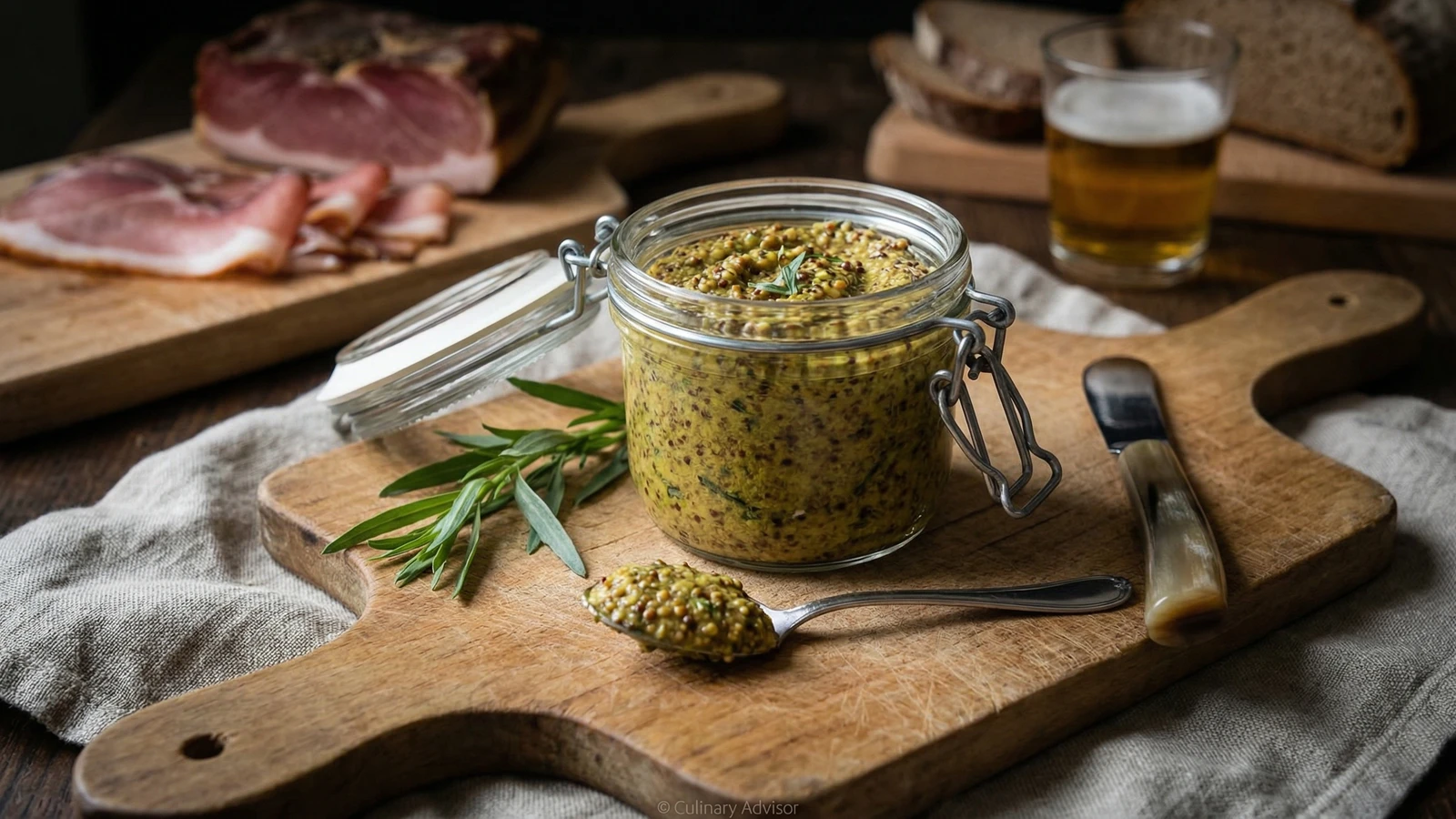
Estragonsenf
Created by Chef Elsa
Austria's sharp, herbal tarragon mustard, the golden-green condiment that belongs next to every sausage, every Brettljause board, and every cold cut platter you'll ever serve.
Every Würstelstand in Austria has a squeeze bottle of Estragonsenf sitting next to the Käsekrainer. It's as much a part of the landscape as the church spires. Sharp, herbal, with that unmistakable golden-green color from fresh tarragon worked through the grain. Most Austrians don't think twice about it. They squeeze it on a sausage and keep walking.
Gretel always said tarragon mustard was one of the things she missed most when she first arrived in England. Not the Torten. Not the Schnitzel. The mustard. English mustard was too hot and too blunt. French mustard was smoother but wrong. Austrian Estragonsenf sits in its own place: the anise warmth of tarragon softening the bite of the seeds, a touch of honey holding everything together, white wine vinegar keeping it sharp and clean. There is nothing else quite like it, and once you know the taste you'll notice its absence on every other mustard shelf in the world.
Making your own takes almost no effort, just patience. You soak the seeds overnight in vinegar and wine, blend them the next day, fold in fresh tarragon and a little honey, then let the jar sit in the fridge for a few days while everything gets acquainted. The result is sharper and more alive than anything from a tube. Spoon it onto a Brettljause board next to cold cuts, pickled vegetables, and dark bread. Put it beside a plate of Frankfurters. Stir it into a vinaigrette for warm potato salad. This is the mustard Austria runs on, and now your kitchen can too.
Tarragon has been cultivated in Austrian gardens since at least the 16th century, introduced through the trade routes and botanical exchanges of the Habsburg empire. Estragonsenf became Austria's signature mustard by the 19th century, distinguishing it sharply from hotter English mustards and the smoother Dijon tradition in France. When the Würstelstand emerged as Vienna's beloved street sausage institution, Estragonsenf came with it, turning a condiment of bourgeois kitchens into an everyday staple consumed standing up on street corners at midnight.
The technique, the tradition, and the story behind every dish.
Discover Culinary AdvisorIngredients
yellow mustard seeds
Quantity
80g
brown mustard seeds
Quantity
40g
white wine vinegar
Quantity
200ml
dry white wine (Grüner Veltliner ideal)
Quantity
80ml
honey
Quantity
2 tablespoons
fine sea salt
Quantity
1½ teaspoons
ground turmeric
Quantity
½ teaspoon
shallot
Quantity
1 small
finely minced
fresh tarragon leaves
Quantity
3 tablespoons
finely chopped
dried tarragon
Quantity
1 teaspoon
| Ingredient | Quantity |
|---|---|
| yellow mustard seeds | 80g |
| brown mustard seeds | 40g |
| white wine vinegar | 200ml |
| dry white wine (Grüner Veltliner ideal) | 80ml |
| honey | 2 tablespoons |
| fine sea salt | 1½ teaspoons |
| ground turmeric | ½ teaspoon |
| shallotfinely minced | 1 small |
| fresh tarragon leavesfinely chopped | 3 tablespoons |
| dried tarragon | 1 teaspoon |
Equipment Needed
- •Food processor or blender
- •Clean glass jar with tight-fitting lid (400-500ml)
- •Mixing bowl
- •Rubber spatula
Instructions
- 1
Soak the mustard seeds
Combine the yellow and brown mustard seeds in a clean glass jar or bowl. Pour the white wine vinegar and white wine over them. The liquid should cover the seeds completely. Stir once, cover tightly, and leave on the counter overnight, or up to 24 hours. The seeds will swell and absorb most of the liquid, softening their raw bite and developing a rounder, deeper flavor. This step is not optional. Unsoaked seeds will give you a mustard that's harsh and gritty instead of sharp and complex.
The ratio of yellow to brown seeds controls the heat. Yellow seeds are mild and give body. Brown seeds bring the bite. Two parts yellow to one part brown is the Austrian balance. If you want more fire, increase the brown. - 2
Blend to your texture
Transfer the soaked seeds and whatever liquid remains into a food processor or blender. Add the honey, salt, turmeric, dried tarragon, and minced shallot. Pulse in short bursts, scraping down the sides between rounds. You're aiming for a coarse, grainy texture with some whole seeds still visible. Austrian Estragonsenf is not smooth like Dijon. It has character and grain. If you've ever squeezed it from a tube at a Würstelstand, you know what it should look like: rough, a little uneven, full of texture. Stop blending before you think it's done. The mustard will soften further as it matures.
If the mixture is too thick to blend, add a tablespoon of white wine vinegar at a time until it moves. Don't add water. Water dilutes the flavor. Vinegar keeps it sharp. - 3
Fold in the fresh tarragon
Scrape the mustard into a bowl. Fold in the finely chopped fresh tarragon with a spoon. Don't blend it in. You want visible flecks of green throughout the mustard, not a uniform paste. The fresh tarragon is what separates homemade Estragonsenf from anything commercial. It gives you that bright, almost anise-like aroma that hits before the mustard heat does. The dried tarragon you added during blending builds a base of herbal depth. The fresh tarragon on top is the high note.
Use only French tarragon, not Russian tarragon. Russian tarragon looks similar but has almost no flavor. If the leaves don't smell strongly of anise when you crush one between your fingers, it's the wrong plant. - 4
Taste and adjust
Taste the mustard now. It will be sharper and more aggressive than the finished product, which is exactly right. The heat will mellow over the next few days in the fridge. What you're checking for is the balance of salt, sweetness, and acid. If it tastes flat, add a pinch more salt. If the vinegar is too forward, add another half teaspoon of honey. If it needs more herbal punch, chop a few more tarragon leaves in. Trust your palate. You know what mustard should taste like.
- 5
Jar and let it mature
Spoon the mustard into a clean glass jar, pressing out any air pockets. Seal tightly and refrigerate. Here is where patience matters. Fresh mustard is harsh and one-dimensional. After two to three days in the fridge, the heat rounds out, the tarragon infuses through the whole jar, the shallot softens into the background, and everything comes together into something unified and proper. Taste it on day three. That's your Estragonsenf. Mahlzeit!
Chef Tips
- •Fresh tarragon is seasonal, and that matters. In summer and early autumn, when tarragon is at its best, make several jars. The mustard keeps for months in the fridge, so you can carry that summer tarragon flavor well into winter. If you can only find tired, wilted tarragon at the shop, wait. Make something else today.
- •Grüner Veltliner is the ideal wine for this because it's Austrian, dry, and has a peppery quality that complements the mustard seeds. But any dry, unoaked white wine works. Don't use anything you wouldn't drink. The wine is a flavor ingredient, not filler.
- •This mustard improves for about two weeks in the fridge, then holds steady for three months or more. The sharpest heat fades in the first week. By day ten you'll have something balanced and deeply flavored. Label the jar with the date so you know where it is in the process.
- •Serve it the way Austrians do: alongside Frankfurter Würstel, on a Brettljause board with Speck, Landjäger, and pickled gherkins, or stirred into warm potato salad dressing. It belongs next to cold meats the way Preiselbeeren belong next to Schnitzel.
Advance Preparation
- •The mustard must be made at least two to three days before serving. This is not a same-day condiment. The flavors need time to integrate and the raw heat needs time to mellow.
- •Keeps refrigerated for three months or longer. The tarragon flavor will gradually deepen over the first two weeks, then hold steady.
- •If you want to give jars as gifts, make a double batch. Estragonsenf in a labeled jar is one of the best things you can bring to someone who loves good food.
Frequently Asked Questions
Nutrition Information
1 serving (about 15g)
Where cooking meets culture.
Culinary mentorship, cultural storytelling, and the editorial depth that makes cooking meaningful.
Explore Culinary Advisor