Culinary Advisor
A cooking platform built around craft, culture, and the stories behind what we eat.
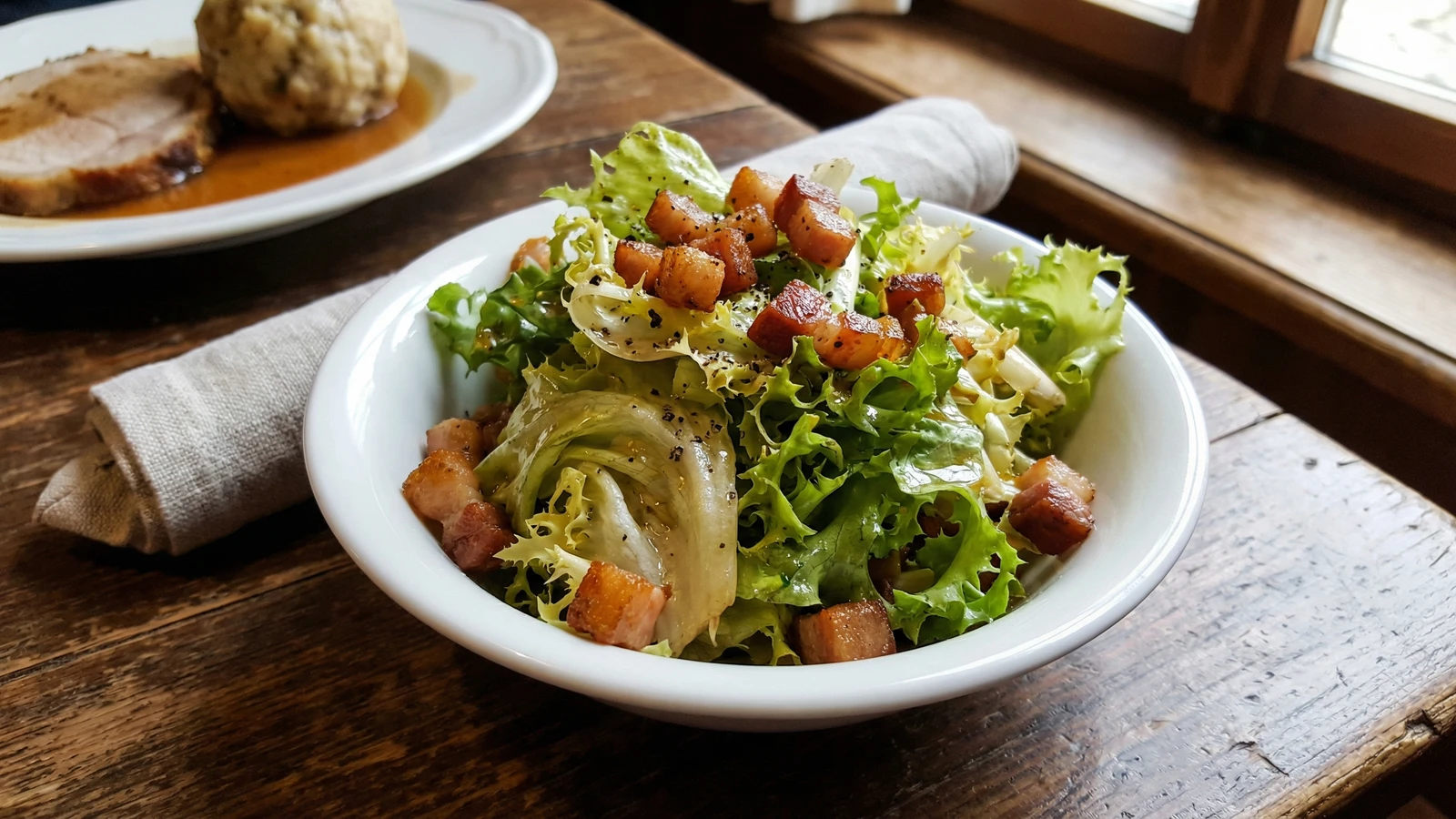
Endiviensalat mit Speck
Created by Chef Elsa
Bitter curly endive wilted just so by a warm dressing of rendered Speck, sharp vinegar, and a touch of mustard, the kind of salad that makes a roast pork dinner feel complete.
There's a salad you find at every Gasthaus in the Salzkammergut, and it's this one. A big bowl of curly endive, slightly bitter and springy, hit with a warm dressing made from rendered Speck and good vinegar. The heat of the dressing softens the leaves just enough that they go from stiff and defiant to tender and willing, but you have to move fast. The dressing has to be hot when it hits the greens. That's the whole trick.
I remember watching Gretel make this on one of our trips to Austria when I was maybe ten or eleven. We'd come back from the Grünmarkt and she had a head of Endivie under her arm and a piece of Speck wrapped in paper. She cut the Speck into small pieces, rendered them slowly in a pan until they were golden and crisp, then splashed vinegar into the hot fat. The kitchen filled with that sharp, porky smell that tells you something good is about to happen. She poured it straight over the torn endive, tossed it twice, and put it on the table. Five minutes, start to finish.
This is the kind of salad Austrians serve alongside Schweinsbraten, Knödel, rich stews, anything that wants a sharp, bitter counterpoint on the plate. It's not a main course salad. It's the thing that cuts through the richness and makes you want another bite of everything else. Good Austrian home cooking doesn't need twenty ingredients. It needs the right four or five, treated with respect.
Warm dressed salads have deep roots in Austrian farmhouse cooking, where rendered pork fat was the everyday kitchen fat and vinegar the primary preserving acid. Endive arrived in Austrian gardens through Italian and Bohemian influence during the Habsburg centuries, and the pairing of bitter greens with warm Speck dressing became a staple across the Alpine provinces. In Salzburg and Upper Austria, Endiviensalat mit Speck remains one of the most common Beilagensalat (side salads) served at traditional Gasthäuser, often appearing as part of a Gemischter Salat alongside Erdäpfelsalat and Gurkensalat.
The technique, the tradition, and the story behind every dish.
Discover Culinary AdvisorIngredients
curly endive (Endivie)
Quantity
1 large head, about 400g
washed, dried, and torn into bite-sized pieces
Speck or smoked slab bacon
Quantity
150g
cut into small Würfel (5mm cubes)
shallot
Quantity
1 small
finely diced
Apfelessig (apple cider vinegar) or Hesperidenessig
Quantity
3 tablespoons
smooth Dijon-style mustard
Quantity
1 teaspoon
granulated sugar
Quantity
1 teaspoon
warm water or light beef broth
Quantity
3 tablespoons
black pepper
Quantity
to taste
freshly ground
salt
Quantity
to taste
neutral oil (sunflower or rapeseed) (optional)
Quantity
1 tablespoon
| Ingredient | Quantity |
|---|---|
| curly endive (Endivie)washed, dried, and torn into bite-sized pieces | 1 large head, about 400g |
| Speck or smoked slab baconcut into small Würfel (5mm cubes) | 150g |
| shallotfinely diced | 1 small |
| Apfelessig (apple cider vinegar) or Hesperidenessig | 3 tablespoons |
| smooth Dijon-style mustard | 1 teaspoon |
| granulated sugar | 1 teaspoon |
| warm water or light beef broth | 3 tablespoons |
| black pepperfreshly ground | to taste |
| salt | to taste |
| neutral oil (sunflower or rapeseed) (optional) | 1 tablespoon |
Equipment Needed
- •Heavy-bottomed pan or skillet (24cm)
- •Salad spinner
- •Large serving bowl
Instructions
- 1
Prepare the endive
Separate the endive leaves, discarding any that are bruised or very tough at the outer edges. Wash them in cold water and dry them thoroughly. A salad spinner earns its place in your kitchen here. If the leaves are wet, the warm dressing slides right off and pools at the bottom of the bowl instead of clinging to the greens. Tear larger leaves into pieces you can eat in one or two bites. Pile them into a large serving bowl.
Use the pale inner leaves too. They're more tender and less bitter. The contrast between the sturdy outer leaves and the delicate hearts is part of what makes this salad interesting. - 2
Render the Speck
Place the Speck cubes in a cold, dry pan. Set it over medium-low heat. Starting in a cold pan matters. It lets the fat render slowly and evenly instead of seizing up and burning on the outside while staying soft inside. Stir occasionally. After six or seven minutes, the Speck should be golden, crisp at the edges, and swimming in its own rendered fat. The kitchen will smell wonderful. If your Speck is very lean and renders barely any fat, add a tablespoon of neutral oil to the pan.
Austrian Speck is cold-smoked and drier than American bacon. If you can find Tiroler Speck or a good Bauernspeck from a deli, use it. Regular smoked slab bacon works too, but avoid pre-sliced streaky bacon. You want cubes with substance. - 3
Build the warm dressing
Add the diced shallot to the pan with the crisp Speck. Cook for one minute, stirring, until the shallot softens and turns translucent. Don't let it brown. Pull the pan off the heat. Add the vinegar, mustard, sugar, and warm water or broth. Swirl the pan to combine everything. The vinegar will hiss and spit when it hits the hot fat. That's what you want. Put the pan back on low heat for thirty seconds, just long enough for the sugar to dissolve and the dressing to come together into something unified. Taste it. It should be sharp, porky, and barely sweet. Season with salt and pepper. Go easy on the salt because the Speck has brought its own.
Gretel always said the Marinade should make you pucker a little when you taste it from the spoon. Austrian salad dressings are vinegar-forward, not oily. If it doesn't have bite, add another splash of vinegar. - 4
Dress and serve immediately
Pour the hot dressing, Speck and all, directly over the endive. Toss it quickly with two large spoons or your hands if you can stand the heat. The leaves will wilt slightly where the dressing touches them, losing their rigid curl and turning silky at the edges while the centers stay crisp. This contrast is exactly what you're after. Grind black pepper over the top. Serve the salad right now, while the dressing is still warm and the leaves are caught between crisp and tender. Two minutes from now it's a different dish. A good one still, but not this one.
Chef Tips
- •The dressing must be hot when it hits the leaves. Don't make it and let it sit while you answer the phone. Have the endive washed, dried, and ready in the bowl before you start cooking the Speck. This salad moves fast at the end.
- •If you can't find curly endive, Frisée works beautifully. It's the same family, slightly more delicate, and wilts even more gracefully under the warm dressing. Regular escarole is your next best option. Iceberg lettuce is not an option.
- •Use Apfelessig (apple cider vinegar) or, if you can find it, Hesperidenessig, which is a Viennese citrus vinegar with a gorgeous fragrance. White wine vinegar is fine. Balsamic is not. This is not an Italian salad.
- •Serve this alongside Schweinsbraten and Semmelknödel, or next to a plate of Bauernschmaus. It's a Beilagensalat, a side salad, meant to cut through rich pork and dumplings. That bitterness has a job to do on the plate.
Advance Preparation
- •The endive can be washed, dried, and torn up to four hours ahead. Store it wrapped in a clean tea towel in the fridge. Cold, dry leaves take the warm dressing better than room-temperature ones.
- •The Speck can be cubed ahead and kept covered in the fridge. But the dressing itself cannot be made in advance. It takes five minutes and it needs to go straight from the hot pan onto the greens.
Frequently Asked Questions
Nutrition Information
1 serving (about 150g)
Where cooking meets culture.
Culinary mentorship, cultural storytelling, and the editorial depth that makes cooking meaningful.
Explore Culinary Advisor