Culinary Advisor
A cooking platform built around craft, culture, and the stories behind what we eat.
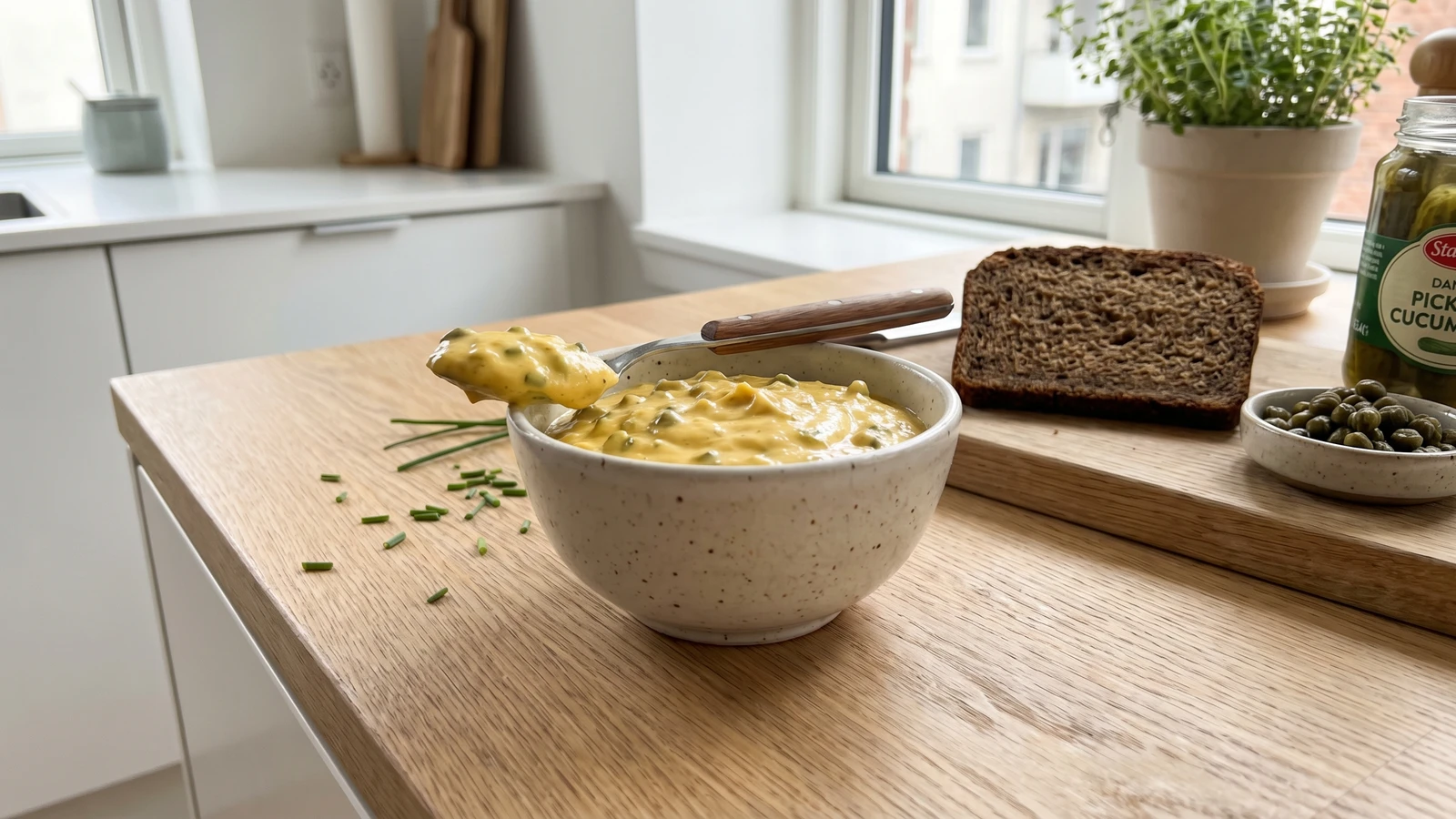
Dansk Remoulade
Created by Chef Freja
The classic Danish remoulade, made from scratch with chopped pickles, capers, a whisper of curry, and the particular warm yellow that means someone in the kitchen knows what they're doing.
There is no Danish kitchen without remoulade. It sits in the fridge door in a jar, always half-used, always ready. You reach for it the way you reach for salt: without thinking, because the meal isn't complete without it.
Remoulade is a mayonnaise, but calling it that misses the point. The French made a sauce and gave it a name. The Danes took the name, added pickles and capers and a breath of curry powder, turned it golden, and made it theirs. It goes on smorrebrod. It goes beside fiskefrikadeller, those pan-fried fish cakes that every Danish child eats on weeknights. It goes on the hot dog from the polsevogn, the red sausage cart on the corner that smells of mustard and fried onions. It goes beside stegt flaesk with parsley sauce. It belongs everywhere, and it makes everything it touches a little more Danish.
I want you to make it from scratch, because the homemade version is better than anything you'll buy, and the technique is simpler than you think. The only step that requires your full attention is building the mayonnaise: adding the oil slowly, a few drops at a time at first, so the emulsion holds. After that, it's just chopping and folding. Give it an hour in the fridge before you serve it. The resting changes everything. You'll taste it and you'll understand.
Remoulade arrived in Denmark from French culinary tradition in the mid-1800s, likely through the Copenhagen restaurants that modeled themselves on Parisian dining. The original French sauce, a mustardy mayonnaise with herbs and anchovy, was gradually adapted to Danish tastes: pickled cucumbers replaced the cornichons, capers stayed, and at some point in the early twentieth century, curry powder entered the recipe, a legacy of Denmark's connections to the East India spice trade. By the 1920s, the bright yellow Danish version had diverged so far from its French ancestor that it became its own thing entirely, inseparable from the polsevogn hot dog cart and the smorrebrod lunch table.
The technique, the tradition, and the story behind every dish.
Discover Culinary AdvisorIngredients
egg yolks
Quantity
2 large
at room temperature
Danish or Dijon mustard
Quantity
1 tablespoon
neutral oil (rapeseed or sunflower)
Quantity
250ml
white wine vinegar
Quantity
1 tablespoon
caster sugar
Quantity
1 teaspoon
fine sea salt
Quantity
1/2 teaspoon
mild curry powder
Quantity
1/2 teaspoon
ground turmeric
Quantity
1/4 teaspoon
Danish pickled cucumbers (syltede agurker)
Quantity
80g
finely chopped
capers
Quantity
2 tablespoons
drained and finely chopped
shallot
Quantity
1 small
very finely minced
pickle brine
Quantity
1 tablespoon
fresh chives
Quantity
1 tablespoon
finely snipped
| Ingredient | Quantity |
|---|---|
| egg yolksat room temperature | 2 large |
| Danish or Dijon mustard | 1 tablespoon |
| neutral oil (rapeseed or sunflower) | 250ml |
| white wine vinegar | 1 tablespoon |
| caster sugar | 1 teaspoon |
| fine sea salt | 1/2 teaspoon |
| mild curry powder | 1/2 teaspoon |
| ground turmeric | 1/4 teaspoon |
| Danish pickled cucumbers (syltede agurker)finely chopped | 80g |
| capersdrained and finely chopped | 2 tablespoons |
| shallotvery finely minced | 1 small |
| pickle brine | 1 tablespoon |
| fresh chivesfinely snipped | 1 tablespoon |
Equipment Needed
- •Medium mixing bowl
- •Balloon whisk or hand whisk
- •Sharp knife and chopping board
- •Jug or bottle with a pouring spout for the oil
- •Clean jar or airtight container for storage
Instructions
- 1
Prepare the base
Set everything out before you start. The egg yolks, the mustard, the vinegar, the oil in a jug you can pour from. Mayonnaise is an emulsion, which means two things that don't want to mix are being convinced to hold together. The secret is patience and temperature. Cold eggs resist. Room temperature eggs cooperate. That's why you take them out of the fridge an hour before.
If your eggs are still cold, place them in a bowl of warm water for five minutes. That's enough to take the chill off and let the emulsion form properly. - 2
Build the mayonnaise
Put the egg yolks and mustard in a medium bowl. Whisk them together until smooth and slightly thickened. Now begin adding the oil, a few drops at a time, whisking constantly. This is the moment that matters. If you pour too fast, the emulsion breaks and you're left with a greasy, separated mess. After the first two tablespoons of oil have been incorporated and the mixture looks thick and glossy, you can start pouring in a thin, steady stream. Keep whisking. Don't stop. The mayonnaise will build itself around you, getting thicker and paler with every pass of the whisk.
Place a damp cloth under the bowl to keep it steady. You need one hand for the whisk and one for the oil. The bowl has to stay still on its own. - 3
Season the mayonnaise
Once all the oil is in and you have a thick, glossy mayonnaise, whisk in the white wine vinegar, the sugar, and the salt. The vinegar loosens the texture slightly and sharpens the flavor. The sugar isn't there to make it sweet. It's there to round the edges. Now add the curry powder and turmeric and whisk until the color turns that particular warm yellow that every Dane recognizes. Taste it. Adjust the salt if it needs it. The base should be creamy, gently tangy, and just barely spiced.
- 4
Chop the vegetables finely
Drain the pickled cucumbers well and chop them finely. Not minced to a paste, but small enough that they distribute evenly through the sauce. Think the size of a caper. Chop the capers to the same size. Mince the shallot as finely as you can manage. These three ingredients give the remoulade its character: sweet-sour from the pickles, salt-brine from the capers, and a gentle sharpness from the shallot.
Use a clean, sharp knife and a dry board. Wet pickles on a wet board slide under the blade and you'll end up with uneven pieces. Pat everything dry first. - 5
Fold and finish
Fold the chopped pickles, capers, shallot, pickle brine, and snipped chives into the mayonnaise with a spatula. Don't whisk. Folding keeps the texture intact so you get those little bursts of pickle and caper when you eat it. The tablespoon of pickle brine thins the remoulade just enough and adds another layer of the sweet-sour tang that makes it Danish. Taste it once more. You'll know when it's right: creamy, tangy, a little sweet, gently spiced, with enough texture that you can feel the chopped vegetables against your tongue.
- 6
Rest before serving
Transfer the remoulade to a clean jar or bowl, press a piece of cling film directly onto the surface to keep the air out, and refrigerate for at least one hour before serving. The resting time matters. The flavors need to meet each other, settle in, and stop competing. What comes out of the fridge after an hour is a different sauce from what went in. Calmer. More itself.
Chef Tips
- •Use Danish pickled cucumbers, syltede agurker, if you can find them. They're sweeter and milder than French cornichons. If you can't find Danish pickles, bread-and-butter pickles are the closest substitute. Dill pickles are too vinegary and will shift the balance.
- •The curry powder should be mild and barely there. You're not making a curry sauce. You're adding warmth and color, just enough that someone who knows what they're tasting will notice, and someone who doesn't will simply think it tastes right.
- •If the emulsion breaks, don't panic. Start a fresh egg yolk in a clean bowl and add the broken mixture to it, drop by drop, whisking the whole time. It will come back together. This is a rescue, not a failure.
- •Remoulade made with homemade mayonnaise keeps for four to five days in the fridge. If you prefer to start with good store-bought mayonnaise, skip steps one through three and begin at the chopping. It won't be quite the same, but it will still be good.
Advance Preparation
- •Remoulade improves overnight. Make it the day before you need it and the flavors will be more settled and unified when you serve.
- •Store in a clean jar with cling film pressed against the surface. It keeps for four to five days in the fridge. If the top darkens slightly, stir it through. The flavor underneath is still good.
Frequently Asked Questions
Nutrition Information
1 serving (about 50g)
Where cooking meets culture.
Culinary mentorship, cultural storytelling, and the editorial depth that makes cooking meaningful.
Explore Culinary Advisor