Culinary Advisor
A cooking platform built around craft, culture, and the stories behind what we eat.
Dampfnudeln
Created by Chef Elsa
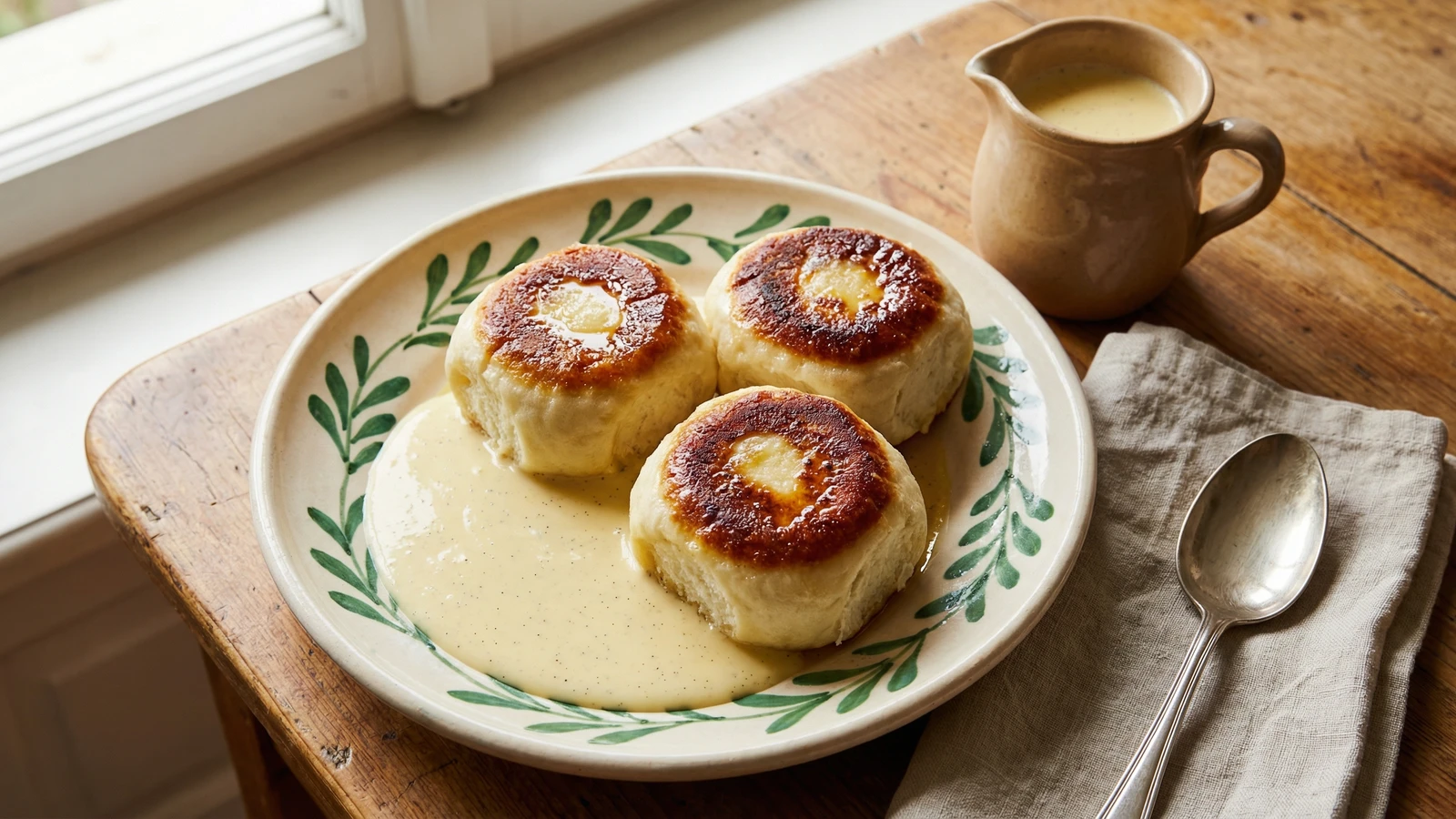
Soft yeast dumplings steamed under a sealed lid until the bottoms turn into a golden caramelized crust the Austrians call Krustl, served with homemade vanilla sauce and the kind of silence that means everyone at the table is happy.
The first time I watched Gretel make Dampfnudeln, I was maybe nine years old, and I remember the hardest part was not lifting the lid. She put the dough balls into the pot, clamped the lid down, looked at me, and said: twenty minutes. Don't touch it. I sat on the kitchen stool and watched the clock on my grandmother Eva's wall like my life depended on it. When Gretel finally lifted that lid, the Nudeln had puffed into fat, pale domes that pressed against each other like bread rolls at a bakery. She flipped one over with a fork and the bottom was this deep, shining gold. That's the Krustl, she told me. That's what you waited for.
Dampfnudeln are a Mehlspeise from Upper Austria and the Bavarian borderlands, though every Austrian grandmother will tell you her region invented them. The technique is the thing that makes them special. You cook yeast dumplings in a sealed pot with butter, milk, and a little sugar. The milk steams the tops soft and pillowy. The butter and sugar caramelize the bottoms into a crust so good you'll fight over who gets the darkest one. It's two textures in one bite, cloud above and caramel below, and it's achieved by doing almost nothing except keeping your hands off the lid.
I serve them at my restaurant in Salzburg with a proper Vanillesauce, made with real vanilla and egg yolks, poured alongside so you can tear the dumpling open and drag each piece through the sauce. Some cooks serve them with stewed fruit or poppy seed sauce, and those are good too. But vanilla sauce is where I always come back. It's what Gretel made, it's what my grandmother Eva expected, and it lets the Dampfnudel itself be the star.
Dampfnudeln have roots in both Upper Austrian and Bavarian peasant cooking, where yeast dough was an everyday staple and fuel for hard physical work. The dish appears in Austrian cookbooks from the early 19th century, though the technique of steaming dumplings in a sealed pot over caramelizing butter is certainly older. In the Innviertel, the region along the Austrian-Bavarian border, Dampfnudeln are still considered a main course rather than a dessert, often served with savory accompaniments. The sweet version with Vanillesauce became the standard in Upper Austria and spread to Viennese Gasthäuser, where it settled into its current role as one of the great Mehlspeisen.
The technique, the tradition, and the story behind every dish.
Discover Culinary AdvisorIngredients
plain flour
Quantity
500g
dried yeast (or 20g fresh)
Quantity
7g
granulated sugar (for dough)
Quantity
80g
Vanillezucker (vanilla sugar)
Quantity
2 sachets
whole milk (for dough)
Quantity
200ml
lukewarm
unsalted butter (for dough)
Quantity
80g
softened
egg yolks (for dough)
Quantity
2 large
salt (for dough)
Quantity
pinch
unsalted butter (for pot)
Quantity
50g
whole milk (for pot)
Quantity
150ml
granulated sugar (for pot)
Quantity
2 tablespoons
salt (for pot)
Quantity
pinch
whole milk (for vanilla sauce)
Quantity
500ml
egg yolks (for vanilla sauce)
Quantity
3 large
granulated sugar (for vanilla sauce)
Quantity
40g
cornflour
Quantity
1 tablespoon
vanilla pod or 2 sachets Vanillezucker
Quantity
1 pod
| Ingredient | Quantity |
|---|---|
| plain flour | 500g |
| dried yeast (or 20g fresh) | 7g |
| granulated sugar (for dough) | 80g |
| Vanillezucker (vanilla sugar) | 2 sachets |
| whole milk (for dough)lukewarm | 200ml |
| unsalted butter (for dough)softened | 80g |
| egg yolks (for dough) | 2 large |
| salt (for dough) | pinch |
| unsalted butter (for pot) | 50g |
| whole milk (for pot) | 150ml |
| granulated sugar (for pot) | 2 tablespoons |
| salt (for pot) | pinch |
| whole milk (for vanilla sauce) | 500ml |
| egg yolks (for vanilla sauce) | 3 large |
| granulated sugar (for vanilla sauce) | 40g |
| cornflour | 1 tablespoon |
| vanilla pod or 2 sachets Vanillezucker | 1 pod |
Equipment Needed
- •Wide heavy-bottomed pot with tight-fitting lid (26-28cm)
- •Medium saucepan for vanilla sauce
- •Stand mixer with dough hook or strong arms for kneading
- •Kitchen scale
Instructions
- 1
Activate the yeast
Warm the 200ml milk until it's lukewarm, body temperature, no hotter. If you can hold your finger in it comfortably, it's right. Stir in a teaspoon of the sugar and crumble or sprinkle the yeast over the surface. Let it sit for ten minutes. You'll see it foam and bubble and start to smell yeasty and alive. If nothing happens, your yeast is dead. Start again with fresh yeast and milk that isn't too hot. Heat kills yeast faster than anything.
Fresh yeast gives a slightly better rise and a rounder flavor than dried. If you can get it from a bakery, use 20g crumbled into the warm milk. - 2
Make the dough
Put the flour in a large bowl. Add the remaining sugar, Vanillezucker, and a pinch of salt. Make a well in the center and pour in the foamy yeast mixture, the softened butter, and the two egg yolks. Work everything together with your hands or a wooden spoon until it comes together into a shaggy mass, then turn it out onto a clean surface and knead. This takes eight to ten minutes by hand. The dough will start sticky and annoying. Keep going. It transforms. When it's ready, it should be smooth, elastic, and pull away from the surface cleanly. If you poke it with your finger, it springs back slowly. That's the gluten telling you it's developed enough.
- 3
First rise
Shape the dough into a ball and return it to the bowl. Cover with a clean tea towel and set it somewhere warm, not hot. The top of the fridge, near a window in the sun, inside an oven that's been warmed for thirty seconds and then turned off. Let it rise until it doubles in size. This takes forty-five minutes to an hour depending on how warm your kitchen is. Don't rush it. The flavor develops during this rise, not just the volume.
Gretel always said yeast dough needs warmth and time, just like people. A cold kitchen means a longer rise, but the dough will get there eventually. - 4
Shape the Nudeln
Punch the risen dough down gently. Turn it out and divide it into eight equal pieces. You can weigh them if you like, but eyeballing is fine as long as they're roughly the same size. They need to cook at the same rate. Roll each piece into a smooth, tight ball by cupping it in your palm and rolling it against the work surface with a circular motion. The surface should be completely smooth with no seams or tears. Set the balls on a lightly floured tray, cover again, and let them rest for fifteen minutes. They'll puff up slightly. That's good.
- 5
Prepare the pot
Choose a wide, heavy pot with a tight-fitting lid. This is the most important piece of equipment in the recipe. The lid must seal well because you cannot open it during cooking. Melt the 50g of butter in the pot over medium heat. Add the 150ml of milk, two tablespoons of sugar, and a pinch of salt. Stir until the sugar dissolves and the mixture just begins to simmer. Small bubbles at the edges, nothing more.
If your lid doesn't seal tightly, lay a sheet of foil over the pot and press the lid on top. The seal traps the steam that cooks the tops of the Nudeln while the bottoms caramelize. A loose lid means flat, sad dumplings. - 6
Cook the Dampfnudeln
Carefully place the dough balls into the simmering butter-milk mixture. They should sit snugly but not touching each other. They'll expand. Put the lid on, reduce the heat to low, and do not touch it for twenty minutes. I mean this. Do not lift the lid. Do not peek. The Dampfnudeln are steaming from above and caramelizing from below at the same time, and opening the lid releases the steam they need to puff up into pillowy domes. You'll hear a gentle sizzling sound after about fifteen minutes. That's the liquid evaporating and the butter beginning to caramelize the bottoms. This is the Krustl forming. When you hear it, reduce the heat to its lowest setting and wait another five minutes.
- 7
Make the vanilla sauce
While the Dampfnudeln cook, prepare the Vanillesauce. Split the vanilla pod lengthwise and scrape the seeds into 400ml of the milk. (If using Vanillezucker instead of a pod, add it with the sugar.) Heat until small bubbles appear at the edges. In a separate bowl, whisk the three egg yolks with the sugar and cornflour until pale and thick. Add the remaining 100ml of cold milk and whisk smooth. Pour the hot vanilla milk slowly into the egg mixture, whisking constantly. Return everything to the pot and cook over low heat, stirring without stopping, until the sauce thickens enough to coat the back of a spoon. This takes three to four minutes. Don't let it boil or the eggs will scramble and you'll have sweet vanilla rubble instead of sauce.
If you're nervous about the sauce curdling, keep a fine-mesh sieve nearby. If you see any lumps forming, immediately pour the sauce through it. But if your heat is low and your spoon keeps moving, you'll be fine. - 8
Check the Krustl
After the full twenty to twenty-five minutes, lift the lid. The Dampfnudeln should be puffed up high, pale and smooth on top, touching each other where they've risen together. Carefully lift one with a spatula and check the bottom. It should be deep golden brown, caramelized, and crisp. That's the Krustl. If it's still pale, put the lid back on for another three minutes over the lowest heat. If it's nearly black, your heat was too high and you'll know for next time.
- 9
Serve immediately
Lift the Dampfnudeln out carefully and set them Krustl-side up on warm plates so everyone can see that golden crust. Pour the warm vanilla sauce generously alongside, not over the top. You want to tear the Dampfnudel open with your spoon and dip the soft, pillowy inside into the sauce yourself. That contrast between the crisp caramelized bottom, the cloud-soft interior, and the cool vanilla cream is thewhole point of this dish. Mahlzeit!
Chef Tips
- •The lid is everything. If your pot doesn't have a heavy, tight-fitting lid, this recipe will disappoint you. The steam must stay trapped. Wrap a tea towel around the lid handle to catch condensation, but make sure no fabric touches the flame or heating element.
- •Listen to the pot. For the first fifteen minutes, you'll hear gentle bubbling. When the liquid has mostly evaporated and the butter starts frying the bottoms, the sound changes to a quieter sizzle. That's your signal to drop the heat as low as it goes. If you hear aggressive crackling, it's burning.
- •The Vanillesauce should be loose enough to pool on the plate, not thick like custard. If it gets too thick, whisk in a splash of cold milk to loosen it. Gretel always said a sauce that doesn't move isn't a sauce, it's a mistake.
- •Dampfnudeln are best eaten within minutes of leaving the pot. The Krustl softens as it sits. If you're making these for guests, have the sauce done and the plates warm before you lift that lid.
Advance Preparation
- •The dough can be made and shaped into balls, then refrigerated overnight on a floured tray covered tightly with cling film. Let them come to room temperature for thirty minutes before cooking. The cold rise actually develops more flavor.
- •Vanillesauce can be made up to a day ahead and gently reheated. Press cling film directly onto the surface while it cools to prevent a skin from forming.
- •The actual cooking of the Dampfnudeln cannot be done ahead. They must go from pot to plate.
Frequently Asked Questions
Nutrition Information
1 serving (about 410g)
Where cooking meets culture.
Culinary mentorship, cultural storytelling, and the editorial depth that makes cooking meaningful.
Explore Culinary Advisor