Culinary Advisor
A cooking platform built around craft, culture, and the stories behind what we eat.
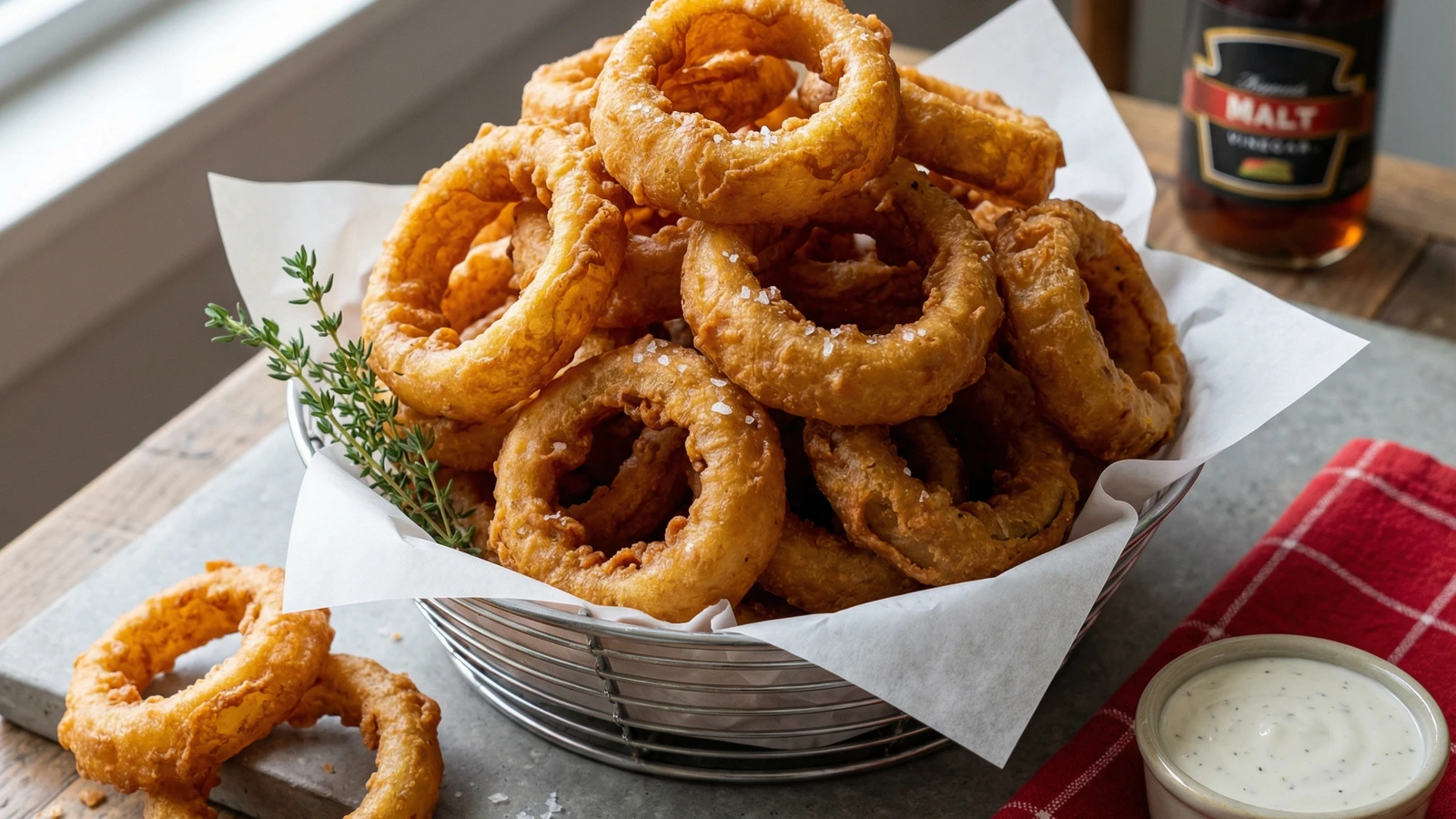
Crispy Beer-Battered Onion Rings
Created by
Thick-cut sweet onion rings wrapped in a gossamer beer batter that shatters at first bite, releasing tender, almost creamy onion within. This is the onion ring that makes drive-thru versions seem like an insult.
The onion ring occupies curious territory in American cooking. We treat it as an afterthought, a basket filler, something the kitchen throws in because the fryer is already hot. This is a mistake. A properly made onion ring, with its shatteringly crisp exterior giving way to sweet, almost molten onion, deserves the same attention we give any fried food worth eating.
The secret to great beer batter is temperature. Everything stays cold. The beer comes straight from the refrigerator, ideally from the back where it's coldest. The flour gets chilled. When that cold batter hits 375-degree oil, the temperature differential creates an explosion of tiny bubbles. Carbon dioxide from the lager expands violently, forming the lacework structure that makes beer batter so impossibly light. Warm batter produces dense, greasy results. This is physics, not preference.
I learned to make onion rings at a roadhouse outside Portland, Oregon, where they served them in paper-lined baskets with malt vinegar and homemade ranch. The cook, a woman named Della who'd worked the fryer for thirty years, showed me how she kept her batter bowl nested in ice the entire service. Her rings shattered when you bit them. The sound carried across the dining room. That's what we're after here.
Choose your onions with care. Vidalias from Georgia are my first choice when summer arrives, their sweetness unmatched. Walla Wallas from Washington State run a close second. Maui onions work beautifully if you can find them. What you want is size and sugar content. Storage onions, the yellow globes available year-round, will work in a pinch, but they lack the sweetness that makes a truly memorable ring.
The technique, the tradition, and the story behind every dish.
Discover Culinary AdvisorIngredients
large sweet onions (Vidalia, Walla Walla, or Maui)
Quantity
3, about 2 pounds total
all-purpose flour
Quantity
2 cups
divided
cornstarch
Quantity
1/2 cup
baking powder
Quantity
1 teaspoon
fine sea salt
Quantity
1 teaspoon
plus more for finishing
smoked paprika
Quantity
1/2 teaspoon
garlic powder
Quantity
1/4 teaspoon
cayenne pepper
Quantity
1/4 teaspoon
freshly ground black pepper
Quantity
1/4 teaspoon
ice-cold lager beer
Quantity
1 1/2 cups
large egg
Quantity
1
cold
vegetable or peanut oil
Quantity
about 2 quarts
for frying
| Ingredient | Quantity |
|---|---|
| large sweet onions (Vidalia, Walla Walla, or Maui) | 3, about 2 pounds total |
| all-purpose flourdivided | 2 cups |
| cornstarch | 1/2 cup |
| baking powder | 1 teaspoon |
| fine sea saltplus more for finishing | 1 teaspoon |
| smoked paprika | 1/2 teaspoon |
| garlic powder | 1/4 teaspoon |
| cayenne pepper | 1/4 teaspoon |
| freshly ground black pepper | 1/4 teaspoon |
| ice-cold lager beer | 1 1/2 cups |
| large eggcold | 1 |
| vegetable or peanut oilfor frying | about 2 quarts |
Equipment Needed
- •Large Dutch oven or heavy-bottomed pot (at least 5-quart capacity)
- •Deep-fry or candy thermometer
- •Spider skimmer or slotted spoon
- •Wire cooling rack set over a sheet pan
Instructions
- 1
Slice and separate the onions
Trim the root and stem ends from each onion and peel away the papery skin. Slice crosswise into rounds about 1/2-inch thick. You want substantial rings here, not delicate wisps. Separate the slices into individual rings, keeping only the larger outer rings for frying. Reserve the smaller inner pieces for another use (they make excellent additions to tomorrow's scrambled eggs or a quick pickle).
Rings smaller than 2 inches in diameter tend to overcook before the batter crisps properly. Save them for other cooking. - 2
Prepare the dredging flour
Place 1 cup of the flour in a wide, shallow bowl. This dry dredge gives the wet batter something to grip. Without it, the coating slides off in the oil, leaving you with naked onion and floating batter debris. Set this bowl near your frying station.
- 3
Mix the cold batter
In a large bowl, whisk together the remaining 1 cup flour, cornstarch, baking powder, salt, smoked paprika, garlic powder, cayenne, and black pepper. Create a well in the center. Pour in the ice-cold beer and crack in the cold egg. Whisk from the center outward, gradually incorporating the dry ingredients until you have a smooth batter about the consistency of heavy cream. A few small lumps are fine. Overworking develops gluten, which makes the coating tough rather than crisp.
Nest your batter bowl in a larger bowl filled with ice to keep it cold throughout the frying process. Temperature is everything. - 4
Heat the oil
Pour oil into a large Dutch oven or heavy-bottomed pot to a depth of 3 inches. Clip a deep-fry thermometer to the side. Heat over medium-high until the oil reaches 375°F. This takes 10 to 15 minutes depending on your burner. Resist the urge to rush it. Oil that isn't hot enough produces greasy, soggy results. Oil that's too hot burns the coating before the onion softens.
- 5
Set up the frying station
Line a sheet pan with a wire rack (paper towels trap steam and make your crisp coating soggy within minutes). Arrange your workspace in order: onion rings, dredging flour, batter bowl nested in ice, then the hot oil with the rack-lined pan beside it. This assembly line prevents dripping batter across your stovetop and keeps the process moving efficiently.
- 6
Dredge, batter, and fry
Working with 4 to 5 rings at a time, dredge each ring in the flour, shaking off excess. Dip into the cold batter, letting the excess drip off for a moment (count to three). Carefully lower into the hot oil, sliding rings away from you to prevent splashing. Fry for 2 to 3 minutes, flipping once with a spider or slotted spoon, until deeply golden on both sides. The batter will puff and form an irregular, craggly surface. That texture is exactly what you want.
Don't crowd the pot. Too many rings at once drops the oil temperature dramatically, resulting in pale, greasy coating instead of crisp and golden. - 7
Drain and season immediately
Transfer fried rings to the wire rack and season immediately with a generous pinch of flaky sea salt while the surface is still glistening with oil. The salt needs that residual oil to stick. Allow the oil to return to 375°F between batches. This usually takes 1 to 2 minutes. Continue until all rings are fried.
- 8
Serve hot
Pile the onion rings in a basket lined with parchment or stack them casually on a platter. Serve immediately with your preferred dipping sauce. These wait for no one. The contrast between shatteringly crisp coating and sweet, tender onion exists for perhaps ten minutes before physics begins its inevitable work. Eat them while they're honest.
Chef Tips
- •The beer choice matters less than its temperature. A straightforward American lager works perfectly. Save your craft IPAs for drinking. The hops can add unwanted bitterness to the batter.
- •If you don't have a deep-fry thermometer, test the oil by dropping in a small spoonful of batter. It should sink briefly, then rise immediately and bubble vigorously. If it sits on the bottom, your oil isn't hot enough. If it burns within 30 seconds, it's too hot.
- •For extra insurance against greasy rings, chill the flour for the batter in the freezer for 30 minutes before mixing. Cold flour, cold beer, cold egg. The trifecta of crisp.
- •Leftover batter keeps poorly, but any sweet onion rings you don't fry can be wrapped tightly and refrigerated overnight. Bring them to room temperature before dredging and frying.
- •Serve with malt vinegar for a nod to the British chip shop tradition, ranch dressing for pure Americana, or a chipotle aioli if you want some heat. All three work beautifully.
Advance Preparation
- •Onions can be sliced and separated up to 4 hours ahead. Store covered with a damp paper towel in the refrigerator.
- •The dry flour mixture for the batter can be whisked together a day ahead and stored airtight. Add the wet ingredients just before frying.
- •Onion rings do not hold well or reheat successfully. Plan to fry and serve immediately for the best texture.
Frequently Asked Questions
Nutrition Information
1 serving (about 85g)
Where cooking meets culture.
Culinary mentorship, cultural storytelling, and the editorial depth that makes cooking meaningful.
Explore Culinary Advisor