Culinary Advisor
A cooking platform built around craft, culture, and the stories behind what we eat.
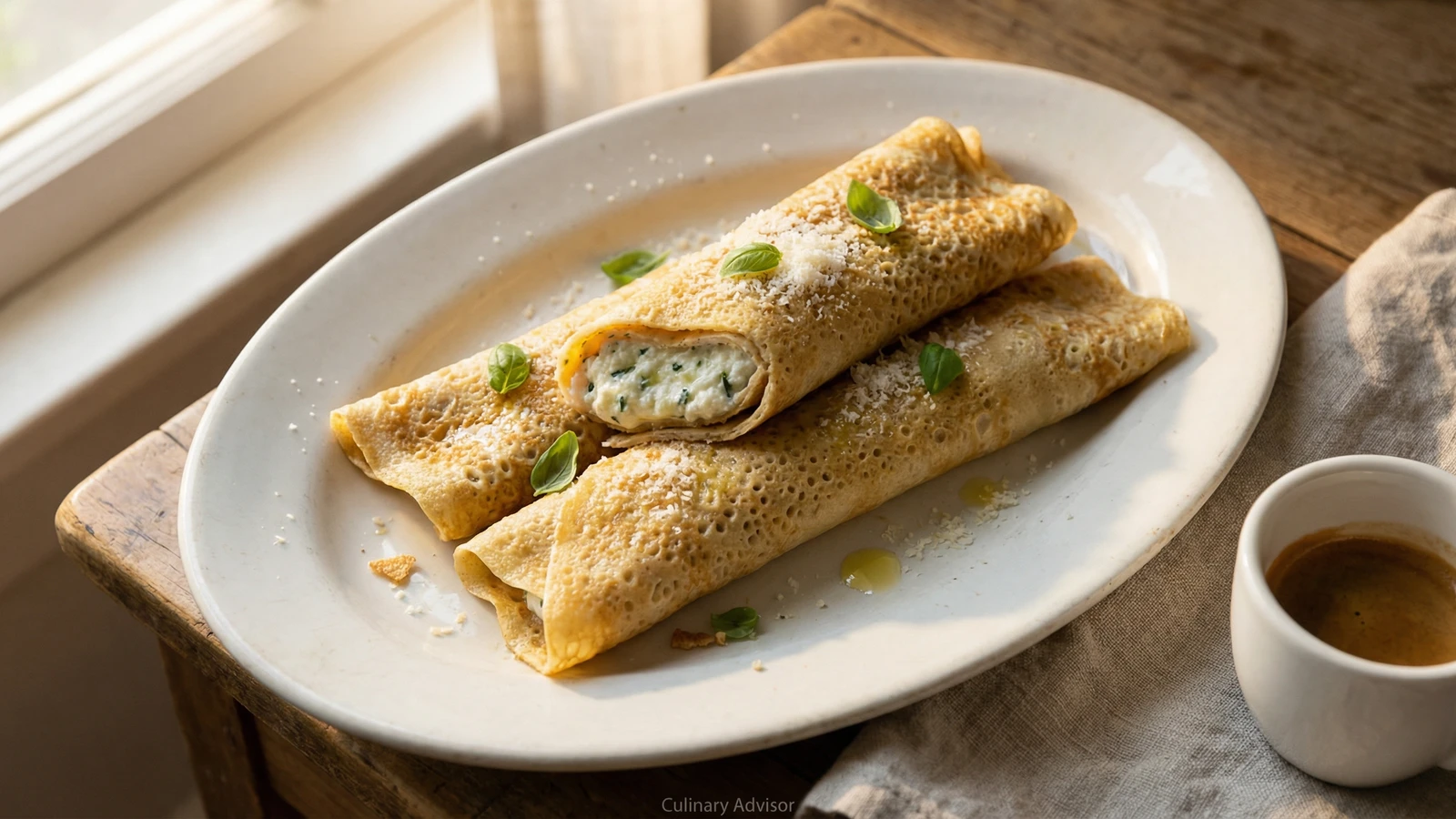
Crespelle con Ricotta ed Erbe
Created by Chef Graziella
Thin Italian crepes wrapped around fresh ricotta brightened with garden herbs. A dish that proves breakfast can be civilized, that morning can begin with restraint and grace rather than excess.
Crespelle are what Italians call crepes, though they are not quite the same thing. The batter is lighter, thinner, almost translucent when cooked properly. French crepes can be sturdy. Italian crespelle should whisper.
The filling here is ricotta, and the quality of your ricotta will determine everything. The watery supermarket product sold in plastic tubs has nothing to do with real ricotta. Seek out fresh ricotta from an Italian market, or make it yourself from good milk. It should be creamy, slightly sweet, with the clean taste of fresh dairy. If your ricotta is grainy or sour, your crespelle will be ordinary.
The herbs are simple: parsley, basil, chives. Three. Not seven. The nutmeg is a whisper, a tradition from Emilia-Romagna where it appears in anything containing eggs and cheese. You should barely taste it, yet you would notice its absence.
This is breakfast as it should be. Quiet. Considered. Something you sit down to eat with proper coffee and the morning light coming through the window.
Crespelle appear in Italian cookery texts as early as the 14th century, when Florentine cooks wrapped thin batters around savory and sweet fillings for noble tables. The name derives from the Latin 'crispus,' meaning curled or wavy, describing the lacy edges that form in a hot pan. While the French perfected the street-corner crepe, Italians kept crespelle in the home kitchen, filling them with ricotta, spinach, or béchamel for family meals.
The technique, the tradition, and the story behind every dish.
Discover Culinary AdvisorIngredients
all-purpose flour
Quantity
1 cup
large eggs
Quantity
3
whole milk
Quantity
1 cup
unsalted butter
Quantity
2 tablespoons, plus more for the pan
melted
fine sea salt
Quantity
1/4 teaspoon
fresh ricotta
Quantity
1 pound
drained if wet
Parmigiano-Reggiano
Quantity
1/2 cup, plus more for serving
freshly grated
large egg yolk
Quantity
1
fresh flat-leaf parsley
Quantity
3 tablespoons
chopped fine
fresh basil
Quantity
2 tablespoons
cut into thin ribbons
fresh chives
Quantity
1 tablespoon
minced
nutmeg
Quantity
1/8 teaspoon
freshly grated
black pepper
Quantity
to taste
freshly ground
| Ingredient | Quantity |
|---|---|
| all-purpose flour | 1 cup |
| large eggs | 3 |
| whole milk | 1 cup |
| unsalted buttermelted | 2 tablespoons, plus more for the pan |
| fine sea salt | 1/4 teaspoon |
| fresh ricottadrained if wet | 1 pound |
| Parmigiano-Reggianofreshly grated | 1/2 cup, plus more for serving |
| large egg yolk | 1 |
| fresh flat-leaf parsleychopped fine | 3 tablespoons |
| fresh basilcut into thin ribbons | 2 tablespoons |
| fresh chivesminced | 1 tablespoon |
| nutmegfreshly grated | 1/8 teaspoon |
| black pepperfreshly ground | to taste |
Equipment Needed
- •8-inch nonstick or well-seasoned crepe pan
- •Fine-mesh strainer for draining ricotta
- •Whisk
- •Thin flexible spatula
Instructions
- 1
Make the batter
Put the flour in a bowl and make a well in the center. Crack the eggs into the well. Begin whisking the eggs, gradually drawing flour from the sides. Add the milk in a slow stream, whisking constantly until smooth. Whisk in the melted butter and salt. The batter should be thinner than pancake batter, like heavy cream. If lumps remain, strain through a fine sieve. Let the batter rest at room temperature for 30 minutes. This is not optional.
The resting allows the flour to hydrate fully and the gluten to relax. Skip this step and your crespelle will be tough and uneven. - 2
Prepare the filling
While the batter rests, make the filling. In a bowl, combine the ricotta, Parmigiano-Reggiano, egg yolk, parsley, basil, chives, and nutmeg. Season with pepper and a small pinch of salt. Mix gently with a fork until just combined. The ricotta should remain light, not beaten into paste. Taste it. Adjust the seasoning. The filling should taste of fresh cheese and garden herbs, nothing more.
- 3
Cook the crespelle
Heat an 8-inch nonstick pan or well-seasoned crepe pan over medium heat. Add a small piece of butter and swirl to coat. Pour a scant quarter cup of batter into the center of the pan and immediately tilt and rotate the pan so the batter covers the entire surface in a thin, even layer. Cook until the edges begin to turn golden and curl slightly away from the pan, about one minute. The underside should be pale gold with lacy brown spots.
Italian crespelle are thinner than French crepes. If yours are thick, use less batter. If they tear when you flip them, the pan is too hot. - 4
Flip and finish
Using your fingers or a thin spatula, flip the crespella and cook the second side for 30 seconds more. It should have light golden spots but remain pliable. Transfer to a plate. Repeat with remaining batter, adding a small touch of butter before each crespella. Stack them as you go. You should have 8 crespelle.
- 5
Fill and fold
Place a crespella on your work surface, prettier side down. Spoon about 3 tablespoons of the ricotta filling in a line across the lower third. Fold the bottom edge up over the filling, then fold in the sides like an envelope, then roll into a neat cylinder. Place seam-side down on a serving plate. Repeat with remaining crespelle.
- 6
Warm and serve
The crespelle can be served at room temperature, or warmed briefly. To warm them, place the filled crespelle in a buttered baking dish, dot with a little butter, and bake at 350 degrees for 10 minutes until just heated through. Grate fresh Parmigiano-Reggiano over the top and serve immediately. Do not overheat them. The filling should remain creamy, not dry.
Chef Tips
- •If your ricotta is wet, drain it in a fine-mesh strainer lined with cheesecloth for an hour. Excess moisture makes the filling weep and the crespelle soggy.
- •The first crespella is always imperfect. It tests the temperature, seasons the pan. Eat it standing at the stove. Call it the cook's privilege.
- •Fresh herbs are essential here. Dried herbs would be an insult to the dish. If your basil is wilted or your parsley yellowed, do not use them.
- •These can be made ahead through the filling step and refrigerated, covered, for several hours. Bring to room temperature or warm gently before serving.
Advance Preparation
- •The batter can be made the night before and refrigerated. Bring to room temperature and whisk before cooking.
- •Unfilled crespelle stack well between sheets of wax paper and keep, wrapped tightly, for one day at room temperature or three days refrigerated.
- •The filling can be prepared several hours ahead and refrigerated. Do not add the herbs until just before filling, or they will darken.
Frequently Asked Questions
Nutrition Information
1 serving (about 260g)
Where cooking meets culture.
Culinary mentorship, cultural storytelling, and the editorial depth that makes cooking meaningful.
Explore Culinary Advisor