Culinary Advisor
A cooking platform built around craft, culture, and the stories behind what we eat.
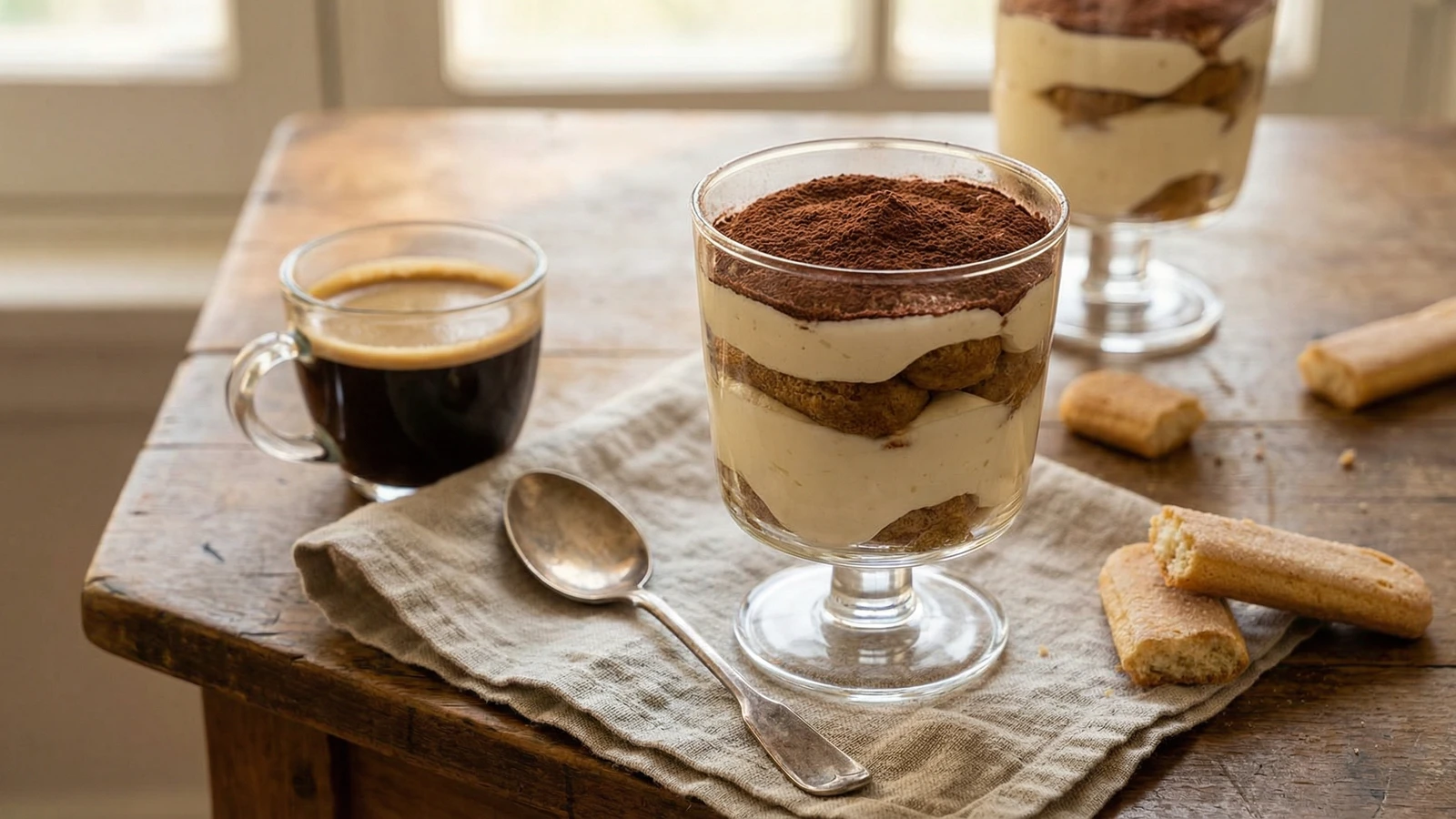
Coppa di Mascarpone con Caffè
Created by Chef Graziella
Individual mascarpone parfaits layered with espresso-soaked biscuits and dusted with cocoa. The essence of tiramisù, distilled into something a home cook can master without fear.
This is tiramisù's quieter cousin, the one who does not demand attention but earns it anyway. Where tiramisù requires zabaglione folded into mascarpone, a production that intimidates many home cooks, the coppa asks for nothing more than mascarpone beaten with eggs and sugar, layered with espresso-soaked biscuits in individual glasses.
The result is no less satisfying. In some ways, it is more honest. You taste the mascarpone directly, rich and faintly tangy, the way Lombardy intended. You taste the coffee, dark and bitter, cutting through the cream. The cocoa on top is not decoration. It provides the same bitter counterpoint that makes tiramisù complete.
I have served this at dinner parties for decades. Guests always ask for the recipe, expecting complexity. When I tell them it takes fifteen minutes to assemble and requires no cooking, they do not believe me. But this is the truth of Italian home cooking: simple does not mean easy, but sometimes it does mean quick. The difficulty lies in using proper ingredients and having the restraint to add nothing more.
Mascarpone has been made in Lombardy since at least the 16th century, originally a winter cheese because the cold temperatures prevented spoilage. The pairing with coffee in layered desserts gained popularity in the 1960s and 70s across northern Italy, with tiramisù eventually becoming the most famous variation. Home cooks in the Veneto and Lombardy regions often made simpler versions like this coppa when tiramisù seemed too fussy for a weeknight.
The technique, the tradition, and the story behind every dish.
Discover Culinary AdvisorIngredients
mascarpone cheese
Quantity
500g
at room temperature
large egg yolks
Quantity
4
granulated sugar
Quantity
100g
espresso
Quantity
1 cup
freshly brewed, cooled completely
dark rum or Marsala (optional)
Quantity
2 tablespoons
savoiardi (Italian ladyfingers)
Quantity
200g, about 24 biscuits
Dutch-process cocoa powder
Quantity
3 tablespoons
unsweetened
fine sea salt
Quantity
pinch
| Ingredient | Quantity |
|---|---|
| mascarpone cheeseat room temperature | 500g |
| large egg yolks | 4 |
| granulated sugar | 100g |
| espressofreshly brewed, cooled completely | 1 cup |
| dark rum or Marsala (optional) | 2 tablespoons |
| savoiardi (Italian ladyfingers) | 200g, about 24 biscuits |
| Dutch-process cocoa powderunsweetened | 3 tablespoons |
| fine sea salt | pinch |
Equipment Needed
- •Electric hand mixer or stand mixer
- •Large mixing bowl
- •Shallow bowl for dipping
- •Six 8-ounce glasses or parfait cups
- •Fine-mesh strainer for cocoa
Instructions
- 1
Prepare the espresso
Brew the espresso and let it cool completely to room temperature. If you wish to add rum or Marsala, stir it in now. The coffee must not be warm when you dip the biscuits, or they will become sodden and fall apart. Pour the cooled espresso into a shallow bowl wide enough to accommodate a ladyfinger laid flat.
- 2
Beat the yolks and sugar
In a large bowl, combine the egg yolks, sugar, and salt. Beat with an electric mixer on high speed until the mixture becomes pale yellow and falls in thick ribbons when you lift the beaters, about 4 minutes. The volume will nearly triple. This step cannot be rushed, and it cannot be done adequately by hand.
The eggs must be at room temperature. Cold yolks resist incorporating air, and you will beat for twice as long with inferior results. - 3
Incorporate the mascarpone
Add the mascarpone to the egg mixture. Beat on medium speed just until smooth and combined, about one minute. Do not overbeat. The mascarpone should be at room temperature, or it will form lumps that no amount of beating will dissolve. Scrape the sides of the bowl once during mixing.
Real mascarpone from Lombardy is preferable. It should be thick enough to hold a spoon upright and taste faintly of cream with a pleasant acidity. The industrial versions sold in many supermarkets are too thin and bland. - 4
Prepare the glasses
Set out six wine glasses, parfait glasses, or small tumblers, each holding about 8 ounces. The glasses should be clear so the layers are visible. This is not vanity; it is part of the pleasure.
- 5
Dip the biscuits
Working quickly, dip each ladyfinger into the espresso for exactly two seconds per side. Four seconds total. The exterior should absorb coffee while the interior remains slightly dry. This is essential. A soggy biscuit cannot hold its shape, and the coppa becomes a puddle. If your biscuits are thicker than standard savoiardi, you may need one additional second per side. Learn by watching the first biscuit.
Count in your head: one-thousand-one, one-thousand-two, flip, one-thousand-one, one-thousand-two, remove. The timing matters more than any other step in this recipe. - 6
Layer the parfaits
Break or cut the soaked ladyfingers to fit snugly in the bottom of each glass, using about two biscuits per layer. Press gently to eliminate air pockets. Spoon a generous layer of mascarpone cream over the biscuits, about 3 tablespoons, and spread to the edges. Repeat with another layer of soaked biscuits, then more cream. Finish with mascarpone as the top layer. You should have two layers of biscuits and cream ending with cream.
- 7
Chill thoroughly
Cover each glass with plastic wrap pressed directly onto the surface of the cream to prevent a skin from forming. Refrigerate for at least 4 hours, preferably overnight. The biscuits need time to soften fully and meld with the cream. The flavors need time to marry. Patience is required.
- 8
Finish and serve
Just before serving, remove the plastic wrap and dust the top of each coppa generously with cocoa powder through a fine-mesh strainer. The cocoa must be applied at the last moment. It absorbs moisture and becomes muddy if left to sit. Serve immediately with small spoons.
Chef Tips
- •This recipe uses raw egg yolks. Use the freshest eggs from a source you trust. If this concerns you, seek out pasteurized eggs, though the texture of the cream will be slightly less luxurious.
- •The quality of your espresso determines the quality of the dessert. Use proper espresso from a stovetop moka or espresso machine. Drip coffee is too weak and too watery. Instant coffee is beneath consideration.
- •Savoiardi, the Italian ladyfingers, are drier and more absorbent than the spongy American versions. Seek them out at Italian markets. They are labeled Savoiardi or sometimes Pavesini. Do not substitute soft ladyfingers or the structure will fail.
- •The rum or Marsala is traditional but optional. For a dinner party where children are present or guests prefer not to drink, omit it entirely. The coffee carries enough flavor on its own.
Advance Preparation
- •The assembled coppe must be refrigerated at least 4 hours. They are better after 12 hours and hold well for up to 2 days. Do not add cocoa until serving.
- •The mascarpone cream can be made one day ahead and refrigerated separately. Let it sit at room temperature for 20 minutes before layering, or it will be too stiff to spread.
- •Brew the espresso the morning of the day you plan to assemble, giving it ample time to cool. Warm espresso is the most common cause of failure.
Frequently Asked Questions
Nutrition Information
1 serving (about 195g)
Where cooking meets culture.
Culinary mentorship, cultural storytelling, and the editorial depth that makes cooking meaningful.
Explore Culinary Advisor