Culinary Advisor
A cooking platform built around craft, culture, and the stories behind what we eat.
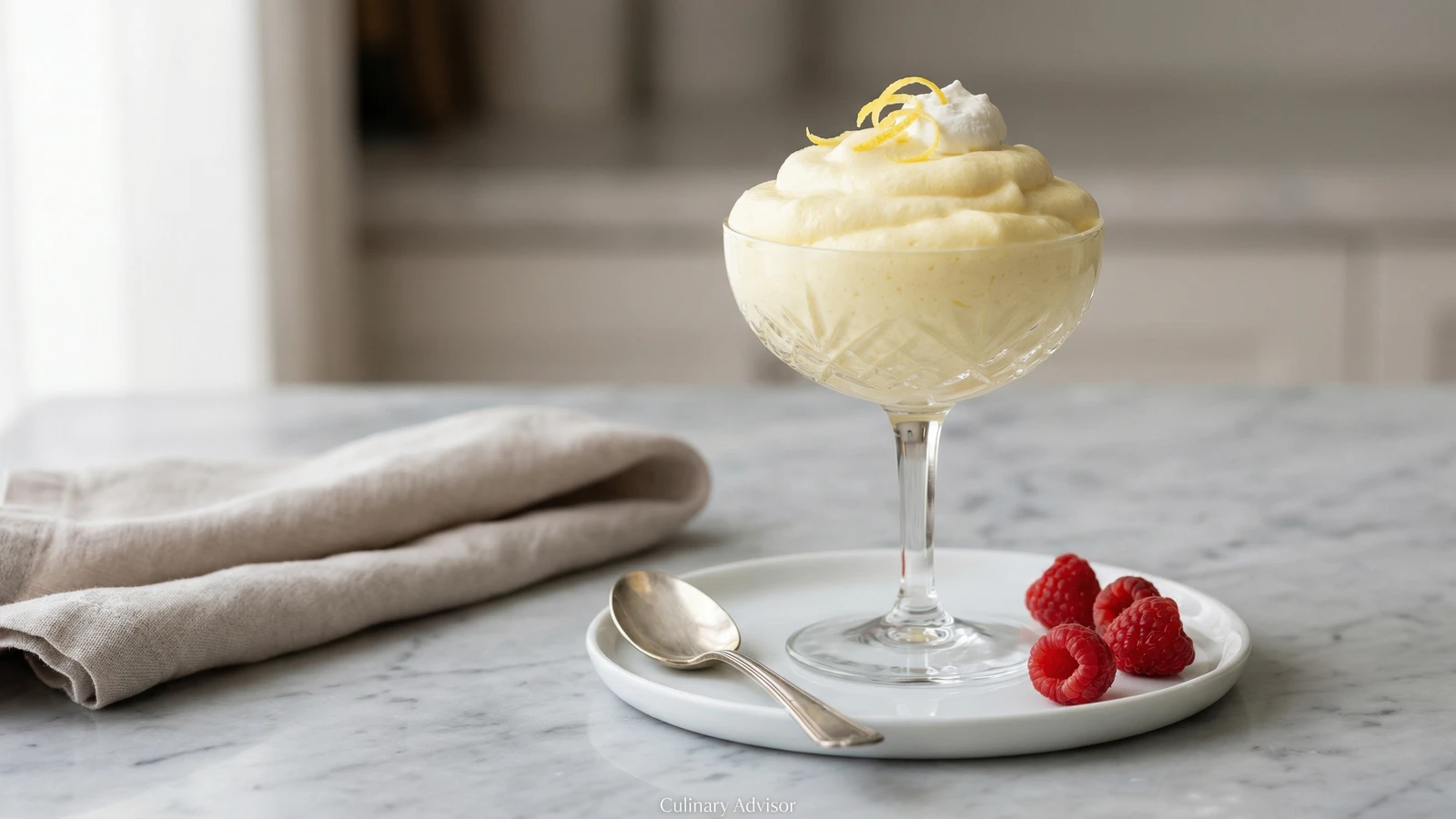
Classic French Lemon Mousse
Created by
Silky homemade lemon curd folded into billows of softly whipped cream, chilled until set but still trembling on the spoon. A dessert that proves elegance requires neither fuss nor apology.
The French have always understood that the best desserts are studies in contrast. Lemon mousse is their proof: tart curd against sweet cream, bright citrus cutting through richness, a texture so light it nearly floats off the spoon yet substantial enough to satisfy.
This is not the mousse of restaurant kitchens with their stabilizers and industrial mixers. This is the mousse a French grandmother might serve at Sunday lunch, made with nothing more than good eggs, fresh lemons, butter, and cream. The technique is forgiving. The results are extraordinary.
I've taught this recipe to students who swore they couldn't make dessert. By the end, they were spooning mousse into glasses with the confidence of pastry chefs. The secret is patience with your curd and gentleness with your fold. Rush either and you'll lose the air that makes this dessert sing. Take your time, trust the process, and you'll produce something worthy of any celebration.
The technique, the tradition, and the story behind every dish.
Discover Culinary AdvisorIngredients
large egg yolks
Quantity
4
granulated sugar
Quantity
3/4 cup (150g)
fresh lemon juice
Quantity
1/2 cup
about 3 large lemons
lemon zest
Quantity
2 tablespoons
finely grated, about 2 lemons
fine sea salt
Quantity
1/4 teaspoon
unsalted butter
Quantity
6 tablespoons (85g)
cut into small cubes and chilled
heavy whipping cream
Quantity
1 1/2 cups (360ml)
cold
powdered sugar
Quantity
2 tablespoons
pure vanilla extract
Quantity
1/2 teaspoon
| Ingredient | Quantity |
|---|---|
| large egg yolks | 4 |
| granulated sugar | 3/4 cup (150g) |
| fresh lemon juiceabout 3 large lemons | 1/2 cup |
| lemon zestfinely grated, about 2 lemons | 2 tablespoons |
| fine sea salt | 1/4 teaspoon |
| unsalted buttercut into small cubes and chilled | 6 tablespoons (85g) |
| heavy whipping creamcold | 1 1/2 cups (360ml) |
| powdered sugar | 2 tablespoons |
| pure vanilla extract | 1/2 teaspoon |
Equipment Needed
- •Medium saucepan for double boiler
- •Fine-mesh strainer
- •Instant-read thermometer
- •Stand mixer or hand mixer
- •Microplane or fine grater
- •Six serving glasses or ramekins (6-8 oz each)
Instructions
- 1
Prepare your citrus
Zest your lemons before juicing them. A microplane produces the finest zest, which disappears into the curd without any bitter pith. Roll each lemon firmly against the counter before cutting, pressing down with your palm. This breaks the internal membranes and releases more juice. Strain the juice through a fine-mesh strainer to catch seeds and pulp.
Room temperature lemons yield significantly more juice than cold ones. If yours are refrigerated, microwave them for ten seconds or drop them in warm water for a few minutes. - 2
Build the curd base
Set a medium saucepan over a pot of barely simmering water to create a double boiler. The bottom of the saucepan should not touch the water. Whisk together the egg yolks and sugar until pale and slightly thickened, about one minute. Add the lemon juice, zest, and salt. Whisk to combine.
- 3
Cook the curd
Cook the mixture, stirring constantly with a wooden spoon or heatproof spatula, until it thickens enough to coat the back of the spoon, eight to twelve minutes. When you draw your finger across the coated spoon, the line should hold without the curd running back together. The temperature should read 170°F on an instant-read thermometer. Do not let it boil or the eggs will curdle.
If you see small lumps forming, remove the pan from heat immediately and whisk vigorously. The curd can usually be saved if you catch it early. - 4
Finish and cool the curd
Remove from heat and add the cold butter cubes, one or two at a time, whisking until each addition melts completely before adding more. The butter enriches the curd and gives it that silky texture. Strain through a fine-mesh strainer into a clean bowl to catch any bits of cooked egg. Press plastic wrap directly onto the surface to prevent a skin from forming. Refrigerate until completely cold, at least two hours or overnight.
- 5
Whip the cream
When the curd is thoroughly chilled, pour the cold cream into the bowl of a stand mixer fitted with the whisk attachment, or use a large bowl and hand mixer. Add the powdered sugar and vanilla. Beat on medium-high speed until soft peaks form, about two to three minutes. The cream should hold gentle peaks that droop slightly when you lift the whisk. Stop before you reach stiff peaks. Overwhipped cream will make the mousse dense rather than airy.
Chill your bowl and whisk in the freezer for ten minutes before whipping. Cold equipment makes lighter cream. - 6
Lighten the curd
Give the chilled curd a good stir to loosen it. It will have set firmly in the refrigerator. Spoon about one cup of the whipped cream into the curd and fold vigorously with a spatula. This sacrificial cream lightens the dense curd and makes the final fold easier. Don't worry about being gentle here.
- 7
Fold to finish
Add the lightened curd to the remaining whipped cream. Fold gently, cutting down through the center with your spatula, sweeping along the bottom of the bowl, and turning the mixture over itself. Rotate the bowl a quarter turn and repeat. Continue until no white streaks remain, about fifteen strokes. Work quickly and stop the moment the mixture is uniform. Every extra fold deflates precious air.
The folding technique matters more than speed. Think of it as turning the bowl and mixture together in a single motion, not stirring. - 8
Portion and chill
Divide the mousse among six glasses, ramekins, or small bowls. Spoon it in gently rather than pouring to preserve the airy texture. Cover each with plastic wrap and refrigerate for at least two hours to set, or up to two days. The mousse is ready when it holds its shape on a spoon but still quivers when you tap the glass.
- 9
Serve with elegance
Remove the mousse from the refrigerator ten minutes before serving. A brief rest at room temperature softens the texture slightly and allows the lemon flavor to bloom. Top with a small dollop of whipped cream if desired, a few curls of lemon zest, or simply serve as is. The mousse needs no apology and no distraction.
Chef Tips
- •Use fresh lemons, never bottled juice. The oils in fresh zest and the brightness of just-squeezed juice cannot be replicated. Meyer lemons, if you can find them, produce a slightly sweeter, more floral mousse.
- •The curd can be made up to five days ahead and stored refrigerated. This makes the mousse an ideal dinner party dessert since the most involved step is already complete.
- •For a more stable mousse that holds beautifully for up to three days, bloom one teaspoon of powdered gelatin in two tablespoons of cold water, then warm gently until dissolved. Whisk into the hot curd before adding butter.
- •If your mousse seems too loose after folding, the curd wasn't cold enough. Refrigerate longer next time. If it seems dense, you likely overwhipped the cream or overfolded the final mixture.
- •This mousse pairs beautifully with fresh berries, particularly raspberries or blueberries, whose sweetness complements the citrus tang. A simple butter cookie alongside adds welcome crunch.
Advance Preparation
- •Lemon curd can be made up to five days ahead and stored refrigerated with plastic wrap pressed directly onto the surface.
- •Completed mousse holds beautifully for up to two days refrigerated, making it ideal for dinner parties. The texture actually improves slightly after overnight chilling.
- •Portion the mousse into individual glasses before refrigerating so you can simply remove and serve when guests arrive.
Frequently Asked Questions
Nutrition Information
1 serving (about 170g)
Where cooking meets culture.
Culinary mentorship, cultural storytelling, and the editorial depth that makes cooking meaningful.
Explore Culinary Advisor