Culinary Advisor
A cooking platform built around craft, culture, and the stories behind what we eat.
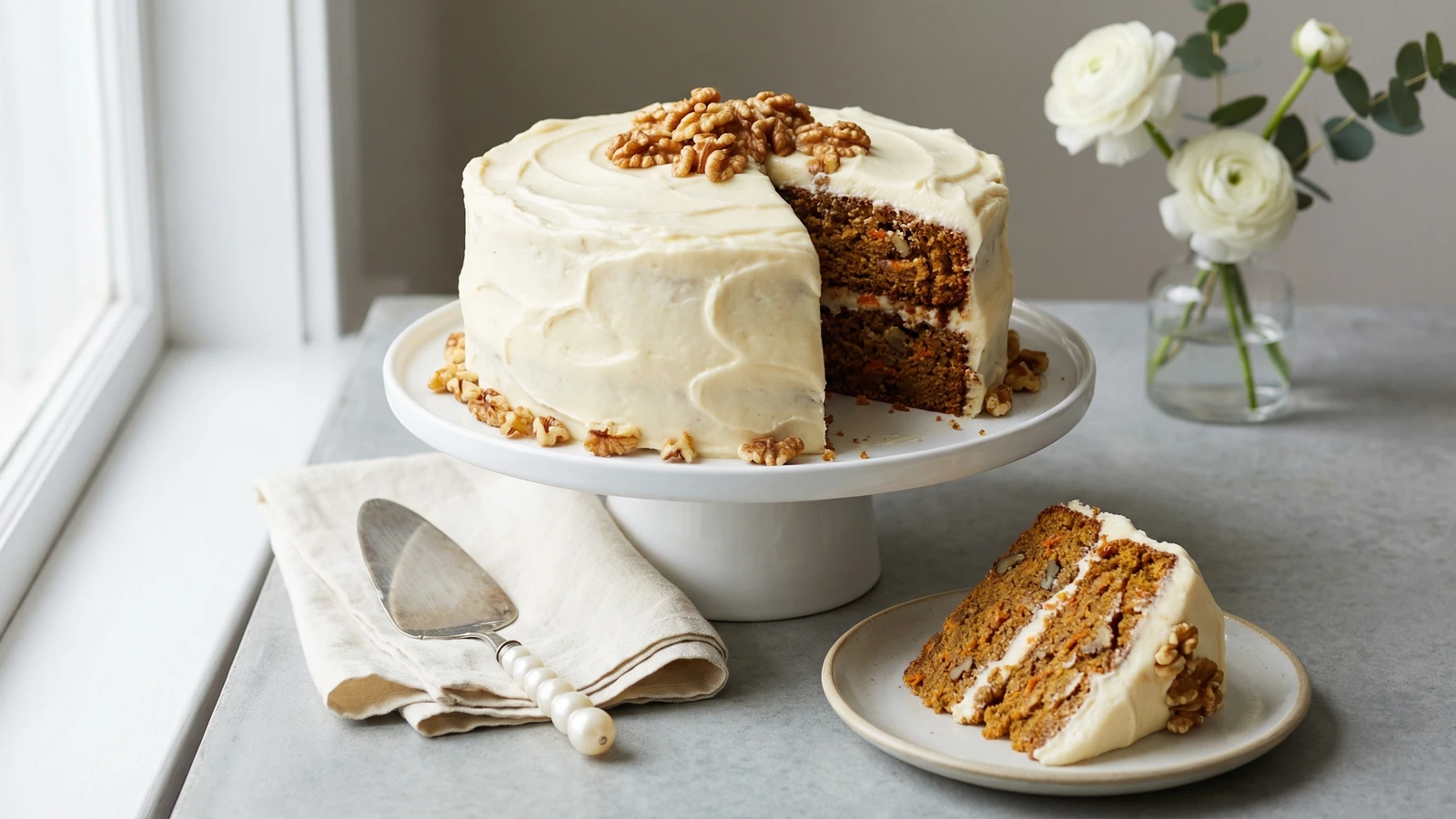
Classic Carrot Cake with Cream Cheese Frosting
Created by
A towering, spice-scented celebration cake so moist it defies physics, loaded with fresh carrots, toasted walnuts, and raisins, then lavished with tangy cream cheese frosting that cuts through the sweetness like a revelation.
Carrot cake arrived in American kitchens as an act of wartime thrift. Sugar rationing during the 1940s sent home bakers searching for natural sweeteners, and carrots, abundant and cheap, answered the call. The vegetable's natural sugars caramelized during baking, producing a cake so moist and flavorful that it outlasted the rationing by decades. By the 1970s, carrot cake had become synonymous with celebration.
The secret to this cake lives in its oil-based batter. Where butter cakes dry out within days, oil keeps carrot cake impossibly moist for nearly a week. The carrots themselves contribute more than sweetness. Their moisture steams gently during baking, creating a tender crumb that holds together without becoming dense. Grate them yourself on the large holes of a box grater. Pre-shredded carrots are too dry and too uniform.
The cream cheese frosting is non-negotiable. Its tangy sharpness cuts through the cake's sweetness, creating balance that makes you reach for another slice before the first is finished. Beat it until silky but do not overwork it. Warm cream cheese breaks and weeps. Cold cream cheese stays stiff and lumpy. Room temperature is your target, and patience is your method.
The technique, the tradition, and the story behind every dish.
Discover Culinary AdvisorIngredients
all-purpose flour
Quantity
2 cups (250g)
baking soda
Quantity
2 teaspoons
ground cinnamon
Quantity
2 teaspoons
ground ginger
Quantity
1 teaspoon
nutmeg
Quantity
1/2 teaspoon
freshly grated
fine sea salt (for cake)
Quantity
1/2 teaspoon
neutral vegetable oil
Quantity
1 1/2 cups (355ml)
granulated sugar
Quantity
2 cups (400g)
large eggs
Quantity
4
at room temperature
pure vanilla extract (for cake)
Quantity
1 teaspoon
carrots
Quantity
3 cups (340g)
freshly grated, about 1 pound whole
walnuts (for cake)
Quantity
1 cup (120g)
toasted and roughly chopped
golden raisins
Quantity
1/2 cup (75g)
cream cheese
Quantity
16 ounces (450g)
at room temperature
unsalted butter
Quantity
1/2 cup (1 stick/113g)
at room temperature
powdered sugar
Quantity
4 cups (480g)
sifted
pure vanilla extract (for frosting)
Quantity
2 teaspoons
fine sea salt (for frosting)
Quantity
1/4 teaspoon
walnuts (for decoration) (optional)
Quantity
1/2 cup (60g)
toasted and chopped
| Ingredient | Quantity |
|---|---|
| all-purpose flour | 2 cups (250g) |
| baking soda | 2 teaspoons |
| ground cinnamon | 2 teaspoons |
| ground ginger | 1 teaspoon |
| nutmegfreshly grated | 1/2 teaspoon |
| fine sea salt (for cake) | 1/2 teaspoon |
| neutral vegetable oil | 1 1/2 cups (355ml) |
| granulated sugar | 2 cups (400g) |
| large eggsat room temperature | 4 |
| pure vanilla extract (for cake) | 1 teaspoon |
| carrotsfreshly grated, about 1 pound whole | 3 cups (340g) |
| walnuts (for cake)toasted and roughly chopped | 1 cup (120g) |
| golden raisins | 1/2 cup (75g) |
| cream cheeseat room temperature | 16 ounces (450g) |
| unsalted butterat room temperature | 1/2 cup (1 stick/113g) |
| powdered sugarsifted | 4 cups (480g) |
| pure vanilla extract (for frosting) | 2 teaspoons |
| fine sea salt (for frosting) | 1/4 teaspoon |
| walnuts (for decoration) (optional)toasted and chopped | 1/2 cup (60g) |
Equipment Needed
- •Two 9-inch round cake pans
- •Box grater or food processor with grating disc
- •Stand mixer or hand mixer
- •Offset spatula
- •Wire cooling racks
- •Cake stand or serving plate
Instructions
- 1
Prepare pans and oven
Position a rack in the center of your oven and preheat to 350°F. Generously butter two 9-inch round cake pans, then line the bottoms with parchment paper cut to fit. Butter the parchment as well, then dust the entire interior with flour, tapping out excess. This double insurance prevents heartbreak when unmolding.
For easier release, use baking spray with flour (like Baker's Joy) instead of the butter-and-flour method. One coat does the work of three steps. - 2
Toast the walnuts
Spread walnuts in a single layer on a rimmed baking sheet. Toast in the preheating oven for 8 to 10 minutes, stirring once halfway through, until fragrant and slightly darkened. Listen for the moment they begin to smell nutty rather than raw. Transfer immediately to a plate to stop the cooking. Roughly chop once cooled.
Walnuts go from toasted to burnt in about 90 seconds. Set a timer and trust your nose more than the clock. - 3
Whisk dry ingredients
In a large bowl, whisk together the flour, baking soda, cinnamon, ginger, nutmeg, and salt until thoroughly combined. The spices should be evenly distributed with no visible pockets. Set aside.
- 4
Combine wet ingredients
In a separate large bowl, whisk together the oil and sugar until the mixture lightens slightly, about one minute. Add eggs one at a time, whisking well after each addition until the batter looks glossy and emulsified. Whisk in the vanilla extract. The mixture should appear smooth and unified, not separated.
- 5
Combine wet and dry
Add the dry ingredients to the wet ingredients in three additions, folding with a large rubber spatula after each. Use broad, gentle strokes from the bottom of the bowl up and over. Stop the moment you no longer see dry streaks. Overmixing develops gluten and produces a tough, dense cake.
The batter will seem thick and almost reluctant. This is correct. The carrots will add moisture once folded in. - 6
Fold in carrots and add-ins
Add the grated carrots, toasted walnuts, and raisins. Fold gently until evenly distributed throughout the batter. The carrots will release some moisture and the batter will loosen slightly. This is good. You should see orange flecks throughout with no clumps of plain batter remaining.
- 7
Fill pans and bake
Divide batter evenly between prepared pans. A kitchen scale helps here: each pan should hold roughly the same weight. Smooth the tops with an offset spatula. Bake 45 to 50 minutes, until the cakes are golden brown, the edges pull slightly away from the pan, and a toothpick inserted in the center emerges with just a few moist crumbs clinging to it.
Rotate pans halfway through baking if your oven has hot spots. The cakes are done when they spring back when gently pressed in the center. - 8
Cool completely
Let cakes cool in their pans on wire racks for 15 minutes. Run a thin knife around the edges, then invert onto the racks and peel away parchment. Cool completely, at least 90 minutes, before frosting. Warm cake melts frosting into a soupy mess. Patience here is mandatory, not suggested.
- 9
Make cream cheese frosting
In a stand mixer fitted with the paddle attachment (or using a hand mixer), beat the cream cheese on medium speed until smooth and free of lumps, about 2 minutes. Add the butter and beat until fully incorporated and fluffy, another 2 minutes, scraping down the bowl as needed. The mixture should be completely smooth with no visible butter streaks.
Both cream cheese and butter must be at true room temperature: soft enough to hold a fingerprint but not shiny or greasy. Cold ingredients create lumps; warm ingredients create soup. - 10
Add sugar and flavorings
Reduce mixer speed to low and add the sifted powdered sugar one cup at a time, beating after each addition until absorbed. Add vanilla and salt with the final cup. Once all sugar is incorporated, increase speed to medium-high and beat for 1 to 2 minutes until light and spreadable. Taste and adjust sweetness if needed.
Sifting the powdered sugar prevents lumps that no amount of beating can remove. Do not skip this step. - 11
Frost the cake
Place one cake layer on your serving plate or cake stand, bottom side up for a flat surface. Spread about 1 1/2 cups of frosting evenly across the top, extending to the edges. Place the second layer on top, also bottom side up. Apply a thin crumb coat over the entire cake: top, sides, everywhere. Refrigerate for 20 minutes to set this seal.
- 12
Final frosting and decoration
Apply remaining frosting generously over the chilled cake, using an offset spatula to create swoops and swirls on the top and sides. The texture should look inviting, not fussy. Press toasted walnut pieces around the bottom edge of the cake and scatter a few across the top. Refrigerate until 30 minutes before serving to let frosting firm up.
For rustic charm, leave visible spatula marks in the frosting. For elegance, run a bench scraper around the sides for a smooth finish.
Chef Tips
- •Grate your own carrots using the large holes of a box grater. Pre-shredded carrots lack moisture and produce a drier cake. One pound of whole carrots yields approximately 3 cups grated.
- •Oil matters less than you think. Any neutral oil works: vegetable, canola, safflower. Avoid olive oil; its flavor competes with the spices.
- •Pecans substitute beautifully for walnuts if that's your preference or your pantry reality. Toast them the same way.
- •If you loathe raisins (I understand the impulse), increase walnuts to 1 1/2 cups or add 1/2 cup sweetened shredded coconut. The cake forgives creative liberty.
- •For maximum spice impact, use freshly grated nutmeg. The pre-ground version tastes like sawdust by comparison. A single whole nutmeg and a microplane will serve you for years.
- •This cake improves overnight. The spices meld, the crumb moistens further, and the flavors deepen. Make it Saturday for a Sunday celebration.
Advance Preparation
- •Unfrosted cake layers can be made up to 2 days ahead. Wrap tightly in plastic wrap and store at room temperature, or freeze for up to 3 months.
- •Cream cheese frosting can be made 3 days ahead and refrigerated in an airtight container. Bring to room temperature and rewhip briefly before using.
- •The fully assembled cake keeps refrigerated for up to 5 days. The frosting actually improves as it melds with the cake. Remove from refrigerator 30 minutes before serving for best texture.
- •To freeze the assembled cake, freeze uncovered until frosting is solid (about 2 hours), then wrap tightly in plastic. Thaw overnight in the refrigerator.
Frequently Asked Questions
Nutrition Information
1 serving (about 117g)
Where cooking meets culture.
Culinary mentorship, cultural storytelling, and the editorial depth that makes cooking meaningful.
Explore Culinary Advisor