Culinary Advisor
A cooking platform built around craft, culture, and the stories behind what we eat.
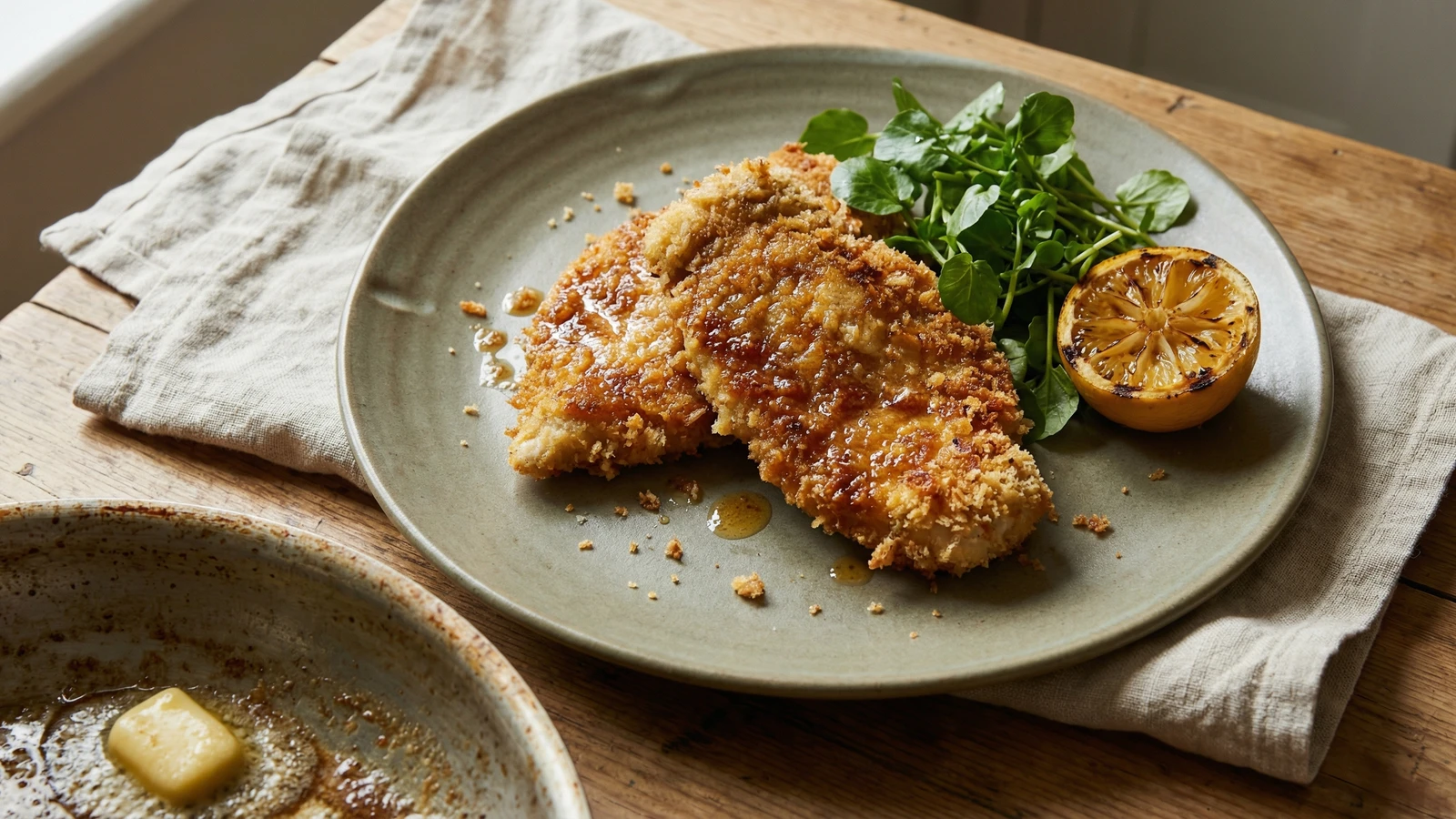
Chicken Escalopes in Breadcrumbs
Created by Chef Thomas
Chicken breasts pounded thin, pressed into coarse breadcrumbs, and fried in butter and oil until the coating is golden and the kitchen smells of toast. The Tuesday night version of something the whole table reaches for.
The smell is what gets you. Butter and breadcrumbs in a hot pan. It's the smell of someone's kitchen when they've decided tonight is going to be a good one, even if it's only Tuesday and there's nothing particular to celebrate.
The supermarkets sell millions of breaded chicken portions every week, and I understand why. The idea is sound. Crisp coating, tender meat, something satisfying about the crunch. But the factory version, coated in a pale, sandy dust that turns soggy in the oven, has almost nothing in common with what happens when you do it yourself. Pound a chicken breast thin, press it into proper breadcrumbs made from a day-old loaf, and fry it in butter and oil until the crust goes deep gold and shaggy. It takes fifteen minutes, start to plate. We're only making dinner.
I wrote this one down in the notebook years ago. The note just says: "Escalopes. Brown butter smell. Quick. Good." It hasn't needed updating since. A recipe is a conversation, not a contract, and this one barely requires a conversation at all. You know what crisp looks like. You know what golden smells like. Trust that.
Serve it with a lemon half and something green. A sharp salad, a pile of watercress, whatever is in the fridge that needs using. The escalope does the heavy lifting. Everything else is just company for it.
The technique, the tradition, and the story behind every dish.
Discover Culinary AdvisorIngredients
chicken breasts
Quantity
2
boneless, skinless
plain flour
Quantity
75g
seasoned with salt and pepper
large eggs
Quantity
2
beaten
fresh white breadcrumbs
Quantity
100g
unsalted butter
Quantity
30g
olive oil
Quantity
2 tablespoons
fine sea salt
Quantity
to taste
black pepper
Quantity
to taste
lemon
Quantity
1
halved
| Ingredient | Quantity |
|---|---|
| chicken breastsboneless, skinless | 2 |
| plain flourseasoned with salt and pepper | 75g |
| large eggsbeaten | 2 |
| fresh white breadcrumbs | 100g |
| unsalted butter | 30g |
| olive oil | 2 tablespoons |
| fine sea salt | to taste |
| black pepper | to taste |
| lemonhalved | 1 |
Equipment Needed
- •Rolling pin for pounding
- •Three shallow dishes for the coating line
- •Wide, heavy-bottomed frying pan (30cm is ideal)
- •Fish slice or wide spatula
Instructions
- 1
Pound the chicken thin
Lay each chicken breast between two sheets of cling film or baking parchment. Beat them with a rolling pin until they're about half a centimetre thick and fairly even. Don't be tentative. Firm, flat strokes from the centre outward. You'll feel the meat give and spread. What you're after is something thin enough to cook through quickly, so the crumb has time to go properly golden before the inside dries out. That's the whole trick.
If the breast is very thick, slice it horizontally through the middle first, then pound each half. Trying to flatten a fat chicken breast into a thin escalope is a fight you won't win cleanly. - 2
Set up the coating
Get three shallow dishes in a row. Flour in the first, seasoned well with salt and pepper. Beaten egg in the second. Breadcrumbs in the third. This is a production line, and it's worth doing properly. Dip each escalope in the flour, shake off the excess, then through the egg, letting the surplus drip away, then press firmly into the breadcrumbs on both sides. Use one hand for the dry stages and the other for the wet. Otherwise you end up breading your own fingers, which helps nobody.
Make your own breadcrumbs from a day-old white loaf. Tear the bread and pulse it in a food processor. They should be coarse, not powdery. The irregular texture is what gives you that shaggy, golden crust that shop-bought crumbs never quite manage. - 3
Fry until golden
Heat the oil and butter together in a wide, heavy frying pan over a medium heat. Wait. The butter needs to foam and settle before anything goes in. When it's stopped fizzing and the foam has calmed to a gentle sizzle, lay the escalopes in carefully. Don't crowd the pan. If you need to cook in batches, cook in batches. They need three to four minutes on the first side. Don't touch them. Don't peek. Don't press down with the spatula. When the edges start to look golden and the crumb has set, turn them once. Another three minutes on the other side. The coating should be a deep, even gold, and the kitchen should smell of toasted bread and butter.
Butter and oil together. The butter gives flavour, the oil stops it burning. One without the other doesn't do the job properly. - 4
Rest and serve
Lift the escalopes onto a warm plate and let them sit for a minute. The residual heat finishes the cooking without drying anything out. Squeeze half a lemon over each one while they're still hot, so the juice sizzles into the crumb. Serve straight away, on warm plates, with whatever you like alongside. A green salad with a sharp dressing. Buttered new potatoes if the season's right. A heap of watercress. Nothing complicated. The escalope is the thing.
Chef Tips
- •The breadcrumbs make or break this. Shop-bought dried breadcrumbs produce a thin, sandy coating that goes from pale to burnt with no golden stage in between. Make your own from a white loaf that's a day or two old. Tear it, pulse it, and leave the texture coarse. The difference on the plate is the difference between something you'd write down and something you'd forget by morning.
- •Get the escalopes thin and even. This is non-negotiable. A thick piece of chicken in breadcrumbs means either a raw middle or a burnt outside, and neither is worth sitting down to. Half a centimetre, evenly pounded. The rolling pin is the most important tool here.
- •Don't move the escalopes once they're in the pan. The crumb needs uninterrupted contact with the hot fat to set and colour properly. Fidgeting with them tears the coating and gives you bald patches. Put them in, leave them alone, turn them once. Patience for six minutes is all this asks of you.
- •A squeeze of lemon while the escalope is still hot is not optional. The acidity cuts through the richness of the butter and breadcrumbs, and it lifts the whole plate. Without it, the dish is good. With it, the dish is right.
Advance Preparation
- •The escalopes can be pounded, crumbed, and laid on a tray lined with parchment up to four hours ahead. Keep them in the fridge, uncovered, and the coating will set and adhere better during frying.
- •Breadcrumbs can be made in bulk and frozen in bags for up to three months. Pull out what you need and use them from frozen. They defrost in minutes on the worktop.
Frequently Asked Questions
Nutrition Information
1 serving (about 240g)
Where cooking meets culture.
Culinary mentorship, cultural storytelling, and the editorial depth that makes cooking meaningful.
Explore Culinary Advisor