Culinary Advisor
A cooking platform built around craft, culture, and the stories behind what we eat.
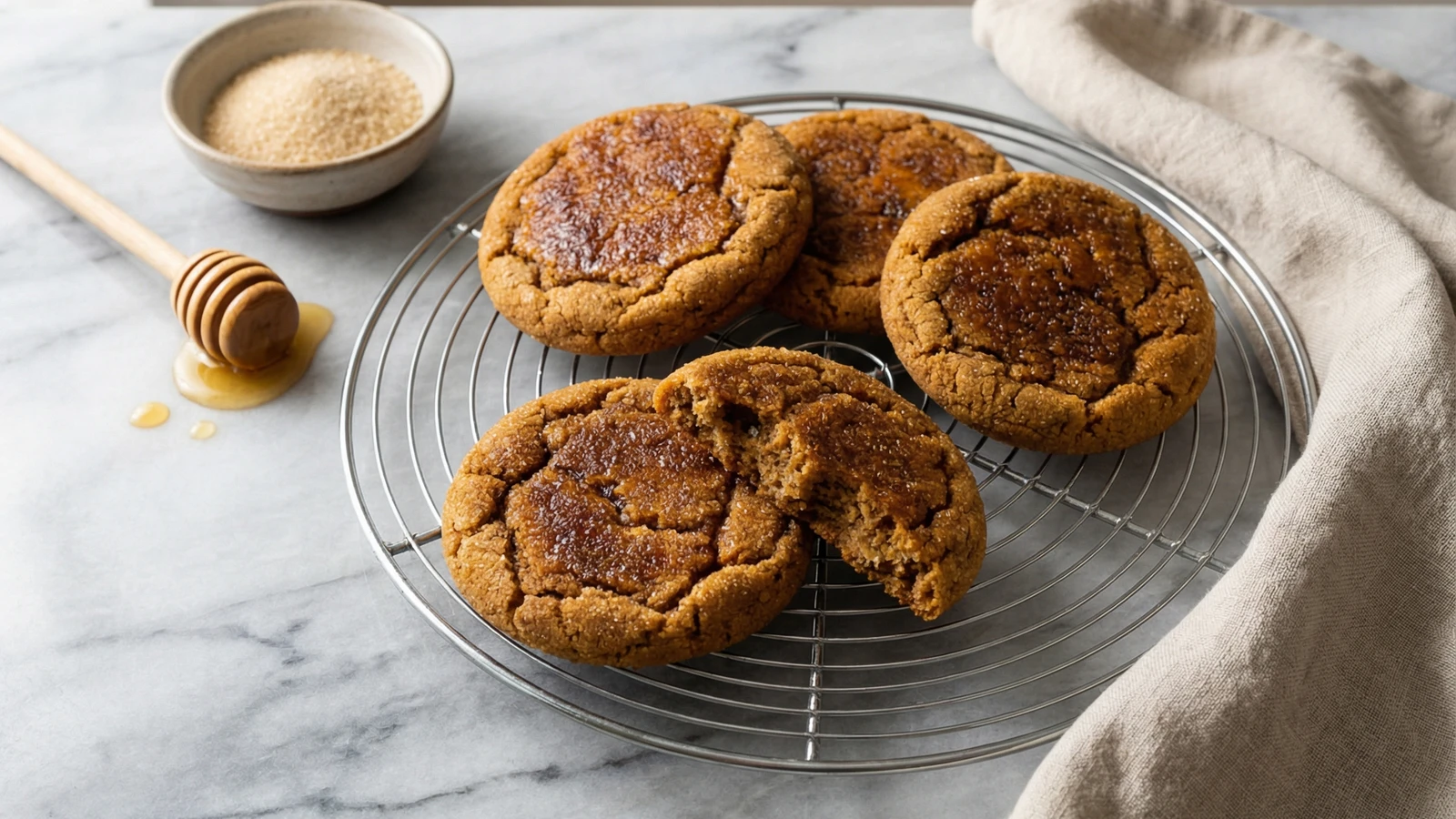
Caramelized Honey Ginger Cookies
Created by
Soft, crackle-topped ginger cookies with honey cooked to deep toffee richness, creating a warmth and complexity that traditional molasses simply cannot match.
Most ginger cookies rely on molasses for their dark sweetness. There's nothing wrong with that approach. I've made thousands of them. But honey, when you take it past its natural state into true caramelization, offers something different: a burnt-sugar intensity that tastes like butterscotch met wildflower in a very good mood.
The technique came to me decades ago from a Greek baker in Astoria who used caramelized honey in her baklava syrup. She'd let it go darker than anyone else dared, right to the edge of bitter, then drown her pastries in it. The result was unforgettable. I adapted her method for American cookies, and the combination with ginger proved exceptional.
These are not crunchy gingersnaps. They're thick, soft, and yielding, with a crackled sugar exterior that shatters against your teeth before giving way to the tender spiced interior. The crystallized ginger studded throughout provides little explosions of heat. Make them for the holidays, certainly, but don't limit yourself. A batch in October, another in February. Good cookies observe no season.
The dough improves with time in the refrigerator. Three days is better than one. The flavors deepen and concentrate. If you can exercise that restraint, do it.
The technique, the tradition, and the story behind every dish.
Discover Culinary AdvisorIngredients
honey
Quantity
3/4 cup
unsalted butter, at room temperature
Quantity
1 cup (2 sticks)
dark brown sugar
Quantity
1 cup
packed
large egg, at room temperature
Quantity
1
pure vanilla extract
Quantity
1 teaspoon
all-purpose flour
Quantity
3 cups
baking soda
Quantity
2 teaspoons
fine sea salt
Quantity
1 teaspoon
ground ginger
Quantity
2 teaspoons
ground cinnamon
Quantity
1 1/2 teaspoons
ground cloves
Quantity
1/2 teaspoon
black pepper
Quantity
1/4 teaspoon
freshly ground
crystallized ginger
Quantity
1/4 cup
finely chopped
granulated sugar
Quantity
for rolling
| Ingredient | Quantity |
|---|---|
| honey | 3/4 cup |
| unsalted butter, at room temperature | 1 cup (2 sticks) |
| dark brown sugarpacked | 1 cup |
| large egg, at room temperature | 1 |
| pure vanilla extract | 1 teaspoon |
| all-purpose flour | 3 cups |
| baking soda | 2 teaspoons |
| fine sea salt | 1 teaspoon |
| ground ginger | 2 teaspoons |
| ground cinnamon | 1 1/2 teaspoons |
| ground cloves | 1/2 teaspoon |
| black pepperfreshly ground | 1/4 teaspoon |
| crystallized gingerfinely chopped | 1/4 cup |
| granulated sugar | for rolling |
Equipment Needed
- •Stand mixer with paddle attachment
- •Small light-colored saucepan for caramelizing honey
- •Cookie scoop (#40 size, about 1.5 tablespoons)
- •Two rimmed baking sheets
- •Wire cooling rack
Instructions
- 1
Caramelize the honey
Pour the honey into a small, light-colored saucepan. You need to see the color change, so avoid dark pans. Set it over medium heat and watch closely. The honey will foam and bubble aggressively at first. Don't stir. Let it work. After 4 to 6 minutes, the bubbles will slow and the color will shift from golden to a deep amber, like aged mahogany. The moment you smell toffee and see wisps of smoke threatening at the edges, pull it off the heat. Pour immediately into a heatproof bowl to stop the cooking. This concentrated sweetness is the soul of your cookie.
Caramelized honey goes from perfect to burnt in seconds. Stay at the stove. The color you want matches dark maple syrup. - 2
Cool the honey
Let the caramelized honey cool for 15 minutes. It will thicken considerably as it cools, becoming almost taffy-like. This is correct. If you add it hot to the butter, you'll melt the butter and throw off the entire texture of your dough. Patience here pays dividends later.
- 3
Cream butter and sugar
In the bowl of a stand mixer fitted with the paddle attachment, beat the softened butter and brown sugar on medium speed until light and fluffy, about 3 minutes. Scrape down the sides twice during this process. The mixture should look almost like caramel frosting: pale tan and doubled in volume. This aeration creates the tender crumb.
- 4
Add wet ingredients
With the mixer on low, drizzle in the cooled caramelized honey. It will resist incorporation at first. Increase to medium and beat until fully combined, about 1 minute. Add the egg and vanilla, beating until the mixture is smooth and glossy. The dough should smell intoxicating at this stage: burnt sugar, warm spice, the promise of something special.
- 5
Mix dry ingredients
In a separate bowl, whisk together the flour, baking soda, salt, ground ginger, cinnamon, cloves, and black pepper. The pepper seems odd until you taste the finished cookie. It adds a subtle warmth that lingers behind the ginger, a trick I learned from German bakers who understood spice cookies better than anyone.
- 6
Combine and add crystallized ginger
Add the dry ingredients to the wet in three additions, mixing on low speed just until combined after each. Overmixing develops gluten, and gluten turns soft cookies into hockey pucks. Fold in the crystallized ginger with a spatula, distributing it evenly throughout. These little jewels provide texture contrast and bursts of sharp ginger heat.
- 7
Chill the dough
Cover the bowl tightly with plastic wrap and refrigerate for at least 1 hour, or up to 3 days. The dough must be cold and firm to roll. More importantly, this rest allows the flour to hydrate fully and the flavors to marry. Cookies baked from rested dough taste noticeably better than those baked immediately. This is not optional.
- 8
Prepare for baking
When ready to bake, position racks in the upper and lower thirds of your oven and preheat to 350°F. Line two baking sheets with parchment paper. Pour granulated sugar into a shallow bowl for rolling.
- 9
Shape the cookies
Scoop tablespoon-sized portions of dough and roll them between your palms into smooth balls. Work quickly; the warmth of your hands softens the dough fast. Roll each ball generously in granulated sugar until completely coated. The sugar creates a crackled, glittering exterior as the cookie spreads in the oven. Place balls 2 inches apart on prepared sheets. They spread considerably.
A #40 cookie scoop (about 1.5 tablespoons) ensures uniform cookies that bake evenly. Consistency matters. - 10
Bake the cookies
Bake for 10 to 12 minutes, rotating the pans halfway through. The cookies are done when the edges are set and lightly golden but the centers still look slightly underdone and puffy. They will appear too soft. They are not. The residual heat firms them as they cool, and overbaking is the death of a soft cookie. Pull them at 11 minutes if you have any doubt.
- 11
Cool and serve
Let cookies cool on the baking sheet for 5 minutes. They're too fragile to move immediately. Transfer to a wire rack to cool completely. The surface will crackle beautifully, revealing the darker dough beneath the sugar crust. Store in an airtight container at room temperature for up to 5 days, though they rarely last that long.
Chef Tips
- •Use a light-colored honey with character: clover, orange blossom, or wildflower. Buckwheat or chestnut honeys are too assertive and will overpower the spices.
- •If your crystallized ginger is large and chunky, chop it fine. You want bits in every bite, not occasional boulders that dominate.
- •The black pepper is not detectable as pepper. It reads as warmth and depth. Don't skip it, and don't tell anyone it's there until they've already decided they love the cookie.
- •For gift-giving, these cookies ship beautifully. Their soft texture means they don't shatter in transit like crisper varieties.
- •Store with a slice of bread in the container if they start to dry out. The cookies will pull moisture from the bread and soften again within hours.
Advance Preparation
- •Dough can be refrigerated for up to 3 days before baking. The flavor improves with longer chilling.
- •Shaped dough balls can be frozen on a baking sheet, then transferred to a freezer bag for up to 3 months. Bake directly from frozen, adding 2 to 3 minutes to the baking time.
- •Baked cookies freeze well for up to 2 months in an airtight container. Thaw at room temperature for 30 minutes before serving.
- •Caramelize the honey up to 1 week ahead and store in a sealed jar at room temperature. It will solidify but softens again when warmed gently.
Frequently Asked Questions
Nutrition Information
1 cookie (about 26g)
Where cooking meets culture.
Culinary mentorship, cultural storytelling, and the editorial depth that makes cooking meaningful.
Explore Culinary Advisor