Culinary Advisor
A cooking platform built around craft, culture, and the stories behind what we eat.
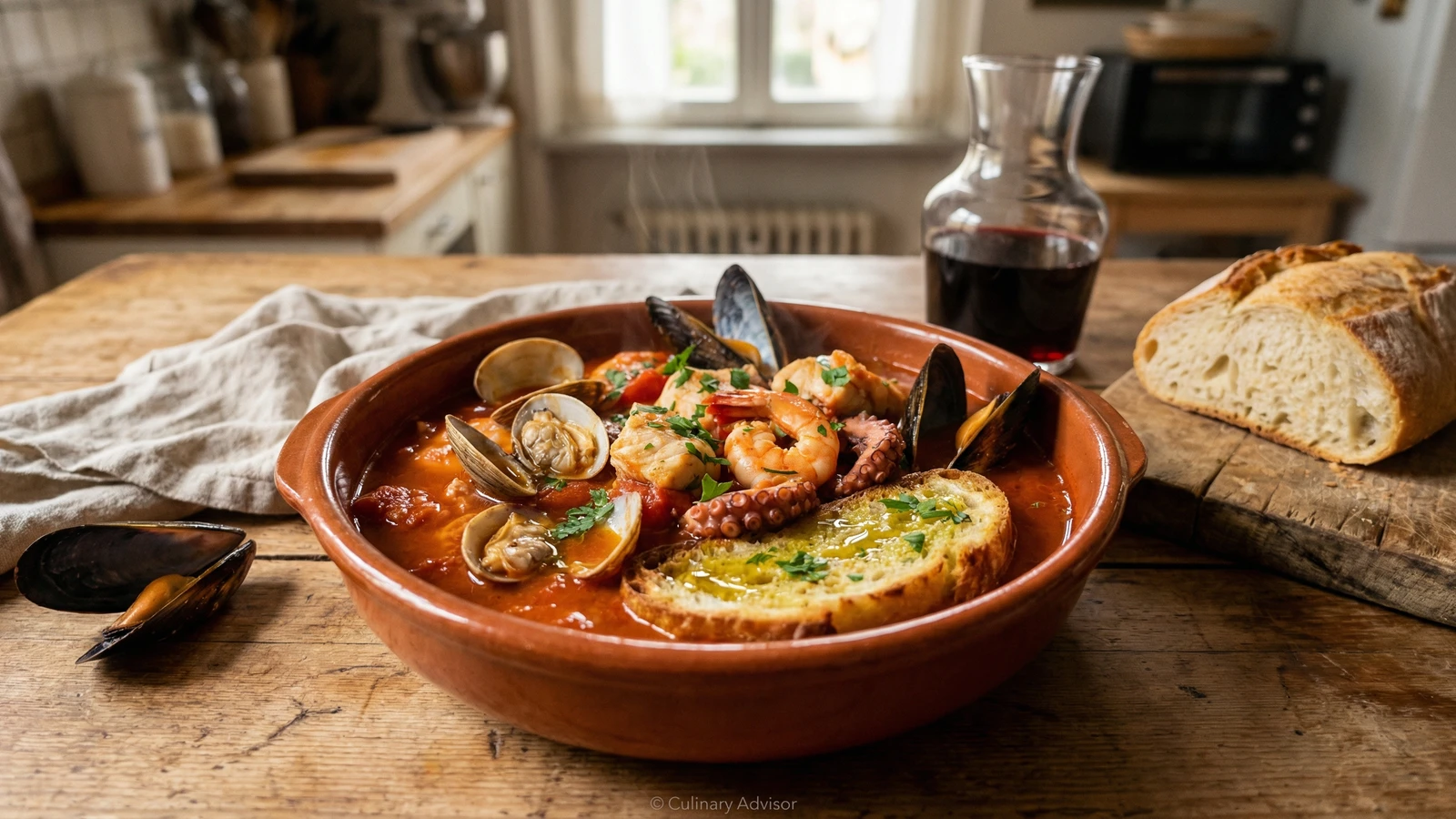
Cacciucco alla Livornese
Created by Chef Graziella
The great fish stew of Livorno, where fishermen transformed the unsellable catch into something magnificent. Five types of seafood minimum, one for each 'c' in the name, swimming in a spicy tomato broth and served over bread rubbed raw with garlic.
Cacciucco is not a refined dish. It was born on the docks of Livorno, where fishermen's wives transformed whatever could not be sold into supper. The ugly fish, the broken shellfish, the small fry that slipped through the nets. Poverty created this stew, and genius perfected it.
The spelling tells you what belongs inside. Five c's demand five varieties of seafood. Some say more is better. I say five is sufficient if you choose well. You need creatures that hold their shape through simmering: octopus and squid that turn tender with time, firm-fleshed fish that do not disintegrate, mussels and clams that steam open at the last moment. The broth must be spicy. Livornese cooking does not fear heat. The peperoncino is not negotiable.
This stew requires your fishmonger's best and your full attention. The timing of adding each seafood determines whether you serve a magnificent cacciucco or an expensive pot of overcooked rubber. There is no recovery from overcooking shellfish. None whatsoever. You must stand at the stove and watch.
Cacciucco likely derives from the Turkish 'küçük,' meaning small or mixed, reflecting Livorno's centuries as a Mediterranean trading port where sailors from every nation mingled on the docks. The dish appears in Livornese records by the 18th century, though fishermen had certainly been making versions of it long before anyone thought to write it down. The five c's legend may be folklore, but it enforces a truth: this stew demands variety.
The technique, the tradition, and the story behind every dish.
Discover Culinary AdvisorIngredients
octopus
Quantity
1 pound
cleaned
squid
Quantity
1 pound
cleaned and cut into rings and tentacles
firm white fish
Quantity
1 pound
cut into 2-inch pieces
mussels
Quantity
1 pound
scrubbed and debearded
littleneck clams
Quantity
1 pound
scrubbed
large shrimp
Quantity
1/2 pound
shell-on
extra virgin olive oil
Quantity
3/4 cup
yellow onion
Quantity
1 large
diced fine
celery stalks
Quantity
2
diced fine
carrot
Quantity
1
peeled and diced fine
garlic cloves
Quantity
6
sliced thin
dried peperoncino flakes
Quantity
1 teaspoon, or more to taste
dry red wine
Quantity
1 cup
San Marzano tomatoes
Quantity
1 can (28 ounces)
crushed by hand
fish broth
Quantity
4 cups
warm
fresh Italian parsley
Quantity
1/2 cup
chopped
kosher salt
Quantity
to taste
stale Tuscan bread
Quantity
6 thick slices
garlic cloves
Quantity
2
halved, for rubbing toast
| Ingredient | Quantity |
|---|---|
| octopuscleaned | 1 pound |
| squidcleaned and cut into rings and tentacles | 1 pound |
| firm white fishcut into 2-inch pieces | 1 pound |
| musselsscrubbed and debearded | 1 pound |
| littleneck clamsscrubbed | 1 pound |
| large shrimpshell-on | 1/2 pound |
| extra virgin olive oil | 3/4 cup |
| yellow oniondiced fine | 1 large |
| celery stalksdiced fine | 2 |
| carrotpeeled and diced fine | 1 |
| garlic clovessliced thin | 6 |
| dried peperoncino flakes | 1 teaspoon, or more to taste |
| dry red wine | 1 cup |
| San Marzano tomatoescrushed by hand | 1 can (28 ounces) |
| fish brothwarm | 4 cups |
| fresh Italian parsleychopped | 1/2 cup |
| kosher salt | to taste |
| stale Tuscan bread | 6 thick slices |
| garlic cloveshalved, for rubbing toast | 2 |
Equipment Needed
- •Heavy 8-quart Dutch oven or wide braising pot
- •Large pot for cooking octopus
- •Slotted spoon for handling seafood
- •Wide shallow bowls for serving
Instructions
- 1
Prepare the octopus
Bring a large pot of salted water to a boil. Add the cleaned octopus and reduce heat to a gentle simmer. Cook until a knife slides easily into the thickest part of the tentacle, about 45 minutes to 1 hour. The octopus should be tender, not tough. Remove, let cool slightly, and cut into bite-sized pieces. Reserve the cooking liquid.
Some Livornese cooks add a wine cork to the pot, believing it tenderizes the octopus. The science is doubtful, but superstition harms nothing. - 2
Build the soffritto
In a wide, heavy pot or Dutch oven, heat half a cup of the olive oil over medium heat. Add the onion, celery, and carrot. Cook slowly, stirring occasionally, until the vegetables are completely soft and the onion is golden, about 15 minutes. Do not rush this foundation. FLAVOR, IN ITALIAN DISHES, builds up from the bottom.
- 3
Add garlic and heat
Add the sliced garlic and peperoncino flakes to the soffritto. Cook for one minute, stirring constantly. The garlic must become fragrant but never brown. Burnt garlic is bitter and will ruin your stew. If your peperoncino is old and dull, use more. The stew should have presence.
- 4
Cook the squid
Add the squid rings and tentacles to the pot. Stir to coat with the soffritto and cook for 3 to 4 minutes until the squid turns opaque. Squid requires either very brief cooking or very long cooking. Anything in between produces rubber.
- 5
Add wine and tomatoes
Pour in the red wine and let it bubble until reduced by half, about 3 minutes. The alcohol smell should disappear. Add the crushed tomatoes and stir thoroughly. Bring to a simmer.
Red wine is traditional in Livorno, unlike most Italian fish preparations. It gives the broth its characteristic deep color. White wine is acceptable, but you will have made a different dish. - 6
Build the broth
Add the warm fish broth and the cooked octopus pieces. If you reserved octopus cooking liquid, add up to one cup of it for depth. Season with salt, remembering that the shellfish will add brine. Simmer uncovered for 20 minutes to marry the flavors. The broth should taste of the sea and tomato in equal measure.
- 7
Add the fish
Nestle the pieces of firm fish into the broth. Do not stir, or the fish will break apart. Let them poach gently in the simmering liquid for 5 minutes. The fish is ready when it just begins to flake at the edges.
- 8
Add the shellfish
Add the shrimp, mussels, and clams to the pot, pushing them into the broth. Cover the pot and cook for 4 to 5 minutes, until the mussels and clams have opened and the shrimp are pink and curled. Discard any shellfish that refuse to open. They were dead before cooking and are not safe.
Once the shellfish go in, you have perhaps six minutes before they overcook. Stand at the stove. Watch. Remove from heat the moment the shells open wide. - 9
Prepare the toast
While the stew finishes, toast the bread slices until golden on both sides. Immediately rub one side of each slice vigorously with the cut garlic clove. The rough surface will grate the garlic into the bread. Drizzle with the remaining olive oil. This is fettunta, and it is essential.
- 10
Serve immediately
Place one slice of garlic toast in the bottom of each wide, shallow bowl. Ladle the cacciucco over the bread, distributing the seafood evenly. Each bowl should contain some of everything. Scatter fresh parsley over the top. Serve at once. Fish stews do not wait for anyone.
Chef Tips
- •Ask your fishmonger to clean the octopus and squid. This is tedious work, and they do it better than you will at home. Buy the freshest fish available, whatever that may be. The specific varieties matter less than their freshness.
- •Make your own fish broth if possible. Collect shrimp shells and fish bones, simmer them with onion, celery, fennel fronds, and white wine for 30 minutes. Strain. This broth makes a profound difference. Commercial fish stock is acceptable, never bouillon cubes.
- •The bread must be stale and sturdy. Fresh bread turns to mush. Proper Tuscan bread, unsalted and dense, is ideal. A good ciabatta serves if you cannot find it. The bread absorbs the broth and becomes part of the dish, not a garnish.
- •Cacciucco should be moderately spicy, not timid. If you can eat it without noticing the peperoncino, you have not added enough. Adjust the heat to your tolerance, but do not eliminate it entirely.
Advance Preparation
- •The octopus can be cooked one day ahead and refrigerated in its cooking liquid. This actually improves its texture.
- •The soffritto and tomato base can be prepared several hours ahead and held at room temperature. Reheat before adding the fish.
- •Do not add the fish or shellfish until just before serving. There is no reheating a fish stew without destroying it.
Frequently Asked Questions
Nutrition Information
1 serving (about 600g)
Where cooking meets culture.
Culinary mentorship, cultural storytelling, and the editorial depth that makes cooking meaningful.
Explore Culinary Advisor