Culinary Advisor
A cooking platform built around craft, culture, and the stories behind what we eat.
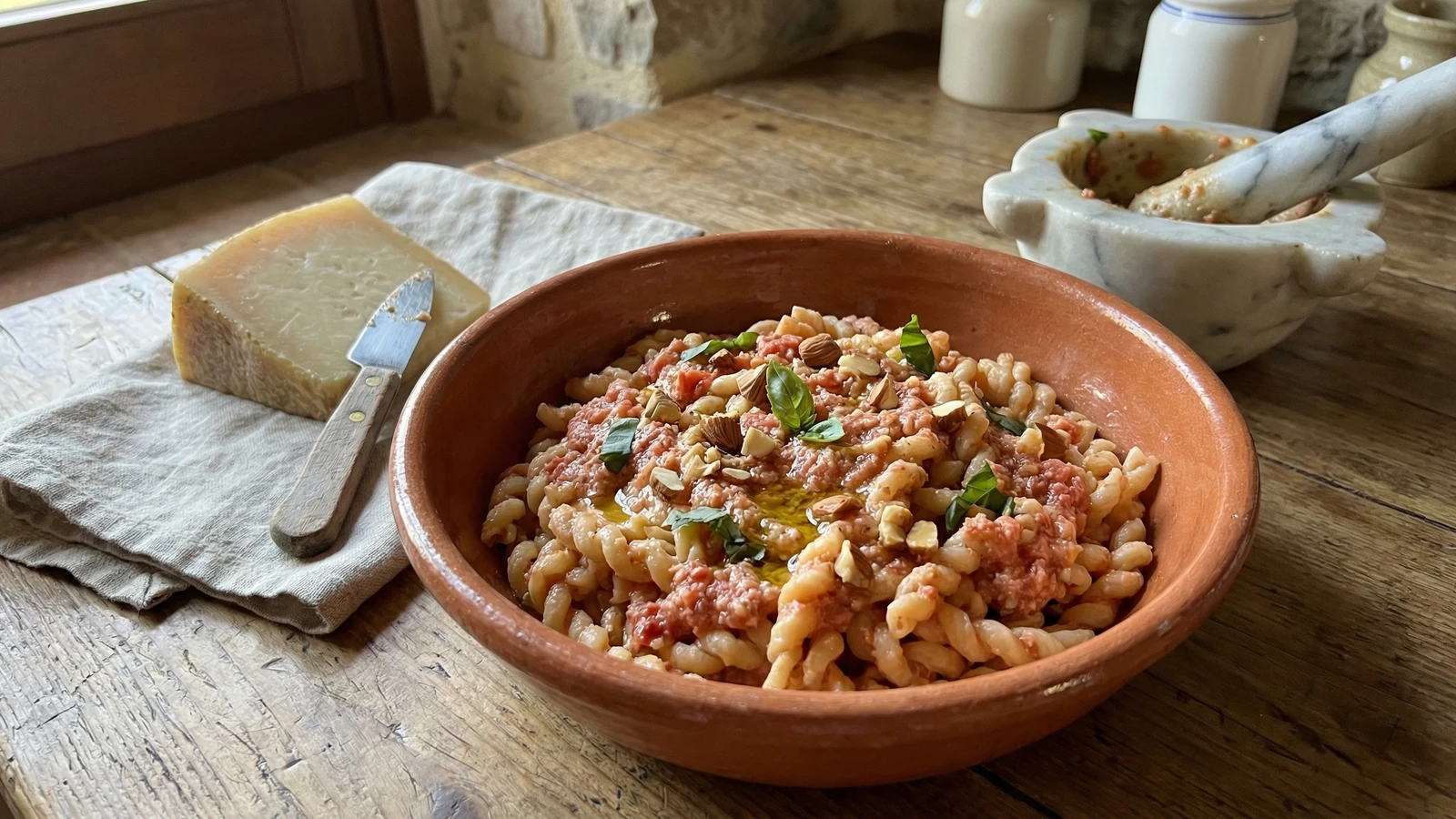
Busiate al Pesto Trapanese
Created by Chef Graziella
Sicily's raw tomato and almond pesto, pounded in a mortar as it has been for centuries, tossed with hand-twisted pasta that traps the sauce in every spiral. Trapani's gift to the world.
Genoa does not own pesto. The Trapanese would like you to know this. While the Ligurians were grinding basil and pine nuts, the cooks of western Sicily were making their own version with almonds and ripe tomatoes, a sauce that tastes like summer concentrated in a mortar.
This is not a cooked sauce. The tomatoes are raw, crushed with almonds that the Arabs brought to Sicily a thousand years ago. The basil is pounded, not chopped. The garlic is present but restrained, as it must always be in Italian cooking. What emerges is bright, fresh, and utterly different from the green pesto most Americans know.
The pasta matters here. Busiate are hand-twisted spirals made by wrapping dough around a thin reed or knitting needle. The corkscrew shape catches the rough pesto in every turn. You can make this with store-bought fusilli if you must, but know that you are compromising. The Trapanese would not approve.
Pesto Trapanese traces its roots to Arab-Norman Sicily, when almonds arrived from the Middle East and transformed the island's cooking. Trapani, a port city on Sicily's western tip, developed this sauce as its answer to Genoa's basil paste. The mortar and pestle method predates the food processor by centuries, and purists insist the texture is superior when pounded by hand.
The technique, the tradition, and the story behind every dish.
Discover Culinary AdvisorIngredients
ripe tomatoes
Quantity
1 pound (about 3 medium)
at room temperature
blanched almonds
Quantity
1/2 cup
garlic cloves
Quantity
2
fresh basil
Quantity
1 large bunch (about 1 ounce)
leaves only
extra virgin olive oil
Quantity
1/2 cup, plus more for drizzling
Pecorino Siciliano or aged Pecorino Romano
Quantity
1/2 cup
freshly grated
kosher salt
Quantity
to taste
busiate or fusilli
Quantity
1 pound
semolina flour (optional)
Quantity
2 cups
warm water (optional)
Quantity
3/4 cup
fine sea salt (optional)
Quantity
1/2 teaspoon
| Ingredient | Quantity |
|---|---|
| ripe tomatoesat room temperature | 1 pound (about 3 medium) |
| blanched almonds | 1/2 cup |
| garlic cloves | 2 |
| fresh basilleaves only | 1 large bunch (about 1 ounce) |
| extra virgin olive oil | 1/2 cup, plus more for drizzling |
| Pecorino Siciliano or aged Pecorino Romanofreshly grated | 1/2 cup |
| kosher salt | to taste |
| busiate or fusilli | 1 pound |
| semolina flour (optional) | 2 cups |
| warm water (optional) | 3/4 cup |
| fine sea salt (optional) | 1/2 teaspoon |
Equipment Needed
- •Large marble or granite mortar and pestle (at least 2-cup capacity)
- •Wooden skewer or thin knitting needle for shaping busiate
- •Wooden pasta board
- •Large pot for boiling pasta
Instructions
- 1
Make the busiate dough
If making fresh pasta, mound the semolina flour on a wooden board. Create a well in the center. Add the salt and warm water to the well. Using a fork, gradually incorporate the flour from the inner walls until a shaggy dough forms. Knead firmly for 10 minutes until the dough is smooth, elastic, and no longer sticky. Wrap tightly in plastic and rest for 30 minutes at room temperature. The dough must rest; do not skip this.
Semolina dough is stiffer than egg pasta dough. This is correct. The firm texture allows the pasta to hold its twisted shape during cooking. - 2
Shape the busiate
Cut the rested dough into small pieces. Roll each piece into a rope about the thickness of a pencil. Cut into 3-inch lengths. Place a thin wooden skewer or knitting needle at one end of a rope, at a slight angle. Roll the dough around the skewer while pressing and stretching, creating a tight spiral. Slide the pasta off the skewer onto a semolina-dusted tray. The shape should resemble a corkscrew. Repeat with remaining dough. This takes time. Do not rush.
Traditional Sicilian cooks use a ferro, a thin iron rod or dried reed. A wooden skewer or thin knitting needle works adequately. The pasta should grip the tool as you roll, creating defined ridges. - 3
Toast the almonds
Place the blanched almonds in a dry skillet over medium heat. Shake the pan frequently, watching carefully. Toast until the almonds are golden and fragrant, 4 to 5 minutes. Do not walk away. Almonds burn quickly and there is no recovering from this. Transfer immediately to a plate to cool.
- 4
Prepare the tomatoes
Bring a small pot of water to boil. Score an X in the bottom of each tomato. Blanch for 30 seconds, then transfer to ice water. Peel the skins, which should slip off easily. Cut the tomatoes in half and squeeze out the seeds and excess liquid. Chop the flesh roughly. The tomatoes must be ripe. If they are not red throughout, fragrant, and slightly soft, wait for better ones.
- 5
Pound the pesto
In a large mortar, combine the garlic and a generous pinch of salt. Pound to a paste. Add the toasted almonds and pound until broken down but still textured; this is not almond butter. Add the basil leaves in batches, pounding and grinding against the sides of the mortar until a rough paste forms. Add the tomatoes and continue pounding until incorporated but not smooth. The texture should be rustic, not pureed.
A food processor produces acceptable results if you pulse carefully and do not overprocess. But the mortar creates superior texture. The pounding releases oils differently than blades do. If I can do this with one and a half arms, you can manage it. - 6
Finish the pesto
Transfer the pounded mixture to a bowl. Stir in the olive oil gradually until the pesto is loose enough to coat pasta but still thick. Fold in the grated pecorino. Taste and adjust salt. The pesto should be bright, fresh, with distinct almond texture. It should not be watery or homogeneous.
- 7
Cook the pasta
Bring abundant salted water to a vigorous boil. The water should taste like the sea. Add the busiate and cook until tender but with pleasant resistance at the center, 8 to 10 minutes for fresh pasta, following package directions for dried. Reserve one cup of pasta water before draining.
- 8
Dress and serve
Transfer the hot pasta to a large serving bowl. Add the pesto and toss vigorously. The heat of the pasta will warm the sauce and release the aromas of the tomato and basil. Add splashes of pasta water as needed to help the sauce coat every spiral. The pesto clings; it does not pool. Serve immediately in warm bowls with additional pecorino at the table. This is a summer dish. Eat it outside if you can.
Chef Tips
- •Sicilian almonds have particular sweetness, but any good blanched almond will serve. Do not use almonds with skins. The bitterness intrudes.
- •The garlic here is modest. Two cloves for a pound of pasta. Those who add more betray the dish. The unbalanced use of garlic is the single greatest cause of failure in would-be Italian cooking.
- •Pecorino Siciliano is traditional but increasingly difficult to find. Aged Pecorino Romano substitutes adequately. Parmigiano-Reggiano is not traditional here, though I have seen Trapanese cooks use it when pecorino was unavailable.
- •This pesto does not keep well. The raw tomatoes oxidize and the basil darkens. Make it within hours of serving. The almonds can be toasted days ahead.
Advance Preparation
- •The busiate can be shaped up to 4 hours ahead and left on a semolina-dusted tray at room temperature. Do not refrigerate; they become gummy.
- •Toast the almonds up to 3 days ahead and store in an airtight container.
- •The pesto must be made fresh. Do not make it the day before. The tomatoes and basil will suffer.
Frequently Asked Questions
Nutrition Information
1 serving (about 300g)
Where cooking meets culture.
Culinary mentorship, cultural storytelling, and the editorial depth that makes cooking meaningful.
Explore Culinary Advisor