Culinary Advisor
A cooking platform built around craft, culture, and the stories behind what we eat.
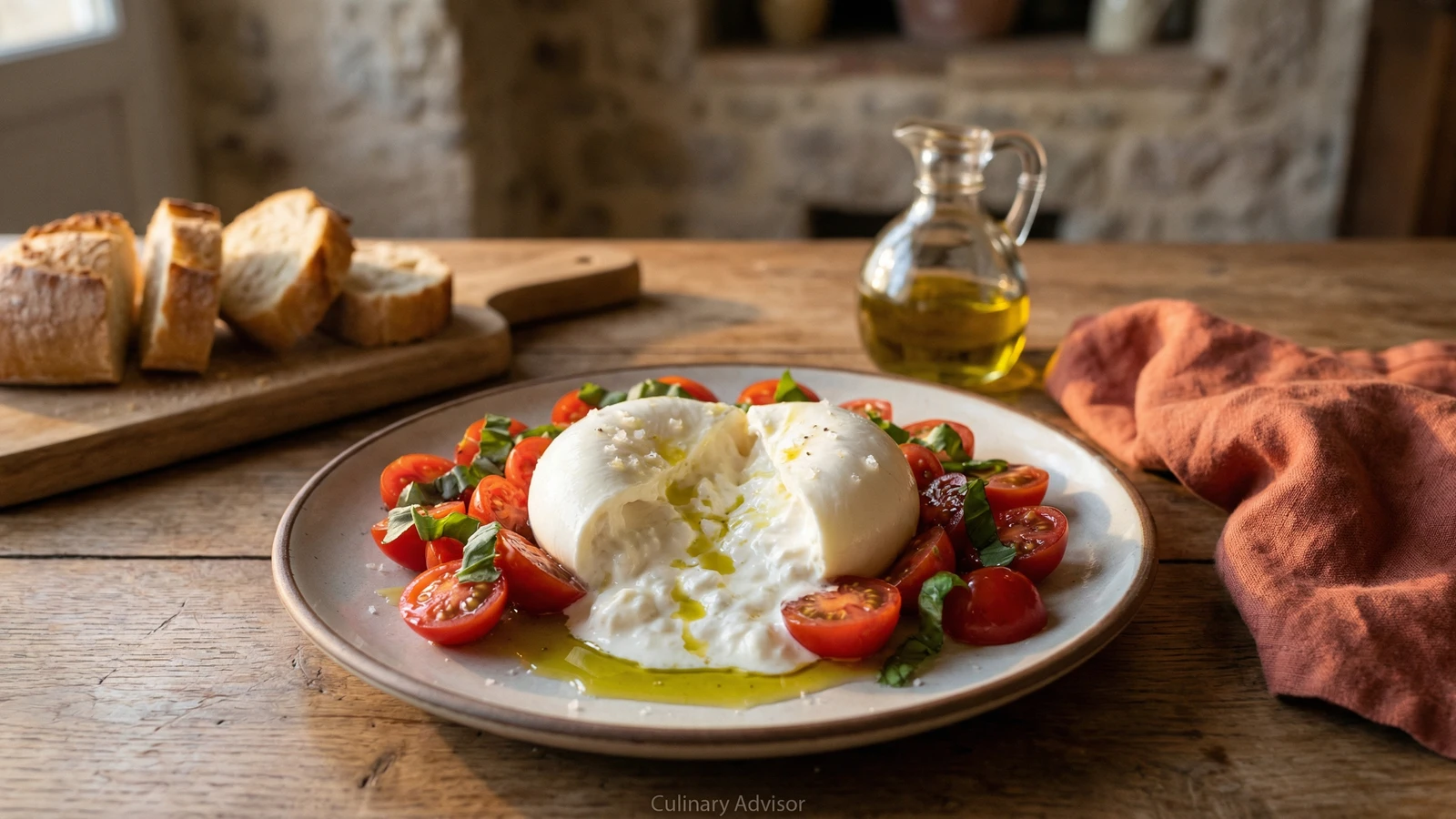
Burrata con Pomodorini e Basilico
Created by Chef Graziella
Puglia's gift to the table: a pillow of fresh mozzarella concealing a heart of cream, surrounded by ripe tomatoes and basil. Three ingredients. No cooking. No forgiveness for mediocrity.
Burrata means 'buttered,' and when you cut into a fresh one, you understand why. The outer shell of mozzarella gives way to a center of stracciatella and cream that pools across the plate like something alive. This is not a cheese you cook with. This is a cheese you worship.
I must be direct with you: if you cannot find excellent burrata, do not make this dish. A mediocre burrata is a sad thing, rubbery on the outside and bland within. The cheese should be no more than two days old, still swimming in its milky whey. In Puglia, they eat it the day it is made. We cannot all live in Puglia, but we can demand freshness.
The same applies to the tomatoes. They must be ripe, fragrant, and at room temperature. Cold tomatoes have no flavor. Refrigeration destroys the volatile compounds that make a tomato worth eating. If your tomatoes smell like nothing, they will taste like nothing. Wait for summer. Wait for tomatoes that smell like the sun.
What you keep out is as significant as what you put in. There is no garlic here, no balsamic reduction, no arugula piled on top like a small forest. The Pugliesi understand that when your ingredients are perfect, your job is to stay out of their way.
Burrata was invented in Andria, Puglia, in the 1920s by Lorenzo Bianchino, who sought a way to use the scraps from mozzarella production. He wrapped stracciatella in a pouch of fresh pasta filata and created something that would conquer the world. For decades it remained a local secret, too fragile to travel. Only with modern refrigeration did burrata escape Puglia to find its way onto tables across Italy and beyond.
The technique, the tradition, and the story behind every dish.
Discover Culinary AdvisorIngredients
fresh burrata
Quantity
2 balls (about 8 ounces each)
ripe cherry tomatoes
Quantity
1 pint (about 12 ounces)
at room temperature
fresh basil
Quantity
1 large bunch (about 1 ounce)
extra virgin olive oil
Quantity
finest quality
flaky sea salt
Quantity
to taste
black pepper
Quantity
to taste
freshly ground
| Ingredient | Quantity |
|---|---|
| fresh burrata | 2 balls (about 8 ounces each) |
| ripe cherry tomatoesat room temperature | 1 pint (about 12 ounces) |
| fresh basil | 1 large bunch (about 1 ounce) |
| extra virgin olive oil | finest quality |
| flaky sea salt | to taste |
| black pepperfreshly ground | to taste |
Equipment Needed
- •Sharp knife for cutting burrata at table
- •Large serving plate or individual plates
Instructions
- 1
Prepare the tomatoes
Remove the tomatoes from the refrigerator at least one hour before serving. Cold tomatoes have no soul. Slice them in half through the stem end. If any are larger than a cherry, quarter them. The pieces should be bite-sized, releasing their juices when cut. Place them in a bowl and season lightly with flaky salt. Let them sit while you prepare the rest. The salt draws out their liquid and concentrates their flavor.
Choose tomatoes that smell like tomatoes. Hold them to your nose. If there is no fragrance, there will be no flavor. Sungolds, cherry tomatoes on the vine, or any small variety at peak ripeness will serve. - 2
Temper the burrata
Remove the burrata from its liquid and set it on a clean kitchen towel to drain for five minutes. The cheese must be at room temperature, not cold. Cold burrata is firm and flavorless. At room temperature, it becomes supple, the cream inside fluid. If the burrata has been refrigerated, let it sit on the counter for 30 minutes before serving.
Fresh burrata should be used within two days of purchase. After that, the cream inside becomes sour and the texture suffers. Ask your cheesemonger when it arrived. - 3
Compose the plate
Place the burrata in the center of a serving plate or divide between individual plates. Scatter the seasoned tomatoes and their accumulated juices around and over the cheese. Tear the basil leaves and distribute them among the tomatoes. Do not chiffonade the basil into ribbons. Tearing releases the oils without bruising the leaves.
- 4
Dress and serve immediately
Drizzle generously with your finest olive oil. This is not the moment for cooking oil. Use the oil you would drink from a spoon. Scatter more flaky salt over the burrata and grind fresh pepper across the plate. Serve immediately with good crusty bread for dragging through the cream and tomato juices. Once the burrata is cut, the clock is ticking. Eat.
Present the burrata whole and cut it at the table. The moment the knife breaks through and the stracciatella spills out is theatrical. Let your guests witness it.
Chef Tips
- •Burrata from Puglia, if you can find it, remains the standard. American burrata has improved greatly, but freshness matters more than origin. A two-day-old domestic burrata beats a week-old import every time.
- •The olive oil should be Pugliese if possible, fruity and peppery, made from Coratina or Ogliarola olives. The regional pairing is not an accident. These flavors grew up together.
- •Serve this as a first course, never as a side dish. Burrata deserves its own moment. Follow it with something simple so the memory lingers.
Advance Preparation
- •This dish cannot be assembled ahead. The burrata weeps, the tomatoes grow soggy, the basil wilts. Prepare it just before serving.
- •You may halve and salt the tomatoes up to 30 minutes in advance. Cover and leave at room temperature.
- •Remove burrata from refrigeration 30 minutes before serving to bring it to proper temperature.
Frequently Asked Questions
Nutrition Information
1 serving (about 215g)
Where cooking meets culture.
Culinary mentorship, cultural storytelling, and the editorial depth that makes cooking meaningful.
Explore Culinary Advisor