Culinary Advisor
A cooking platform built around craft, culture, and the stories behind what we eat.
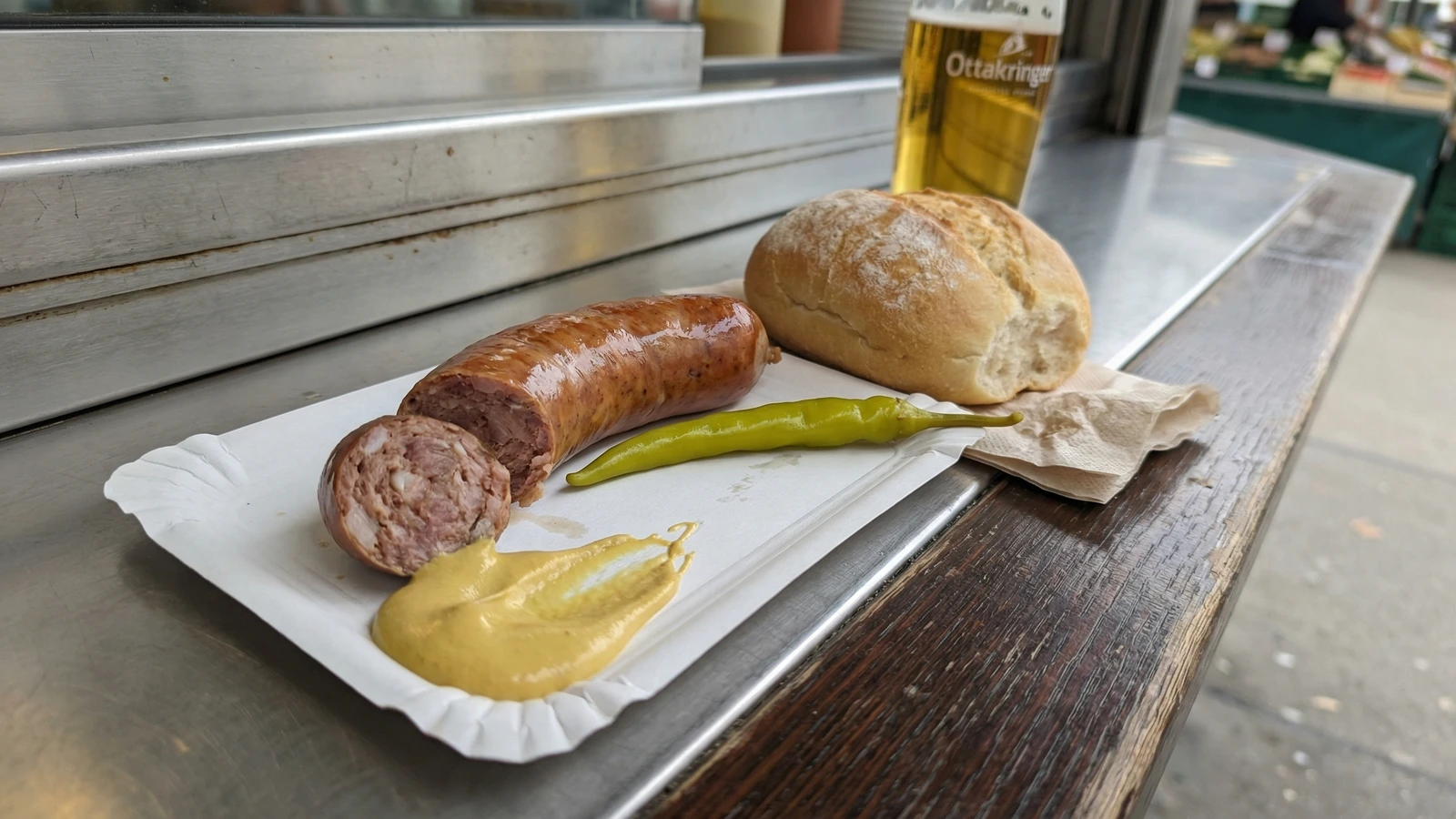
Burenwurst
Created by Chef Elsa
The Würstelstand's coarse, snappy pork sausage served the proper Viennese way: gently heated (never boiled), with sharp mustard, a fresh Semmel, and a Pfefferoni on the side.
Every city has a piece of street food that tells you who lives there. In Vienna, it's the Würstelstand. These little sausage stands sit on street corners all over the city, open until two or three in the morning, and they serve some of the most honest food in Austria. You don't go for the ambiance. You go because it's cold and late and you want a hot sausage with sharp mustard and a torn piece of bread, standing up, no plate, no table, just you and the night and the smell of pork and Senf.
Burenwurst is the Würstelstand sausage that tells you the most about Viennese taste. It's thick and coarse-ground, with visible chunks of pork in the cross-section. When you bite through the casing, it snaps. That snap is everything. It means the casing is natural, the sausage was made properly, and nobody overheated it in the water. The inside is juicy and porky, not smooth like a Frankfurter, not smoked like a Debreziner. Just clean, well-seasoned pork with a texture you can feel.
Gretel always said that simple food is the hardest to get right because there's nowhere to hide. Burenwurst is four ingredients on a paper plate. The sausage has to be good, the mustard has to be sharp, the bread has to be fresh, and the person heating it has to care enough not to let the water boil. That's the whole recipe. That's also the whole philosophy of Viennese street food: do a few things, do them properly, and don't get fancy about it.
Vienna's Würstelstände have been feeding the city since the late 19th century, originally as mobile carts before establishing the permanent kiosk-style stands found on street corners today. The name Burenwurst likely derives from the Boer Wars of 1899 to 1902, when the sausage appeared in Vienna around the same time and the name stuck in local slang. Viennese also call it "Hausse," a stock market term meaning a rising market, possibly because the sausage swells as it heats. The Würstelstand was granted protected cultural status by the city of Vienna, recognizing it as an essential piece of Viennese identity, and it remains the one place in the city where a taxi driver and an opera singer stand side by side at two in the morning, eating the same sausage.
The technique, the tradition, and the story behind every dish.
Discover Culinary AdvisorIngredients
Burenwurst (coarse pork sausages)
Quantity
4, about 150g each
Semmeln (Austrian bread rolls) or dark rye bread
Quantity
4
Scharfer Senf (sharp Austrian mustard)
Quantity
to taste
Pfefferoni (pickled mild peppers)
Quantity
4
for serving
freshly grated horseradish (Kren) (optional)
Quantity
to taste
Essiggurkerl (pickled gherkins) (optional)
Quantity
for serving
| Ingredient | Quantity |
|---|---|
| Burenwurst (coarse pork sausages) | 4, about 150g each |
| Semmeln (Austrian bread rolls) or dark rye bread | 4 |
| Scharfer Senf (sharp Austrian mustard) | to taste |
| Pfefferoni (pickled mild peppers)for serving | 4 |
| freshly grated horseradish (Kren) (optional) | to taste |
| Essiggurkerl (pickled gherkins) (optional) | for serving |
Equipment Needed
- •Wide pot or saucepan (deep enough to submerge sausages)
- •Kitchen tongs
- •Thermometer (optional but helpful)
Instructions
- 1
Heat the water
Fill a wide pot with enough water to submerge the sausages completely. Bring it to a simmer, then reduce the heat until the surface is barely moving. You want the water between 70 and 80 degrees Celsius. If you don't have a thermometer, look for the moment just before tiny bubbles start rising from the bottom. That's your window. A proper Würstelstand keeps its water at exactly this temperature all day long.
Never boil a Burenwurst. Boiling water splits the casing, forces the fat out, and turns a sausage with snap into something sad and waterlogged. Gentle heat is the entire technique here. - 2
Simmer the sausages
Slide the Burenwurst into the hot water. Let them sit for twelve to fifteen minutes. The sausages are already cooked (they're a Brühwurst, a scalded sausage), so you're heating them through, not cooking them raw. The casing should tighten slightly and the surface should look taut and glossy. Press one gently with a finger: it should feel firm and full, with a little give in the center. That means the fat inside has warmed through and the whole sausage is ready.
- 3
Prepare the bread and condiments
While the sausages warm, set out your Semmeln or dark bread, the sharp mustard, Pfefferoni, and any extras. If you're going the Würstelstand route, you serve everything on a small paper plate or a simple board. This is not a dish that wants plating. It wants eating. Split the Semmeln if you're making a sandwich, or leave them whole for tearing and dipping.
- 4
Serve whole or sliced
Lift the sausages out with tongs and let them drain for a moment. Now you have a choice. Viennese eat Burenwurst two ways. Whole: set the sausage on the plate with the Semmel alongside, mustard in a generous smear or a pool for dipping. Or "aufg'schnitten" (sliced): cut the sausage into thick rounds, about two centimeters each, fanned out on the plate so you can see the coarse, meaty interior. Either way, the Pfefferoni goes on the side. A bit of Kren never hurts. Mahlzeit!
If you slice it, the texture shows: coarse chunks of pork visible in the cross-section, not the smooth paste of a Frankfurter. That's the whole character of a Burenwurst. The Viennese call it Hausse, and they order it sliced when they want to taste every bite with a dab of mustard.
Chef Tips
- •Find a good butcher. The quality of Burenwurst depends entirely on the sausage itself. You want natural casing and coarse-ground pork with enough fat to stay juicy. If the sausage looks smooth and uniform, it's not a Burenwurst. Ask for something with visible texture.
- •Sharp mustard means sharp. Austrian Scharfer Senf has a horseradish-like bite that clears your sinuses. If you can only find mild Dijon, stir in freshly grated horseradish until it makes your eyes water. That's closer to what you want.
- •The bread matters more than you think. A fresh Semmel with a crisp crust and soft interior is the proper choice. If you can't find Semmeln, a good crusty white roll works. Soft supermarket rolls will turn to paste against the sausage and that's no good.
- •Don't pierce the casing before or during heating. Every hole lets fat and juice escape, and you end up with a dry sausage sitting in greasy water. Leave it whole. The casing is doing its job.
Advance Preparation
- •Burenwurst keeps well in the fridge for several days and in the freezer for up to two months. Defrost overnight in the fridge before heating.
- •There is no make-ahead step here. This is twenty minutes from cold sausage to plate. That's the beauty of it.
Frequently Asked Questions
Nutrition Information
1 serving (about 285g)
Where cooking meets culture.
Culinary mentorship, cultural storytelling, and the editorial depth that makes cooking meaningful.
Explore Culinary Advisor