Culinary Advisor
A cooking platform built around craft, culture, and the stories behind what we eat.
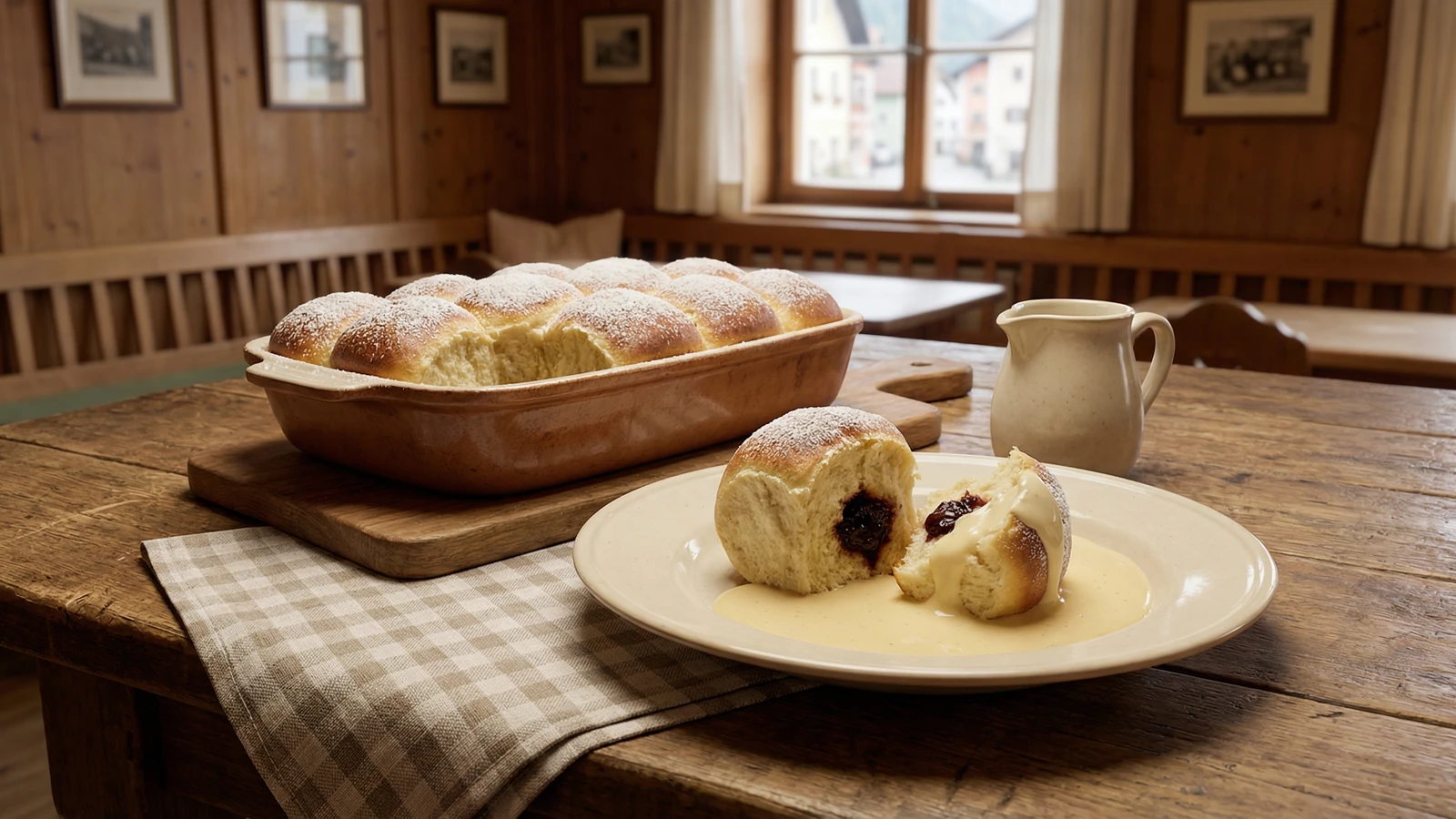
Buchteln mit Vanillesauce
Created by Chef Elsa
Pillowy yeast buns with a hidden pocket of dark Powidl plum jam, baked together so the sides stay impossibly soft, then set swimming in a warm vanilla custard that pools into every crack when you pull them apart.
In my grandmother Eva's kitchen in Kent, Gretel would make Buchteln on grey afternoons when the rain wouldn't stop. She'd set the dough to rise near the radiator, and the whole house would smell like yeast and warm butter before anything had even gone in the oven. I'd stand on my stool and watch her pinch off pieces of dough, press a spoonful of dark Powidl into each one, and fold them shut with fingers that had done it ten thousand times. She packed them into a buttered dish so tightly their shoulders touched, and when they rose again they pushed against each other and upward, like a crowd trying to see over a wall.
Buchteln are Mehlspeisen at their most comforting. The word means "flour dishes," and Austrians treat them as the heart of the cuisine, not an afterthought. In Vienna and across Austria, a plate of Buchteln with Vanillesauce is a proper meal, not a side dish, not dessert after something else. You sit down, you pull a warm bun from the cluster, the soft side tears open to reveal the dark jam hiding inside, and you pour custard over the whole thing until it pools around the base. That is dinner. That is enough.
The technique is forgiving if you understand the principles. The dough is a simple enriched yeast dough, soft and slightly sticky, which means you've added enough butter. You let it rise twice: once in the bowl, once in the baking dish. The second rise is what gives Buchteln their pillowy lightness. Rush it and you get bread rolls. Respect it and you get clouds. Gretel always said Buchteln teach patience the way all good Austrian cooking does: by rewarding you when you wait.
Buchteln arrived in Viennese kitchens from Bohemia, one of many dishes that traveled the Habsburg empire's internal roads from Prague to Vienna. The Czech name buchty refers to the same filled yeast buns, and they remain a staple in Czech and Slovak cooking to this day. In Austria, Buchteln became inseparable from Powidl, the thick, barely sweetened plum butter that Bohemian cooks brought with them, and from the Vanillesauce that Viennese Kaffeehäuser added as their own contribution. The dish is a perfect example of how Austrian cuisine absorbed its empire's traditions and made them its own.
The technique, the tradition, and the story behind every dish.
Discover Culinary AdvisorIngredients
plain flour
Quantity
500g
granulated sugar
Quantity
80g
vanilla sugar (Vanillezucker)
Quantity
1 packet (8g)
dried yeast
Quantity
7g
whole milk (for dough)
Quantity
200ml
lukewarm
unsalted butter (for dough)
Quantity
80g
melted and cooled slightly
egg yolks (for dough)
Quantity
2 large
salt
Quantity
pinch
lemon
Quantity
1
zested
Powidl (thick plum jam)
Quantity
150g
unsalted butter (for baking dish)
Quantity
40g
powdered sugar
Quantity
for dusting
whole milk (for Vanillesauce)
Quantity
500ml
egg yolks (for Vanillesauce)
Quantity
4 large
granulated sugar (for Vanillesauce)
Quantity
60g
vanilla pod
Quantity
1
cornflour
Quantity
1 tablespoon
| Ingredient | Quantity |
|---|---|
| plain flour | 500g |
| granulated sugar | 80g |
| vanilla sugar (Vanillezucker) | 1 packet (8g) |
| dried yeast | 7g |
| whole milk (for dough)lukewarm | 200ml |
| unsalted butter (for dough)melted and cooled slightly | 80g |
| egg yolks (for dough) | 2 large |
| salt | pinch |
| lemonzested | 1 |
| Powidl (thick plum jam) | 150g |
| unsalted butter (for baking dish) | 40g |
| powdered sugar | for dusting |
| whole milk (for Vanillesauce) | 500ml |
| egg yolks (for Vanillesauce) | 4 large |
| granulated sugar (for Vanillesauce) | 60g |
| vanilla pod | 1 |
| cornflour | 1 tablespoon |
Equipment Needed
- •Large mixing bowl
- •Baking dish (approximately 25 x 30cm)
- •Kitchen scale
- •Medium saucepan (for Vanillesauce)
- •Wooden spoon
- •Fine-mesh sieve
- •Pastry brush
Instructions
- 1
Activate the yeast
Warm the milk until it's lukewarm, about body temperature. If you dip your finger in and it feels like nothing, neither warm nor cool, that's right. Stir in the yeast and a teaspoon of the sugar. Leave it for ten minutes. It should foam and smell yeasty. If nothing happens, your yeast is dead and you need to start with a fresh packet. Better to find out now than after you've mixed the dough.
Milk that's too hot will kill the yeast. Too cold and it won't wake up. Lukewarm means 37°C. Your wrist is the best thermometer you have. - 2
Make the dough
Put the flour, remaining sugar, Vanillezucker, salt, and lemon zest in a large bowl. Make a well in the center. Pour in the yeast mixture, the melted butter, and the egg yolks. Stir with a wooden spoon until it comes together, then turn it out and knead by hand for eight to ten minutes. The dough should be soft, smooth, and slightly tacky. If it sticks to your hands like glue, dust them with flour. If it feels dry and tight, you've added too much flour and the Buchteln will come out dense. You want a dough that feels alive, that springs back when you poke it.
- 3
First rise
Shape the dough into a ball and place it in a lightly buttered bowl. Cover with a clean tea towel and set it somewhere warm, not hot, for about an hour. It should double in size. The top will look puffy and slightly domed. When you press a finger into it, the indent should fill back slowly. If it springs back immediately, it needs more time. If it doesn't fill back at all, it's overproofed and you'll want to punch it down and give it twenty minutes more.
Gretel always said the best place for dough to rise is near a warm oven, not inside it. You want gentle warmth, around 25 to 30 degrees. A sunny windowsill or the top of a preheating oven works. - 4
Fill and shape the Buchteln
Punch the risen dough down gently and turn it out onto a lightly floured surface. Divide it into twelve equal pieces. A kitchen scale is your friend here. Each piece should weigh roughly 75 grams. Flatten each piece into a round about the size of your palm. Place a generous teaspoon of Powidl in the center. Pull the edges up and over the filling and pinch them firmly shut. Roll each bun seam-side down between your cupped hands until smooth. The seal must hold or the Powidl will leak during baking and burn on the bottom of the dish. Don't be shy with the pinching.
- 5
Arrange for the second rise
Melt the 40 grams of butter. Pour half into a baking dish, about 25 by 30 centimeters. Place the buns seam-side down in the dish, packed close together so their sides are touching. Brush the tops with the remaining melted butter. Cover with the tea towel again and let them rise for thirty minutes. They'll puff up and press against each other, filling every gap. This is exactly what you want. The touching sides stay soft and tender when they bake, while the tops and the crust of the dish turn golden. That contrast is what makes Buchteln special.
- 6
Bake the Buchteln
Preheat your oven to 180°C (fan 160°C). Bake the Buchteln for 25 to 30 minutes until the tops are deep golden brown and the kitchen smells like a Viennese bakery at six in the morning. The sides where the buns touch will be pale and soft. That's correct. If the tops are browning too quickly, cover loosely with foil for the last ten minutes. Pull them out and let them rest in the dish for five minutes. They'll be too hot to handle and the Powidl inside is molten.
- 7
Make the Vanillesauce
While the Buchteln bake, make the custard. Split the vanilla pod lengthwise and scrape the seeds into the milk. Drop the empty pod in too. Heat the milk in a saucepan until it just begins to shiver at the edges. Don't boil it. In a bowl, whisk the egg yolks with the sugar and cornflour until pale and thick. Pour the hot milk in slowly, whisking constantly. Return everything to the saucepan over low heat and stir with a wooden spoon in slow, steady figure-eights. The sauce is ready when it coats the back of the spoon and a line drawn through it with your finger holds its shape. This takes five to seven minutes. Pull it off the heat immediately.
If the sauce starts to look grainy, you've let it get too hot and the eggs are scrambling. Pour it immediately through a fine sieve into a clean bowl and whisk hard. You can usually save it. The cornflour gives you a safety margin that a pure egg custard doesn't, which is exactly why it's there. - 8
Serve with warmth and generosity
Dust the Buchteln with powdered sugar. Bring the whole baking dish to the table so everyone can pull their own buns from the cluster. The sides will tear softly, showing the pale, steamy interior and the dark seam of Powidl inside. Pour the warm Vanillesauce into a jug and let people help themselves. Be generous. The sauce should pool around the base of each Buchtel on the plate, not sit on top as a polite drizzle. Mahlzeit!
Chef Tips
- •Use real Powidl if you can find it, not regular plum jam. Powidl is cooked down until it's thick, dark, and barely sweet, almost like a plum butter. It's the traditional Bohemian filling and it doesn't run the way looser jams do. Czech or Polish shops often stock it. If you can't find Powidl, use the thickest plum jam you can find and reduce it in a saucepan for five minutes until it holds its shape on a spoon.
- •The Vanillesauce must be warm, not hot. If it's too hot it will thin out and run everywhere. If it's cold it defeats the purpose. You want it at the temperature where you can comfortably hold the jug in your bare hand. That warmth against the warm bun and the cool powdered sugar is everything.
- •Buchteln are forgiving if you underbake by a minute, but punishing if you overbake. Start checking at 22 minutes. The tops should be a rich golden brown, not blonde, not dark. The insides will keep cooking from residual heat.
- •Vanillezucker belongs in both the dough and the sauce. It's not the same thing as vanilla extract. Austrian baking depends on it for a rounded, floral vanilla flavor. Make your own by burying two split vanilla pods in a kilo of caster sugar. In a week you'll have enough to last months.
Advance Preparation
- •The dough can be made the evening before and left to rise slowly overnight in the fridge. Pull it out an hour before shaping to take the chill off. Cold-proofed dough actually develops more flavor and is easier to handle.
- •Shaped Buchteln can be assembled in the buttered dish, covered tightly with cling film, and refrigerated overnight. In the morning, let them come to room temperature and puff for 45 minutes, then bake. This is how you serve fresh Buchteln for a weekend breakfast without waking up at dawn.
- •Vanillesauce can be made several hours ahead and kept warm in a thermos, or reheated very gently over low heat, stirring constantly. It thickens as it cools, so thin it with a splash of warm milk when reheating.
Frequently Asked Questions
Nutrition Information
1 serving (about 400g)
Where cooking meets culture.
Culinary mentorship, cultural storytelling, and the editorial depth that makes cooking meaningful.
Explore Culinary Advisor