Culinary Advisor
A cooking platform built around craft, culture, and the stories behind what we eat.
Benløse Fugle
Created by Chef Freja
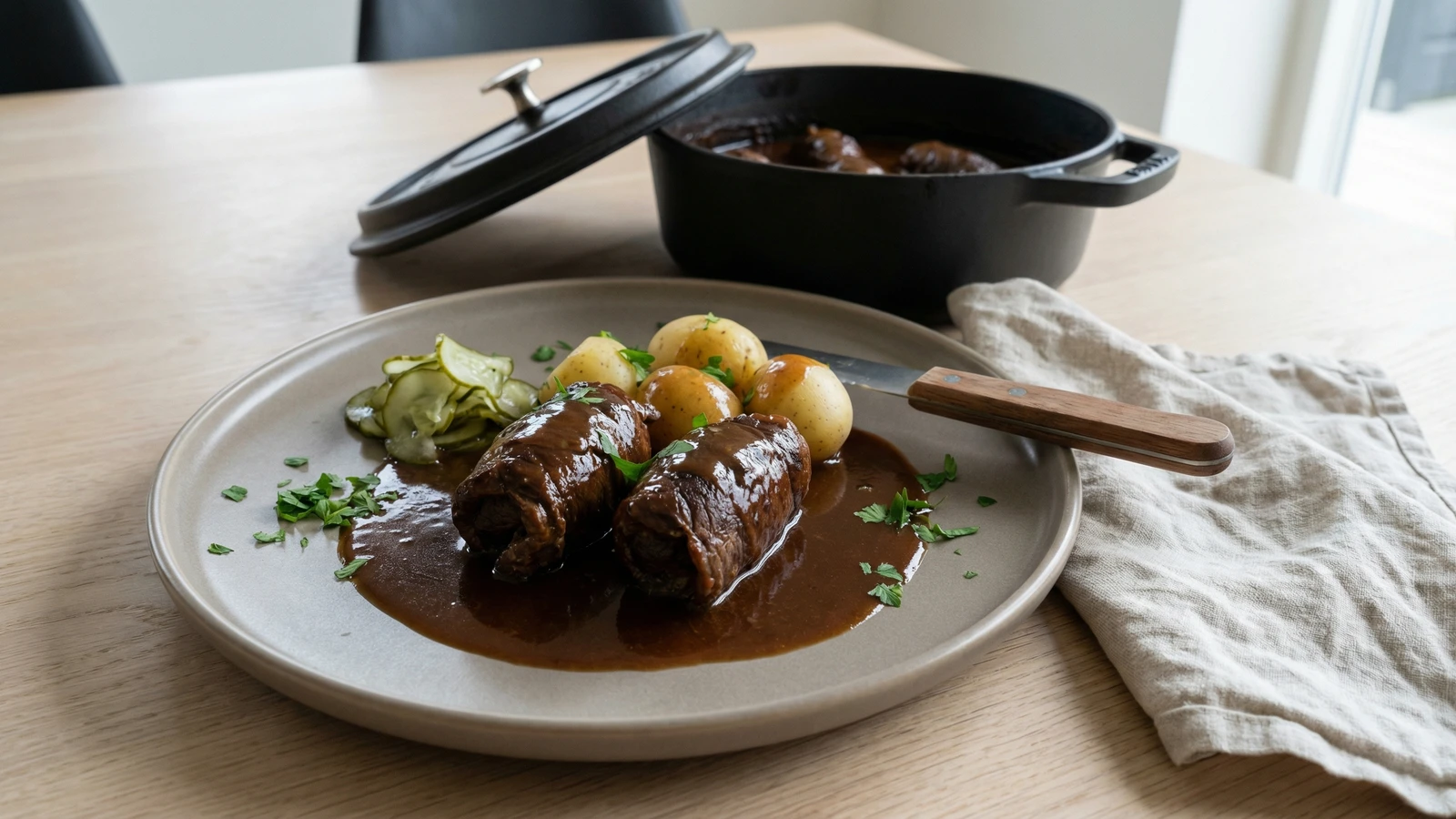
Thin beef slices rolled around bacon and onion, tied with string, and braised slowly in a dark glossy gravy finished with cream and redcurrant jelly. Danish Sunday dinner at its most comforting.
Sunday dinner in January. The short dark days, the windows steaming up, a heavy pot on the back burner for the better part of an afternoon. This is when benløse fugle come out.
The name means 'boneless birds,' and it's one of those Danish names that makes no sense until you see the dish: thin slices of beef rolled tight around bacon and onion, tied with string, looking for all the world like small birds resting on the plate. Nothing to do with poultry. Everything to do with the care that goes into shaping each one and the hours they spend in brown gravy until the meat surrenders completely.
This is mormormad, grandmother food, the Sunday meal that a whole generation of Danes grew up around. There's nothing clever about it. You pound the beef, you roll it, you brown it hard, you braise it slow. What matters is not rushing the browning and not rushing the braise. I'll walk you through both, and you'll finish with a sauce so dark and glossy you'll want to spoon it straight from the pan. The redcurrant jelly at the end is the Danish signature, a quiet sweetness that rounds the whole thing out. Pay attention when you brown the rolls. That's where the flavour of the finished sauce is born, and you'll know when it's right because the fond on the bottom of the pan goes the colour of dark chocolate.
Benløse fugle descend from a broader northern European tradition of stuffed meat rolls, with cousins in the German rouladen and the Polish zrazy, but the Danish version found its own character in the 19th century through the addition of a sauce rounded with cream and a spoonful of redcurrant jelly. The dish became the defining Sunday meal in many Danish households through the postwar decades, when a modest cut of beef could be stretched with bacon and onion to feed a whole family. The name, documented in Danish cookbooks from the mid-1800s, reflects an older European naming convention in which rolled meats were often called 'birds' regardless of their origin, a linguistic fossil that outlasted the kitchens that coined it.
The technique, the tradition, and the story behind every dish.
Discover Culinary AdvisorIngredients
beef top round, thin slices
Quantity
8 slices (about 800g)
pounded to 5mm thick
streaky smoked bacon
Quantity
8 strips
onion (for filling)
Quantity
1 medium
finely chopped
onion (for braise)
Quantity
1 medium
sliced
flat-leaf parsley
Quantity
small bunch
finely chopped
Dijon mustard
Quantity
2 teaspoons
fine sea salt
Quantity
to taste
black pepper
Quantity
freshly ground, to taste
plain flour
Quantity
2 tablespoons
for dusting
unsalted butter
Quantity
50g
neutral oil
Quantity
1 tablespoon
beef stock
Quantity
500ml
ideally homemade
bay leaves
Quantity
2
fresh thyme
Quantity
3 sprigs
redcurrant jelly
Quantity
1 tablespoon
double cream
Quantity
100ml
kitchen string
Quantity
for tying
boiled new potatoes
Quantity
to serve
pickled cucumber
Quantity
to serve
| Ingredient | Quantity |
|---|---|
| beef top round, thin slicespounded to 5mm thick | 8 slices (about 800g) |
| streaky smoked bacon | 8 strips |
| onion (for filling)finely chopped | 1 medium |
| onion (for braise)sliced | 1 medium |
| flat-leaf parsleyfinely chopped | small bunch |
| Dijon mustard | 2 teaspoons |
| fine sea salt | to taste |
| black pepper | freshly ground, to taste |
| plain flourfor dusting | 2 tablespoons |
| unsalted butter | 50g |
| neutral oil | 1 tablespoon |
| beef stockideally homemade | 500ml |
| bay leaves | 2 |
| fresh thyme | 3 sprigs |
| redcurrant jelly | 1 tablespoon |
| double cream | 100ml |
| kitchen string | for tying |
| boiled new potatoes | to serve |
| pickled cucumber | to serve |
Equipment Needed
- •Heavy casserole with tight-fitting lid, 4 litre
- •Meat mallet or heavy flat pan
- •Kitchen string
- •Fine sieve
- •Sharp knife
Instructions
- 1
Pound the beef
Lay each slice of beef between two sheets of baking parchment and pound it gently with the flat side of a meat mallet or a heavy pan until it is about 5mm thick and evenly flat. You're not trying to flatten it into a sheet of paper. You're breaking down the fibers so the meat rolls without tearing and braises into tenderness. If the slices are uneven, the thin parts will overcook while the thick parts stay tough.
Work from the centre outward in gentle taps, not hammer blows. You're persuading the meat, not punishing it. - 2
Season and fill
Lay the pounded slices out on the counter. Season each one lightly with salt and pepper and spread a thin smear of Dijon mustard across the surface. Place a strip of bacon along the length of each slice, then scatter a spoonful of the finely chopped onion and a small pinch of parsley on top. Don't overfill. Too much filling and the rolls burst open in the pan, and you'll spend the next hour fishing onion out of the sauce.
- 3
Roll and tie
Starting from the short end, roll each slice up tightly around the filling, tucking the sides in as you go so nothing escapes. Tie each roll with kitchen string in two or three places, firm but not strangling. The string holds the shape during browning and braising. Without it, the rolls unravel the moment they hit the pan, and you lose the whole point of the dish.
Cut your string into 20cm lengths before you start. Fumbling with a ball of twine while holding a meat-slicked roll is a small misery you can avoid. - 4
Dust with flour
Put the flour on a plate and season it with salt and pepper. Roll each tied parcel in the flour, shaking off the excess. The flour does two things: it gives you a deeper browning in the pan, and it thickens the sauce from the inside as the rolls braise. This is the shortcut that isn't a shortcut. It's the reason Danish braises have that glossy, clinging sauce without needing a cornflour slurry at the end.
- 5
Brown hard
Heat the butter and oil together in a heavy casserole, the kind with a tight-fitting lid, over medium-high heat. When the butter is foaming and smells of hazelnuts, lay the rolls in with space between them. Don't crowd the pan. Crowded meat steams instead of browning, and the whole dish loses its foundation. Turn them as each side takes a deep mahogany colour. This takes about eight minutes and it is the single most important step. The browning is the flavour of the finished sauce. Get it right and the rest takes care of itself.
- 6
Build the braise
Lift the browned rolls out onto a plate. Add the sliced onion to the same pan and cook for three or four minutes in the remaining fat until soft and just starting to colour. Pour in the beef stock and scrape the bottom of the pan with a wooden spoon to lift every dark bit of fond into the liquid. That is where the flavour lives. Add the bay leaves and thyme, return the rolls to the pan, and bring everything to the barest simmer.
- 7
Slow braise
Cover the pan and reduce the heat until the surface of the liquid is barely moving, just the occasional bubble breaking. Braise for an hour and a half, turning the rolls once at the halfway point. The meat should yield to a fork without any resistance. If it's still firm, give it another twenty minutes. The season decides nothing here. Time does. You'll know when it's right because a gentle press with the back of a spoon sinks into the roll like it's made of butter.
- 8
Finish the sauce
Lift the rolls out carefully onto a warm plate and cover them loosely with foil. Strain the cooking liquid through a fine sieve into a smaller pan, pressing the onion gently to extract the flavour but not pushing it through. Bring the sauce to a brisk simmer and reduce by about a third, until it coats the back of a spoon. Stir in the redcurrant jelly and the cream. Taste and adjust the salt. The jelly is the Danish signature, a quiet sweetness that balances the deep savoury weight of the braise. Without it, the sauce tastes like it's missing something. With it, everything lands.
- 9
Serve
Snip the strings off the rolls and lay two on each warm plate. Spoon the dark glossy sauce generously over the top and around. Serve with boiled new potatoes and a small pile of pickled cucumber on the side. The potatoes soak up the sauce and the pickle cuts through the richness. This is mormormad at its best, cooked with love and meant to be eaten slowly. Tak for mad.
Chef Tips
- •Ask your butcher for slices cut from the top round, about 5mm thick, already pounded if possible. A good butcher will do this in thirty seconds and save you ten minutes at home. If you're pounding yourself, do it gently between parchment so the meat doesn't tear.
- •The browning step is not negotiable. If you skip it or rush it, the sauce tastes thin and the whole dish feels underbuilt. Take the full eight minutes and turn each roll onto every side. The fond on the bottom of the pan is the foundation.
- •Redcurrant jelly is the traditional finish and nothing else has quite the same effect. If you can't find it, lingonberry jam is the closest cousin. Don't substitute strawberry or raspberry, which taste out of place with beef.
- •Serve with a glass of something dark and quiet. A Danish porter, a Burgundy, or a glass of aquavit for the brave. This is not a weeknight wine dish, it's a slow dinner and it deserves slow drinks.
Advance Preparation
- •Benløse fugle are one of those dishes that improves overnight. Make the whole thing a day ahead, cool completely, and refrigerate in the braising liquid. Reheat gently on the stovetop until the rolls are warmed through, then finish the sauce with the cream and redcurrant jelly just before serving.
- •The rolls can be assembled and tied up to twelve hours before cooking. Keep them covered in the fridge and bring back to room temperature for twenty minutes before browning, so the butter stays hot when they hit the pan.
- •Leftovers keep beautifully for three days in the fridge and freeze well for up to two months. This is a dish that rewards the joy of waiting.
Frequently Asked Questions
Nutrition Information
1 serving (about 350g)
Where cooking meets culture.
Culinary mentorship, cultural storytelling, and the editorial depth that makes cooking meaningful.
Explore Culinary Advisor