Culinary Advisor
A cooking platform built around craft, culture, and the stories behind what we eat.
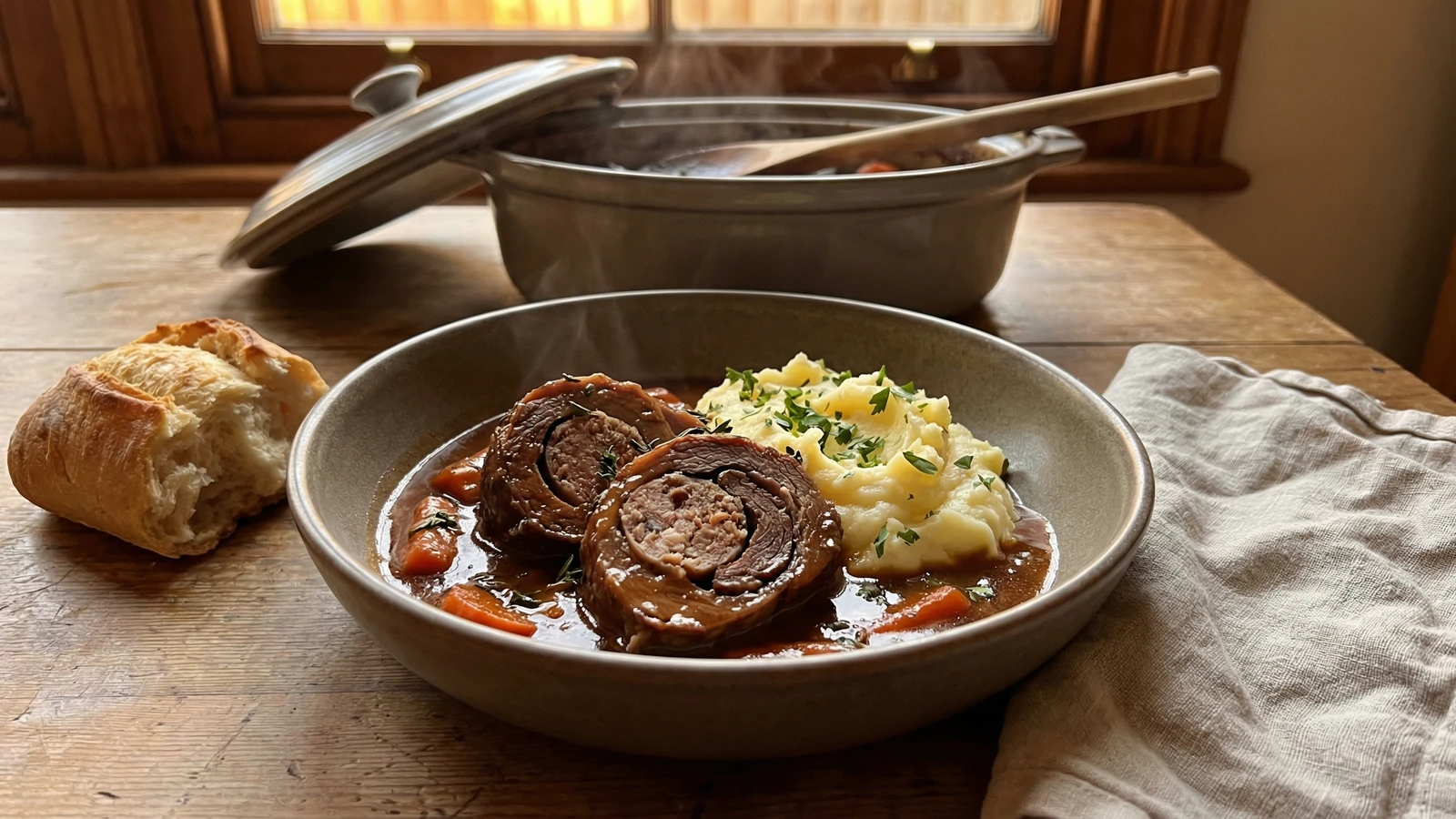
Beef Olives
Created by Chef Thomas
Thin slices of beef rolled around a stuffing of sausage meat and herbs, browned in butter, and braised for two patient hours until the meat yields and the gravy turns dark and rich and worth mopping up with bread.
The kitchen smells different when something is braising. Not the sharp, immediate hit of frying or the dry sweetness of baking, but something lower and slower, a background warmth that settles into the walls. That's the smell of beef olives. It fills the house on a February afternoon and by the time you sit down to eat, the meal already feels like it's been looking after you.
They have nothing to do with olives. Nobody is entirely sure where the name came from, though it may be a corruption of the French 'alouettes,' little birds, because the rolled bundles look vaguely like trussed quail if you squint. What matters is the thing itself: a thin slice of beef spread with a savoury stuffing of sausage meat, herbs, and lemon zest, rolled up, tied, browned in butter, and left to braise in a dark, winey stock until everything goes tender andthe gravy thickens into something you could write sonnets about. Scottish butchers still sell them ready-rolled, and there's something touching about that, a medieval dish surviving in the high street.
I make them when the weather is still properly cold and the evenings close in early. The kind of night when you light the kitchen before four o'clock and the windows steam up. A recipe is a conversation, not a contract, and this one is generous with its margins. Use whatever herbs you have. Adjust the stuffing to your taste. The braising does the real work. Your job is to brown the rolls with conviction, build a good liquid for them to sit in, and then leave them alone for two hours.
There are few better feelings than carrying a casserole dish to the table and lifting the lid. The steam, the colour, the quiet pause before someone picks up a spoon. We're only making dinner. But sometimes dinner is enough.
The technique, the tradition, and the story behind every dish.
Discover Culinary AdvisorIngredients
beef topside
Quantity
4 thin slices, about 600g total
pounded thin by the butcher or at home
pork sausage meat
Quantity
200g
fresh white breadcrumbs
Quantity
50g
small onion (for stuffing)
Quantity
1
very finely chopped
flat-leaf parsley
Quantity
2 tablespoons
finely chopped
fresh thyme leaves
Quantity
1 teaspoon
lemon
Quantity
half
zested
egg yolk
Quantity
1
fine sea salt
Quantity
to taste
black pepper
Quantity
to taste
plain flour
Quantity
2 tablespoons
for dusting
unsalted butter
Quantity
30g
sunflower oil
Quantity
1 tablespoon
onion (for braising)
Quantity
1
sliced
carrots
Quantity
2
peeled and cut into thick rounds
celery
Quantity
2 sticks
sliced
tomato purée
Quantity
1 tablespoon
red wine
Quantity
150ml
beef stock
Quantity
500ml
bay leaves
Quantity
2
thyme sprigs
Quantity
a few
| Ingredient | Quantity |
|---|---|
| beef topsidepounded thin by the butcher or at home | 4 thin slices, about 600g total |
| pork sausage meat | 200g |
| fresh white breadcrumbs | 50g |
| small onion (for stuffing)very finely chopped | 1 |
| flat-leaf parsleyfinely chopped | 2 tablespoons |
| fresh thyme leaves | 1 teaspoon |
| lemonzested | half |
| egg yolk | 1 |
| fine sea salt | to taste |
| black pepper | to taste |
| plain flourfor dusting | 2 tablespoons |
| unsalted butter | 30g |
| sunflower oil | 1 tablespoon |
| onion (for braising)sliced | 1 |
| carrotspeeled and cut into thick rounds | 2 |
| celerysliced | 2 sticks |
| tomato purée | 1 tablespoon |
| red wine | 150ml |
| beef stock | 500ml |
| bay leaves | 2 |
| thyme sprigs | a few |
Equipment Needed
- •Heavy casserole dish or Dutch oven with lid
- •Kitchen string or cocktail sticks
- •Rolling pin
- •Tongs
Instructions
- 1
Make the stuffing
In a bowl, work the sausage meat together with the breadcrumbs, finely chopped onion, parsley, thyme leaves, lemon zest, and the egg yolk. Season it well with salt and pepper. Mix it with your hands until everything is evenly combined. It should feel cohesive but not overworked, like a rough pâté. Taste a small pinch if you like (it's pork, so fry a tiny bit first). The seasoning needs to be confident here because the stuffing has to carry the whole roll.
Good sausage meat makes all the difference. If you can't find it loose, buy the best pork sausages you can and squeeze the meat from the skins. Cheap sausage meat is full of rusk and tastes of nothing. - 2
Prepare the beef slices
Lay each slice of beef between two sheets of cling film or baking parchment and beat them with a rolling pin until they're roughly 5mm thick and fairly even. Don't be violent about it. Firm, steady strikes. You want them thin enough to roll but not so thin they tear. Season each slice on both sides with salt and pepper.
- 3
Roll and tie
Divide the stuffing between the four beef slices, spreading it across the surface and leaving a finger's width of border at the edges. Roll each one up tightly, starting from the shorter end, tucking the sides in as you go, like a parcel. Tie each roll in two or three places with kitchen string. They don't need to be beautiful. They need to hold. Dust the rolls lightly in flour, shaking off the excess.
If you haven't got kitchen string, secure each roll with two or three wooden cocktail sticks instead. Just remember to pull them out before serving. - 4
Brown the rolls
Heat the butter and oil together in a heavy casserole dish or Dutch oven over a medium-high heat. When the butter foams and the foam starts to subside, lay the beef rolls in the pan, seam side down first. Brown them on all sides, turning them carefully with tongs. This takes five or six minutes. You want a proper golden crust, not a pale suggestion of one. The colour is flavour. When they're done, lift them onto a plate and set aside.
- 5
Build the braising liquid
Turn the heat down to medium. Add the sliced onion, carrots, and celery to the same pan with all its buttery, meaty residue. Stir them through and let them soften for eight to ten minutes, until the onion is translucent and the kitchen starts to smell savoury and warm. Add the tomato purée and stir it through for a minute. Pour in the red wine and let it bubble, scraping up anything stuck to the bottom of the pan. This is where the gravy begins. When the wine has reduced by half and lost its raw, boozy edge, pour in the stock. Drop in the bay leaves and thyme sprigs.
The stock matters. Homemade beef stock from bones and time will give you a gravy with real body. If you're using bought stock, choose one without too much salt, as the liquid will reduce and concentrate. - 6
Braise low and slow
Nestle the browned beef rolls back into the liquid. It should come about two-thirds of the way up the rolls. If it doesn't, add a splash more stock. Bring everything to a gentle simmer, then put the lid on and transfer to a low oven, around 160C/140C fan. Leave them alone for an hour and a half to two hours. Check once, halfway through, to make sure the liquid is barely bubbling, not galloping. The beef should be completely tender when you press it with a spoon, and the stuffing firm and fragrant.
- 7
Finish the gravy and serve
Lift the beef olives out carefully and set them on a warm plate. Snip off the string. Fish out the bay leaves and thyme sprigs. Set the casserole over a medium heat on the hob and let the gravy bubble for five to ten minutes until it thickens and the flavour concentrates. Taste it. Season it. If you want it smoother, strain it through a sieve, pushing the softened vegetables through with a spoon. Or leave it as it is, with the carrots and celery still in, which is how I prefer it. Spoon the gravy over the beef olives and bring the dish to the table. Mashed potatoes and something green. That's all it needs.
Chef Tips
- •Ask your butcher to cut the topside thinly for you and to give it a flatten with the meat bat. A good butcher will know what you're after if you say 'beef olives.' If you're doing it at home, pop the slices in the freezer for thirty minutes first. Slightly firm meat is easier to pound evenly.
- •The lemon zest in the stuffing is quiet but important. It lifts the richness of the sausage meat and the beef without announcing itself. Don't skip it. A dish this rich needs something bright working underneath.
- •Leftover beef olives, sliced thickly and reheated in their gravy, are magnificent the next day. The flavours settle and deepen overnight. I'd go so far as to say they improve, which is rare praise for a reheated supper.
- •If you want to stretch this to feed more people, the gravy is the place to be generous. Make extra stock. The rolls go further when they're sitting in a proper lake of sauce with a pile of mash to soak it up.
Advance Preparation
- •The stuffing can be made a day ahead and kept covered in the fridge. Bring it to room temperature before spreading on the beef.
- •The beef olives can be rolled, tied, and refrigerated up to twelve hours ahead. Brown and braise them when you're ready.
- •The finished dish reheats well the following day. Store the rolls in their gravy, covered, in the fridge. Warm through gently in a low oven, covered, for thirty minutes.
Frequently Asked Questions
Nutrition Information
1 serving (about 430g)
Where cooking meets culture.
Culinary mentorship, cultural storytelling, and the editorial depth that makes cooking meaningful.
Explore Culinary Advisor