Culinary Advisor
A cooking platform built around craft, culture, and the stories behind what we eat.
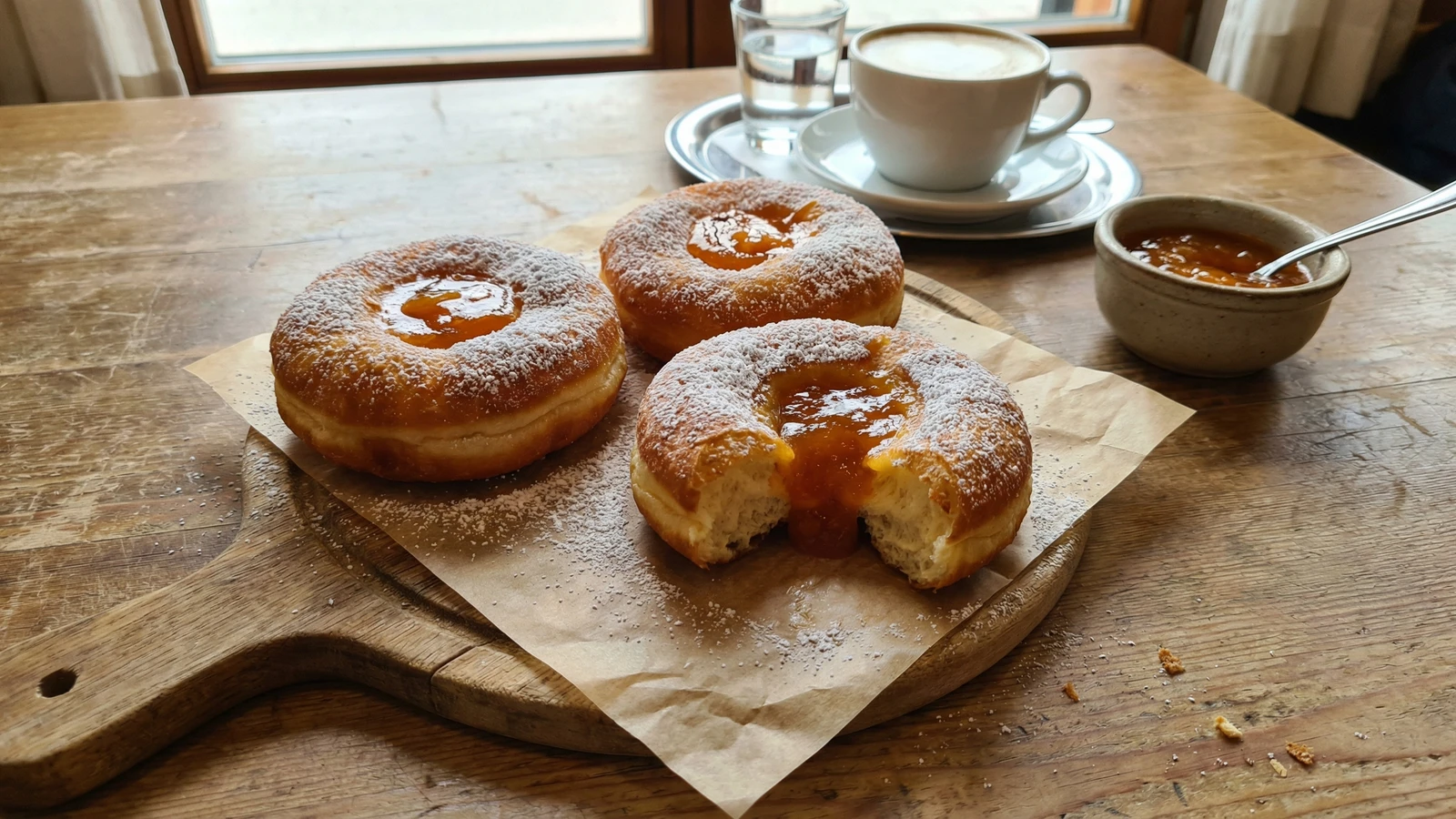
Bauernkrapfen
Created by Chef Elsa
Austria's flat country doughnut with a blistered, paper-thin center and a fat golden rim, pooled with warm apricot jam and buried under powdered sugar. The thing people queue for at every Bauernmarkt from Salzburg to Vienna.
Every autumn at the Salzburger Rupertikirtag, there's a stall that sells nothing but Bauernkrapfen. The queue starts at eight in the morning and doesn't stop. You can smell them from three streets away: hot fat, sweet yeast dough, and that particular caramel note of sugar hitting warm butter. I've gone every year since I moved to Salzburg, and I still stand in line like everyone else.
Bauernkrapfen are not Berliner. They're not filled doughnuts. They're something entirely their own. Flat, round, with a thin, blistered center stretched almost to transparency and a thick, puffy rim that stays soft and pillowy inside. You fill the crisp center with warm Marillenmarmelade and dust the whole thing with powdered sugar. The first bite gives you crunch, then jam, then that soft yeasty ring. Three textures, three temperatures, one piece of fried dough.
Gretel always said Austrian country cooking was peasant food that people were smart enough not to improve. Bauernkrapfen are the proof. The dough is flour, butter, eggs, milk, yeast, and a little rum. The technique is stretching the center thin enough that it blisters in the hot fat while the rim stays plump. That's the whole secret. Nothing fancy. Nothing hidden. Just good dough, treated right, fried with confidence, and eaten while it's warm.
I taught myself to shape them by watching a woman at a Bauernmarkt in the Salzkammergut when I was twelve. She'd take a ball of dough, press it flat with her thumbs, and stretch the center in one smooth motion, then slide it into the fat before you could blink. It took me years to get that fast. You don't need to be fast. You just need to trust the dough.
Bauernkrapfen, literally 'farmer's doughnuts,' come from the rural Alpine tradition of Schmalzgebäck, fried pastries cooked in rendered lard, which goes back centuries in Austrian farmhouse kitchens. The distinctive flat shape with its thin center and raised rim distinguishes them from the filled Faschingskrapfen (carnival doughnuts) of the cities. Regional names vary: in Tyrol they're often called Kirchtagskrapfen because they were made for Kirchtag, the parish fair. In Salzburg and Upper Austria, they're inseparable from the Bauernmarkt and the autumn harvest celebrations. The technique of stretching the center thin likely developed because it allowed the dough to cook through quickly in the fat, saving precious lard in a farmhouse kitchen where nothing was wasted.
The technique, the tradition, and the story behind every dish.
Discover Culinary AdvisorIngredients
plain flour
Quantity
500g
granulated sugar
Quantity
75g
vanilla sugar (Vanillezucker)
Quantity
1 packet (8g)
dried yeast
Quantity
7g
whole milk
Quantity
250ml
lukewarm
unsalted butter
Quantity
80g
melted and cooled
egg yolks
Quantity
2 large
fine salt
Quantity
1/2 teaspoon
lemon
Quantity
1
zested
rum
Quantity
2 tablespoons
lard or vegetable oil
Quantity
approximately 1.5 liters
for deep-frying
Marillenmarmelade (apricot jam)
Quantity
250g
warmed and sieved
powdered sugar
Quantity
for dusting
| Ingredient | Quantity |
|---|---|
| plain flour | 500g |
| granulated sugar | 75g |
| vanilla sugar (Vanillezucker) | 1 packet (8g) |
| dried yeast | 7g |
| whole milklukewarm | 250ml |
| unsalted buttermelted and cooled | 80g |
| egg yolks | 2 large |
| fine salt | 1/2 teaspoon |
| lemonzested | 1 |
| rum | 2 tablespoons |
| lard or vegetable oilfor deep-frying | approximately 1.5 liters |
| Marillenmarmelade (apricot jam)warmed and sieved | 250g |
| powdered sugar | for dusting |
Equipment Needed
- •Large heavy-bottomed pot or deep fryer
- •Kitchen thermometer
- •Slotted spoon or spider strainer
- •Wire cooling rack
- •Kitchen scale
Instructions
- 1
Activate the yeast
Warm the milk until it feels like bathwater against your wrist, no hotter. Stir the yeast and a pinch of sugar into the milk and let it sit for ten minutes. It should foam and bubble at the surface. If nothing happens, your yeast is dead and you need to start again with a fresh packet. Don't build a whole dough on yeast that hasn't proven itself.
If you can get fresh yeast (Germ, as the Austrians call it), use 20g crumbled into the warm milk. Fresh yeast gives a rounder, more complex flavor. Every bakery in Austria still uses it. - 2
Make the dough
Put the flour, sugar, Vanillezucker, salt, and lemon zest in a large bowl. Make a well in the center. Pour in the yeast mixture, the melted butter, egg yolks, and rum. Stir with a wooden spoon until a shaggy mass comes together, then turn it out onto a lightly floured surface and knead. This is a soft, sticky dough. It will cling to your hands and you'll want to add more flour. Resist. Knead for a good ten minutes until it becomes smooth, supple, and pulls cleanly away from the surface. The butter and egg yolks need time to work into the flour. If you add too much flour to make your life easier, you'll end up with tough, heavy Krapfen.
- 3
First rise
Shape the dough into a ball and place it back in the bowl. Cover with a clean tea towel and set it somewhere warm, not hot, for about an hour. The dough should double in size. I put mine near the oven or on top of the fridge where the motor gives off gentle warmth. Yeast is alive. It likes a cozy spot, not a sauna.
If your kitchen is cold, heat your oven to 50 degrees, turn it off, and place the covered bowl inside with the door slightly ajar. Austrian farmhouse kitchens had the Kachelofen for this. We improvise. - 4
Shape the Krapfen
Turn the risen dough onto a lightly floured surface and press it down gently. Divide it into twelve equal pieces, about 70g each. A kitchen scale helps here because even pieces fry evenly. Roll each piece into a smooth ball, tucking the seams underneath. Place them on a floured tea towel, cover, and let them rest for fifteen minutes. This short rest relaxes the gluten so you can shape them without the dough fighting back.
- 5
Stretch the centers
This is where Bauernkrapfen become Bauernkrapfen. Take a ball of dough and press the center flat with your thumbs while keeping the outer rim thick and puffy. Stretch the center gently until it's almost translucent, paper-thin, while the rim stays about two centimeters wide and plump. Imagine a little nest. The thin center will puff and blister in the hot fat, turning crisp and golden, while the rim stays soft and pillowy. Work on a lightly floured surface and be patient. If the dough springs back, let it rest another minute and try again. Place each shaped Krapfen on the floured towel.
The thin center is not a mistake or a shortcut. It's the whole architecture of the thing. When it hits the fat, it puffs into a crisp, blistered disc surrounded by a soft golden ring. That contrast is what makes Bauernkrapfen different from every other doughnut on earth. - 6
Heat the frying fat
Pour enough lard or oil into a deep, heavy pot to reach a depth of at least eight centimeters. Heat it to 170 degrees Celsius. Use a thermometer. Guessing the temperature is how people burn Krapfen or, worse, end up with pale, greasy ones that never crisped properly. If you don't have a thermometer, drop a small piece of dough into the fat. It should sink, then rise to the surface within a few seconds, surrounded by steady bubbles. If it browns instantly, the fat is too hot. If it just sits at the bottom, too cold.
Lard is traditional and gives the best flavor and crispness. If you can get good-quality lard from a butcher, use it. Vegetable oil works well too. Avoid olive oil; the flavor is wrong for sweet dough. - 7
Fry the Krapfen
Slide the shaped Krapfen into the hot fat, thin center facing down first. Don't crowd the pot; fry two or three at a time. The thin center will puff up and blister immediately. Fry for about two minutes on the first side until deep golden, then flip carefully with a slotted spoon and fry another minute or so on the second side. The rim should be golden brown all around and the center crisp. Lift them out with a slotted spoon and drain on a rack set over a tray, not on paper towels. Paper towels trap moisture against the bottom and you lose your crisp.
Check your oil temperature between batches. Cold dough drops the temperature, and if you don't let it recover, each batch comes out greasier than the last. - 8
Fill and dust
While the Krapfen are still warm, spoon a generous tablespoon of warmed, sieved Marillenmarmelade into the center hollow of each one. The jam should pool in the thin crisp center like a little golden lake. Don't be timid. The apricot jam is not decoration; it's the soul of the thing. That sharp, fruity sweetness against the rich, buttery dough is what makes people line up at Bauernmarkt stalls at seven in the morning. Dust everything generously with powdered sugar. Mahlzeit!
Chef Tips
- •The dough should be softer than you're comfortable with. If it's easy to handle, you've added too much flour and your Krapfen will be dense instead of light. Lightly oil your hands if the sticking drives you mad, but don't add more flour to the dough itself.
- •Sieve your Marillenmarmelade while it's warm. You want it smooth and pourable, not chunky. Good Austrian apricot jam, Staud's or d'Arbo from Tyrol, has a sharpness that cuts through the richness of the fried dough. Don't substitute with generic apricot preserves if you can help it.
- •Eat them within an hour of frying. Bauernkrapfen are not pastries that improve with age. They're at their absolute best still warm from the fat, dusted with sugar, standing at a market stall in the cold morning air. At home, that means frying and serving in the same conversation.
- •If you're making these for a crowd, keep finished Krapfen warm on a rack in a low oven (80 degrees Celsius) while you fry the rest. Don't stack them or the crisp centers will go soft.
Advance Preparation
- •The dough can be made the evening before and left to rise slowly overnight in the fridge. Take it out an hour before shaping to let it come to room temperature. Cold dough won't stretch properly.
- •Marillenmarmelade can be sieved and stored in a jar days ahead. Warm it gently before filling.
- •Bauernkrapfen themselves cannot be made ahead. They must be fried and eaten the same day. Reheating a Krapfen is an insult to the original effort.
Frequently Asked Questions
Nutrition Information
1 serving (about 110g)
Where cooking meets culture.
Culinary mentorship, cultural storytelling, and the editorial depth that makes cooking meaningful.
Explore Culinary Advisor