Culinary Advisor
A cooking platform built around craft, culture, and the stories behind what we eat.
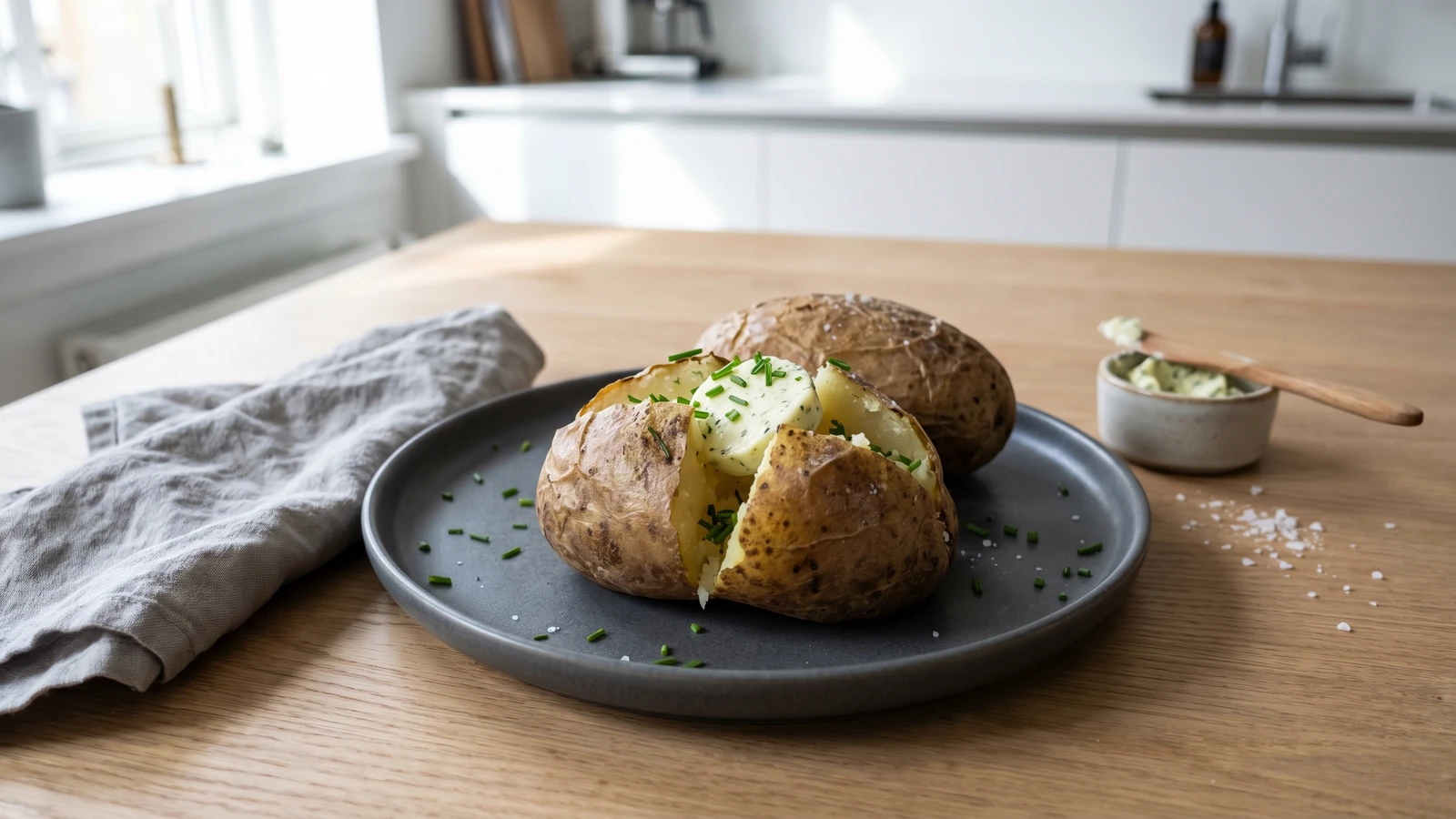
Bagte Kartofler med Kryddersmor
Created by Chef Freja
Large baking potatoes rubbed with oil and coarse salt, baked until the skin crackles, split wide and filled with garlic parsley kryddersmor. The side dish that owns every Danish grill night.
The long light comes back in June, and with it the smell of charcoal from every garden and balcony in Denmark. This is grill season. These potatoes belong to it the way cold beer belongs to a warm evening.
Bagte kartofler med kryddersmor is the side dish that sits next to everything at a Danish summer table. At the bofhus, the steakhouse restaurants that have been part of Copenhagen's dining landscape for decades, you'll find them alongside a peppered entrecote. At home, they sit on a board next to whatever comes off the grill: flankesteg, polser, marinated chicken. The potatoes are baked until the skin is dry and crackling and the inside is so soft it falls apart when you press it. Then you split them open and drop in a generous knob of kryddersmor, herb butter made with garlic and parsley, and watch it melt into the flesh.
Two things matter here. First, the skin. You need it crisp and salty, because the butter inside is rich and the contrast is everything. Rub the potatoes with oil and coarse salt before they go in the oven, and bake them directly on the rack so the heat reaches every side. Second, the butter. Make it while the potatoes bake. Real butter, good garlic, flat-leaf parsley, a squeeze of lemon to lift it. You'll know when it's right because it smells like summer and you want to eat it with a spoon.
The Danish bofhus tradition emerged in the 1960s and 1970s as American-style steakhouse culture crossed the Atlantic and was absorbed into Danish dining. Baked potatoes with herb butter became the defining accompaniment, gradually displacing the boiled potatoes that had dominated Danish plates for two centuries. The word kryddersmor, literally spiced butter, entered everyday Danish kitchen vocabulary during this period, and the technique of compound butter, borrowed from French cuisine through the bofhus kitchens, became something Danish home cooks claimed as their own.
The technique, the tradition, and the story behind every dish.
Discover Culinary AdvisorIngredients
large baking potatoes
Quantity
4, each about 300g
neutral oil or olive oil
Quantity
2 tablespoons
coarse sea salt
Quantity
for the skin
unsalted butter
Quantity
150g
softened to room temperature
garlic
Quantity
3 cloves
finely minced
flat-leaf parsley
Quantity
small bunch
finely chopped
fresh chives
Quantity
1 tablespoon
snipped
lemon
Quantity
half
juiced
fine sea salt
Quantity
to taste
black pepper
Quantity
freshly ground, to taste
flaky sea salt (optional)
Quantity
to finish
| Ingredient | Quantity |
|---|---|
| large baking potatoes | 4, each about 300g |
| neutral oil or olive oil | 2 tablespoons |
| coarse sea salt | for the skin |
| unsalted buttersoftened to room temperature | 150g |
| garlicfinely minced | 3 cloves |
| flat-leaf parsleyfinely chopped | small bunch |
| fresh chivessnipped | 1 tablespoon |
| lemonjuiced | half |
| fine sea salt | to taste |
| black pepper | freshly ground, to taste |
| flaky sea salt (optional) | to finish |
Equipment Needed
- •Oven rack (no baking tray for the potatoes)
- •Baking tray for drip-catching on the shelf below
- •Small mixing bowl for the butter
- •Clean cloth for handling hot potatoes
Instructions
- 1
Prepare the potatoes
Heat the oven to 200C. Scrub the potatoes under cold water and dry them thoroughly with a clean cloth. Damp skin will not crisp. It traps moisture against the surface, and moisture is the enemy of everything you want from this potato. Prick each one four or five times with a fork. This lets the steam escape from the inside so they don't burst in the oven. Rub the skins all over with oil, then roll them in a generous coating of coarse sea salt. The salt draws the last moisture from the skin during baking, leaving it dry and crackling.
Choose floury potatoes, not waxy. You want a potato that bakes to a fluffy, almost crumbly interior. Waxy potatoes hold their shape, which is wrong here. You want the flesh to collapse and absorb the butter. - 2
Bake until crackling
Place the potatoes directly on the oven rack with a tray on the shelf below to catch any drips. Do not wrap them in foil. Foil traps steam and you end up with boiled potatoes in a jacket, which is a different dish and not this one. Bake for fifty minutes to an hour, depending on size. The skin should feel papery and taut when you press it, and the potato should give slightly in the center. If it feels hard, give it another ten minutes. A skewer pushed through the middle should meet no resistance at all.
Baking directly on the rack matters. Air circulates around the entire potato, so the skin crisps evenly on all sides. On a tray, the bottom sits in contact with metal and stays soft. - 3
Make the kryddersmor
While the potatoes bake, beat the softened butter in a bowl until it's light and smooth. Add the minced garlic, chopped parsley, snipped chives, lemon juice, a good pinch of fine salt, and several grinds of black pepper. Mix everything together until the herbs are evenly distributed through the butter. Taste it. The butter should be savoury and bright, with the lemon lifting everything without announcing itself. If it tastes flat, it needs more salt. If it tastes heavy, a little more lemon. Trust your tongue.
The butter must be properly soft before you start, not melted, not cold. Cold butter won't incorporate the herbs evenly, and melted butter separates. Press it with your finger. If it dents easily and holds the shape, it's right. - 4
Split and fill
When the potatoes are done, take them from the oven and let them sit for two minutes. Hold each one in a cloth and cut a deep cross into the top, going about two-thirds of the way through. Now squeeze the sides gently. The potato will open like a flower, the white flesh pushing up through the cut, fluffy and steaming. Drop a generous spoonful of the kryddersmor into the opening. Let it begin to melt. Add another spoonful if you like. This is not the moment for restraint.
The squeeze is the whole trick. It breaks the interior apart and creates pockets and crevices for the butter to run into. A potato that's just sliced open and laid flat doesn't do the same thing. - 5
Finish and serve
Scatter a pinch of flaky sea salt over each potato and a few extra snippings of chives if you have them. Serve immediately while the butter is still pooling and the skin is still crackling. These potatoes wait for no one. They belong next to a steak, beside a pile of salad on a summer evening, or honestly just on their own with a cold beer and the last of the daylight. Tak for mad.
Chef Tips
- •Make more kryddersmor than you need. Roll the extra into a log in cling film and freeze it. You'll reach for it all summer: a slice on a grilled steak, melting over steamed new potatoes, stirred into rice. It keeps for two months in the freezer and defrosts in minutes.
- •If you're making these for a grill night, bake the potatoes in the oven first, then move them to the cooler edge of the grill for the last ten minutes. They pick up a faint smokiness that belongs to the evening.
- •The best baking potatoes in Denmark appear in late summer and autumn from the new harvest. Earlier in the season, stored potatoes work fine, but the fresh ones have a sweetness and a fluffier texture that you'll notice.
- •Don't rush the baking time. An underdone baked potato is dense and waxy in the center, and no amount of butter fixes that. When in doubt, give it another ten minutes. There's no penalty for a longer bake, only a crispier skin.
Advance Preparation
- •The kryddersmor can be made up to three days ahead. Keep it wrapped tightly in the fridge and bring it to room temperature before serving so it melts properly on contact with the hot potato.
- •Potatoes are best baked fresh. If you must prepare ahead, bake them an hour early and reheat in a hot oven for ten minutes to revive the skin. The interior stays fluffy, though the skin won't be quite as crackling as the first time.
Frequently Asked Questions
Nutrition Information
1 serving (about 285g)
Where cooking meets culture.
Culinary mentorship, cultural storytelling, and the editorial depth that makes cooking meaningful.
Explore Culinary Advisor