Culinary Advisor
A cooking platform built around craft, culture, and the stories behind what we eat.
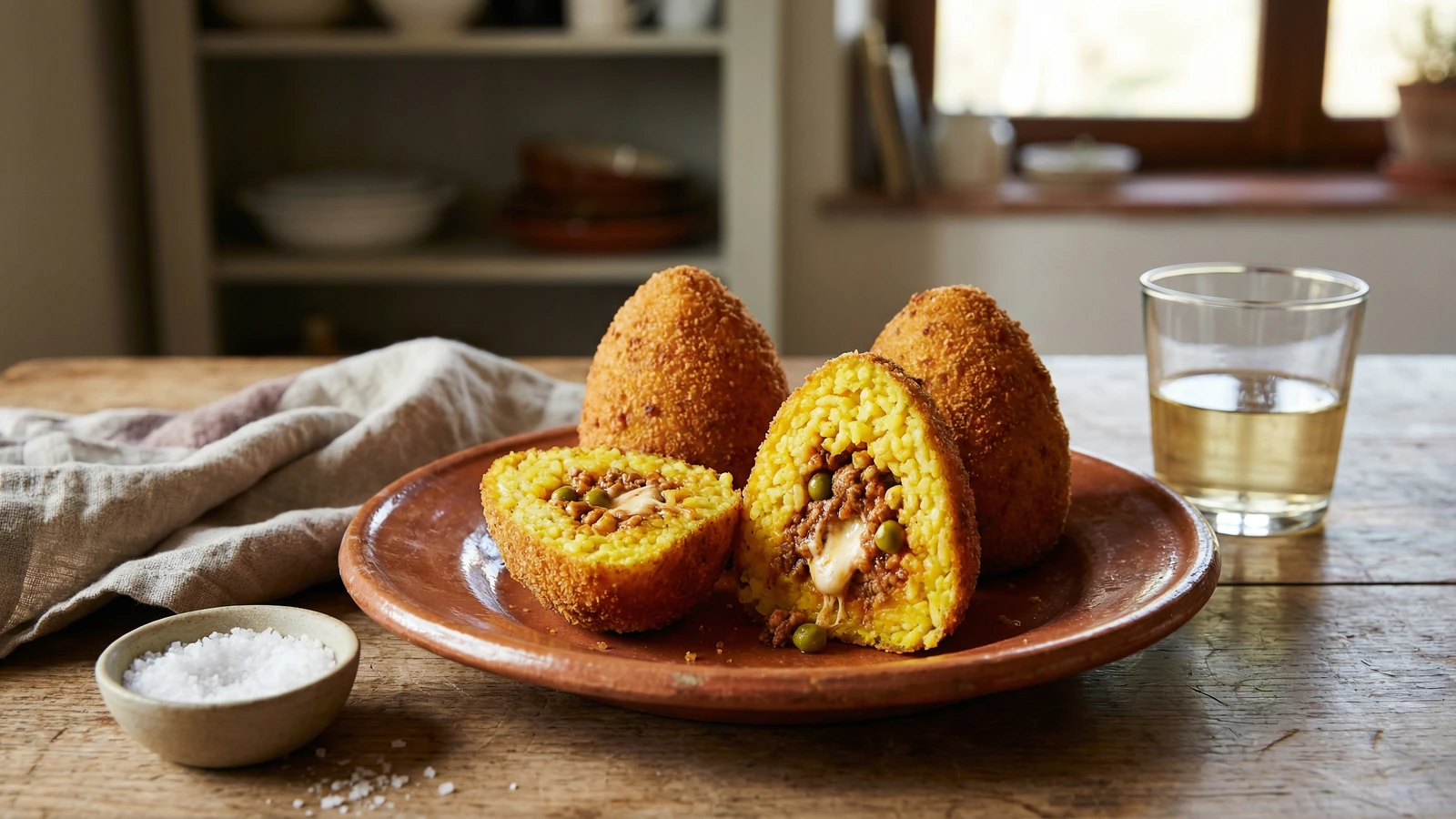
Arancini di Riso alla Siciliana
Created by Chef Graziella
Golden fried rice balls from Sicily, where Arab cooks first wrapped saffron-scented rice around meat and cheese. The exterior shatters; the interior yields. This is street food elevated to art.
Americans think of risotto when they think of Italian rice. This is understandable but incomplete. The South has rice traditions that predate Northern risotto by centuries, and arancini are their crown jewel.
These fried rice balls emerged in Sicily during Arab rule, when cooks discovered that saffron rice could be shaped, stuffed, and fried into portable meals. The name means 'little oranges,' for their shape and golden color. Inside hides a core of ragù and stretchy mozzarella. Outside, a shell of breadcrumbs fries to shattering crispness.
Sicilians argue about arancini the way Bolognese argue about ragù. In Palermo, they are round and called arancini. In Catania, they are pointed like small volcanoes and called arancine. The feminine plural. Catanians will correct you. Both cities insist theirs is authentic. Both are correct, because authentic Italian food is regional, and regions disagree.
This is not a simple recipe. The rice must be made and cooled. The ragù must be prepared and reduced until it holds its shape. The mozzarella must be drained. The forming requires practice. The frying requires attention. Simple does not mean easy. But when you bite through that crackling shell into the warm, saffron-scented rice and hit the molten cheese at the center, you will understand why Sicilians have been making these for a thousand years.
Arab rulers brought saffron, rice cultivation, and the technique of shaping rice into portable forms to Sicily in the 10th century. The earliest arancini were likely plain rice balls carried by travelers and workers, with the ragù filling developing later under Spanish influence. The pointed shape of Catania's version may reference Mount Etna, the volcano that dominates their horizon.
The technique, the tradition, and the story behind every dish.
Discover Culinary AdvisorIngredients
Arborio or Carnaroli rice
Quantity
2 cups
chicken or beef broth
Quantity
4 cups
saffron threads
Quantity
1/2 teaspoon
unsalted butter
Quantity
4 tablespoons
Parmigiano-Reggiano
Quantity
1/2 cup
freshly grated
large egg yolks
Quantity
3
kosher salt
Quantity
to taste
extra virgin olive oil
Quantity
1 tablespoon
yellow onion
Quantity
1/2 medium
diced fine
carrot
Quantity
1 small
diced fine
celery stalk
Quantity
1
diced fine
ground beef
Quantity
8 ounces
ground pork
Quantity
4 ounces
dry white wine
Quantity
1/2 cup
tomato passata
Quantity
1 cup
frozen peas
Quantity
1/2 cup
thawed
black pepper
Quantity
to taste
freshly ground
low-moisture mozzarella
Quantity
8 ounces
cut into 1/2-inch cubes
all-purpose flour
Quantity
1 cup
large eggs
Quantity
4
beaten
fine dry breadcrumbs
Quantity
2 cups
vegetable oil
Quantity
about 2 quarts
for frying
| Ingredient | Quantity |
|---|---|
| Arborio or Carnaroli rice | 2 cups |
| chicken or beef broth | 4 cups |
| saffron threads | 1/2 teaspoon |
| unsalted butter | 4 tablespoons |
| Parmigiano-Reggianofreshly grated | 1/2 cup |
| large egg yolks | 3 |
| kosher salt | to taste |
| extra virgin olive oil | 1 tablespoon |
| yellow oniondiced fine | 1/2 medium |
| carrotdiced fine | 1 small |
| celery stalkdiced fine | 1 |
| ground beef | 8 ounces |
| ground pork | 4 ounces |
| dry white wine | 1/2 cup |
| tomato passata | 1 cup |
| frozen peasthawed | 1/2 cup |
| black pepperfreshly ground | to taste |
| low-moisture mozzarellacut into 1/2-inch cubes | 8 ounces |
| all-purpose flour | 1 cup |
| large eggsbeaten | 4 |
| fine dry breadcrumbs | 2 cups |
| vegetable oilfor frying | about 2 quarts |
Equipment Needed
- •Heavy 3-quart saucepan with tight-fitting lid for rice
- •Large skillet for ragù
- •Deep heavy pot or Dutch oven for frying (at least 6 quarts)
- •Deep-fry or instant-read thermometer
- •Spider or slotted spoon
- •Wire cooling rack set over baking sheet
Instructions
- 1
Prepare the saffron
Warm one cup of the broth and crumble the saffron threads into it. Let it steep for at least 15 minutes. The broth should turn deep gold. Sicilian arancini get their characteristic color from saffron, not food coloring. Do not skip this.
- 2
Cook the rice
In a heavy saucepan, bring the remaining three cups of broth plus the saffron-infused broth to a simmer. Add the rice and stir once. Cover tightly, reduce heat to very low, and cook for 18 minutes. Do not lift the lid. Do not stir. The rice should absorb all the liquid and be tender but not mushy.
This is not risotto technique. You are not stirring constantly. You are cooking rice pilaf-style, which gives you grains that hold together when shaped but remain distinct. - 3
Finish the rice
Remove the rice from heat and immediately stir in the butter until melted. Add the Parmigiano-Reggiano and egg yolks, stirring vigorously. The residual heat will cook the yolks gently into a binding mixture. Season with salt. Spread the rice on a baking sheet in an even layer and refrigerate until completely cold, at least one hour. The rice must be cold or the arancini will fall apart when you form them.
- 4
Build the ragù
While the rice cools, make the filling. Heat the olive oil in a skillet over medium heat. Add the onion, carrot, and celery. Cook until soft and the onion is translucent, about 10 minutes. Add the ground beef and pork, breaking it into small pieces with a wooden spoon. Cook until browned and no pink remains, about 12 minutes.
- 5
Simmer the ragù
Pour in the wine and let it bubble until evaporated completely. Add the tomato passata and season with salt and pepper. Reduce heat and simmer uncovered, stirring occasionally, until the sauce is very thick and concentrated, about 25 minutes. It should hold its shape on a spoon. Stir in the peas during the last 5 minutes. Spread on a plate and refrigerate until completely cold.
The filling must be cold and thick. Warm or loose filling will make your arancini impossible to form. It will ooze out the sides and make you miserable. - 6
Form the arancini
Wet your hands with cold water. Take about one-third cup of cold rice and flatten it in your palm into a disk about four inches across. Place a heaping tablespoon of the cold ragù in the center and push two cubes of mozzarella into the meat. Cup your hand and bring the edges of the rice up and over the filling, pressing and shaping into a ball. The filling should be completely enclosed with no cracks. If the rice cracks, wet your hands again and smooth the surface. Repeat with remaining rice and filling.
If you want to make pointed arancini in the Catania style, form them into cones instead of balls. The pointed end should stand upright. This takes practice. - 7
Bread the arancini
Set up three shallow bowls: flour in the first, beaten eggs in the second, breadcrumbs in the third. Roll each arancino in flour, shaking off excess. Dip in egg, letting excess drip off. Roll in breadcrumbs, pressing gently to adhere. For extra crunch, dip again in egg and roll again in breadcrumbs. Place on a baking sheet. Refrigerate for 30 minutes to set the coating.
- 8
Fry the arancini
Pour oil into a heavy pot to a depth of at least 4 inches. Heat to 350°F. Use a thermometer. Fry the arancini in batches of two or three, turning occasionally, until deep golden brown on all sides, about 5 to 6 minutes per batch. The oil temperature will drop when you add the arancini; adjust heat to maintain 340-350°F. Remove with a slotted spoon to a wire rack set over a baking sheet.
If your oil is too hot, the outside will burn before the center warms through. If too cool, the arancini will absorb oil and become greasy. Temperature control is not optional. - 9
Rest and serve
Let the arancini rest for 3 to 4 minutes before serving. This allows the interior to finish warming from residual heat and prevents burned mouths. The mozzarella should stretch when you pull the arancino apart. Serve warm, not hot. They do not need sauce. The sauce is inside.
Chef Tips
- •Low-moisture mozzarella is correct here, not fresh mozzarella di bufala. Fresh mozzarella releases too much water when heated and makes the filling soggy. The Sicilians know what they are doing.
- •Arancini can be formed and breaded, then frozen on a baking sheet and transferred to freezer bags. Fry directly from frozen, adding two minutes to the frying time. Thawing first makes them fall apart.
- •In Sicily, arancini are street food, sold from glass cases at bars and cafes, eaten standing up for breakfast or as a midday snack. They are not served with marinara sauce on the side. This is an American invention.
- •Some Sicilian versions include a béchamel-based filling instead of ragù. Others use ham and cheese, or spinach. The ragù version is most traditional to Palermo. Ask a Sicilian which is correct and prepare for a lengthy argument.
Advance Preparation
- •The rice and ragù can be made one day ahead and refrigerated separately. Cold components are actually preferable for forming.
- •Formed and breaded arancini can be refrigerated for up to 8 hours before frying. Bring to room temperature for 20 minutes before frying.
- •Fried arancini can be kept warm in a 200°F oven for up to 30 minutes, but they are best eaten promptly. Reheating in the oven at 375°F for 10 minutes works if necessary.
Frequently Asked Questions
Nutrition Information
1 serving (about 165g)
Where cooking meets culture.
Culinary mentorship, cultural storytelling, and the editorial depth that makes cooking meaningful.
Explore Culinary Advisor